
In This Article
If you’ve ever stood in a cold Calgary garage at –25°C, staring at two space heaters on a shelf and wondering which one will actually make a dent in that bone-deep chill — you’re not alone. The debate over infrared vs oil filled heater technology is one of the most searched heating questions in Canada every autumn, and honestly, the answer isn’t as straightforward as most websites would have you believe.
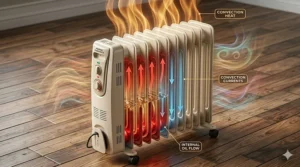
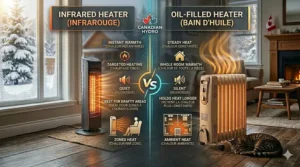
Here’s a quick definition to get us started: an infrared heater converts electricity into radiant electromagnetic waves that warm people and objects directly — much like sunshine on a crisp winter day — while an oil filled heater uses a sealed reservoir of diathermic oil heated by an electric element, which then gradually warms the surrounding air through convection. Both draw roughly the same peak wattage (typically 1,500W), but they deliver that energy in fundamentally different ways, making each one suited to a different type of Canadian home and lifestyle.
Why does this matter especially in Canada? Because our winters aren’t just cold — they’re long. From the damp coastal chill of Vancouver to the prairie freeze of Saskatoon, Canadians run supplemental heaters for five to seven months of the year. Choosing the wrong type doesn’t just mean being a little uncomfortable; it means wasting hundreds of dollars on your hydro bill. According to Natural Resources Canada, space heating accounts for roughly 60% of the energy used in a typical Canadian household — making every heating decision a financial one as much as a comfort one.
In this guide, I’ve researched seven real products available on Amazon.ca, compared their technology in depth, and built a practical framework to help you decide which heater belongs in your home — whether you’re in a Toronto condo, a rural Nova Scotia farmhouse, or a Winnipeg bungalow with drafty 1970s insulation.
Quick Comparison: Infrared vs Oil Filled Heater at a Glance
| Feature | Infrared Heater | Oil Filled Heater |
|---|---|---|
| Heat-up time | Instant (seconds) | 15–30 minutes |
| Heating method | Radiant (direct to objects/people) | Convection (warms the air) |
| Best room size | Small to medium (up to ~25 m²) | Medium to large (up to ~35 m²) |
| Noise level | Low to moderate (fan-assisted) | Near-silent (fanless) |
| Portability | Lightweight (4–7 kg) | Heavier (9–12 kg) |
| Safety near children/pets | Moderate — surface gets warm | High — cool-touch exterior on most models |
| Energy efficiency style | Zone/spot heating | Sustained ambient heating |
| Price range (Amazon.ca) | $80–$250 CAD | $60–$200 CAD |
| Best for | Drafty rooms, garages, offices | Bedrooms, nurseries, overnight use |
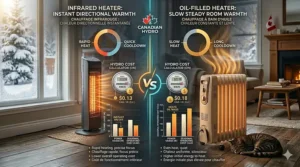
What the table above is really telling you: if you need warmth now and you’re sitting still — at a desk, watching TV, or working in the garage — an infrared heater is your answer. But if you want to maintain a steady, comfortable temperature in a bedroom all night without waking up to check on anything, an oil filled heater’s “set it and forget it” nature is hard to beat. Budget-conscious Canadians should also note that because oil filled units cycle on and off to maintain temperature, their long-run energy costs are often lower than infrared models left running continuously.
💬 Just one click — help others make better buying decisions too! 😊
✨ Don’t Miss These Exclusive Deals!
🔍 Take your home heating to the next level with these carefully selected products. Click on any highlighted item to check current pricing and availability on Amazon.ca. These heaters will keep your family warm through even the fiercest Canadian winter!
Top 7 Infrared vs Oil Filled Heaters: Expert Analysis for Canadian Buyers
1. Dr. Infrared Heater DR-968 — Best Overall Infrared Heater
The DR-968 is the heater I’d recommend without hesitation to anyone asking for an “all-rounder” infrared unit available in Canada. Its dual heating system — combining an infrared quartz tube with a PTC (positive temperature coefficient) ceramic element — produces approximately 5,200 BTU (1,524W), which the brand claims delivers 60% more effective warmth than single-element competitors. At 39 dB, the built-in high-pressure blower is quieter than most refrigerators, which matters enormously if you’re using it in a home office or bedroom.
What most Canadian buyers overlook about this model is the UL listing for both the US and Canada — that’s the Underwriters Laboratories certification that aligns with Canadian Electrical Code requirements. In provinces like Ontario and BC where electrical safety standards are strictly enforced, this matters. The 12-hour auto shut-off and tip-over protection give extra peace of mind during those February nights when you fall asleep on the couch.
Canadian reviewers consistently praise the DR-968’s ability to warm a 20–25 m² (215–270 sq. ft.) room quickly, though some note it can feel too intense in very small spaces. The caster wheels and 1.8 m (6 ft.) cord make it genuinely portable between rooms.
✅ Dual infrared + PTC heating for faster warm-up
✅ UL certified for Canada — meets electrical safety standards
✅ Whisper-quiet 39 dB blower with remote control
❌ Bulkier than panel-style infrared heaters (weighs about 8.6 kg / 19 lbs)
❌ Not ideal for open-concept spaces — works best in enclosed rooms
Price range: $150–$220 CAD |
Verdict: Best value-per-watt infrared pick on Amazon.ca

2. De’Longhi Radia S TRRS0715ECA — Best Oil Filled Heater Overall
De’Longhi’s Radia S is the oil filled heater I keep coming back to as the benchmark for Canadian bedrooms and living rooms. The Canadian-specific model (note the “ECA” suffix) is engineered for 120V North American outlets and includes a digital thermostat, 3 heat settings (600W / 900W / 1,500W), a 24-hour programmable timer, and De’Longhi’s ECO energy-saving mode that automatically cycles between power levels to maintain your chosen temperature without running at full blast continuously.
Here’s what the spec sheet won’t tell you: De’Longhi’s patented fin design on the Radia S creates a larger surface area than competitors’ 7-fin models, meaning heat distributes more evenly across a room. In practice, this translates to fewer hot spots near the unit and a more consistent 21°C (70°F) throughout a 25 m² (270 sq. ft.) bedroom — something I consider crucial for the six-month Canadian heating season. The fanless operation is completely silent, making it the go-to choice for light sleepers and nurseries.
Canadian buyers on Amazon.ca appreciate the bilingual French/English controls (required by Canadian consumer labelling law), and the slim profile means it fits neatly beside furniture without dominating a room.
✅ Fanless silent operation — perfect for bedrooms and nurseries
✅ Canadian-model ECA suffix ensures 120V compatibility and bilingual labelling
✅ ECO mode reduces energy consumption for long overnight runs
❌ 15–20 minute warm-up time — not suitable when you need immediate heat
❌ Heavier than infrared at approximately 10 kg (22 lbs)
Price range: $120–$190 CAD |
Verdict: The standard-setter for oil filled comfort in Canadian homes
3. PELONIS PHO15A2AGW Basic Electric Oil Filled Radiator — Best Budget Oil Filled
Don’t let the word “basic” fool you — the PELONIS PHO15A2AGW is a genuinely capable oil filled heater at a price point that makes it accessible to students, renters, and anyone furnishing a second bedroom or basement suite on a tight budget. It runs at 1,500W with three settings (600W / 900W / 1,500W), features a mechanical adjustable thermostat, tip-over protection, and a fanless design for silent operation.
What makes this worth considering over a random no-name alternative: PELONIS is a legitimate brand with genuine Amazon.ca availability, and this specific model has accumulated thousands of Canadian reviews. The luggage-style handle and easy-glide casters make it surprisingly mobile despite weighing around 9 kg (20 lbs). For a basement workshop in Hamilton or a bedroom addition in Fredericton that doesn’t have a dedicated heating vent, this fills the gap without a complicated installation.
The trade-off is the lack of digital controls or a timer — if you want programmability, step up to the PELONIS Digital model or the De’Longhi above. But for pure “plug in and stay warm” simplicity, this is exceptional value.
✅ Outstanding price-to-performance ratio in CAD
✅ Fanless and silent — suitable for sleeping areas
✅ Available on Amazon.ca with Prime shipping in most provinces
❌ No digital timer or programmable controls
❌ Manual thermostat is less precise than digital alternatives
Price range: $60–$100 CAD |
Verdict: Best entry-level oil filled pick for budget-conscious Canadians
4. DREO Oil Filled Radiator Heater — Best Oil Filled with Smart Features
The DREO Oil Filled Radiator stands out in a crowded category because it bridges the gap between basic oil filled comfort and modern smart-home convenience. With a remote control, child lock, 4 operating modes, a 24-hour digital timer, and digital thermostat, it offers De’Longhi-level functionality at a noticeably lower price point on Amazon.ca. The 1,500W output and quiet fanless design make it a strong contender for Canadian families with young children.
What I find compelling about the DREO specifically is the child lock feature — if you have curious toddlers or pets in a Mississauga townhouse or an Edmonton semi-detached, being able to lock the controls means no accidental temperature changes at 2 a.m. The overheat and tip-over protection are standard on this class of heater, but DREO’s implementation includes an automatic restart function after a tip-over is corrected, which not all competitors offer.
Canadian reviewers have noted that the DREO unit maintains accurate temperature within 1–2°C (2–4°F) of the set point, which is solid performance for a mid-range oil filled radiator. The remote range covers an average-sized room without issues.
✅ Remote control + child lock — ideal for family households
✅ 24-hour programmable timer for overnight and away-from-home use
✅ Competitive mid-range pricing on Amazon.ca
❌ Slightly louder clicking sounds as oil expands (normal but noticeable in quiet bedrooms)
❌ Remote batteries not always included — check packaging
Price range: $80–$140 CAD |
Verdict: Smartest oil filled pick for Canadian families
5. Heat Storm HS-1500-PHX Infrared Heater — Best Wall-Mounted Infrared
The Heat Storm HS-1500-PHX solves a problem that floor-standing heaters can’t: it keeps heating off the floor entirely, which is a meaningful advantage in Canadian homes where floor-level cold air is constant during winter. This model can be mounted directly on a wall using the included bracket, or used as a free-standing unit with the attachable feet — a flexibility that most single-function heaters don’t offer. It delivers 750W or 1,500W of infrared heat with a built-in thermostat and remote control.
For condo dwellers in Vancouver or Toronto where floor space is at an absolute premium, the wall-mount option is genuinely transformative. You recover the full footprint of the unit without sacrificing heat output. The infrared element also means no fan noise — a quiet, radiant warmth that’s surprisingly effective in rooms up to approximately 18 m² (195 sq. ft.).
One caveat for Canadian buyers: verify the model ships to your province on Amazon.ca, as availability can vary. The HS-1500-PHX-WIFI variant adds Wi-Fi connectivity for app control — useful if you want to pre-heat a room before you arrive home on a –15°C January evening.
✅ Wall-mount or floor-stand versatility — saves precious floor space
✅ Silent infrared operation — no fan, no noise
✅ Wi-Fi model available for smart home integration
❌ Smaller heating coverage than floor-standing infrared units
❌ Installation requires a stud or wall anchor — not ideal for renters
Price range: $100–$160 CAD |
Verdict: Best space-saving infrared option for condos and small rooms

6. DREO Space Heater H3 Series (PTC Ceramic/Infrared Hybrid) — Best for Bedrooms
The DREO H3-series heaters occupy an interesting middle ground in the infrared heater vs ceramic heater debate: they use PTC (positive temperature coefficient) ceramic elements that self-regulate temperature — meaning they become less efficient as they heat up, naturally preventing overheating without needing a separate sensor. Pair that with 70° oscillation, a 12-hour timer, remote control, and 5 operating modes, and you have one of the most feature-rich space heaters available on Amazon.ca in the $80–$130 CAD range.
The best heater type for bedroom use is often debated, and honestly the DREO H3 makes a strong case for itself: the oscillation spreads warmth evenly (unlike a fixed infrared panel that creates hot spots), the timer lets you set it to shut off after you fall asleep, and the overheat/tip-over protection adds meaningful safety margin. For a 12–18 m² (130–195 sq. ft.) bedroom in Ottawa or Halifax, this heats to a comfortable temperature within about 10 minutes.
Canadian users specifically praise the 12-hour timer as a feature that aligns with overnight heating needs — set it before bed, and it shuts off automatically without wasting electricity at dawn.
✅ 70° oscillating heat distribution — better room coverage than fixed infrared
✅ Self-regulating PTC element for inherent safety
✅ 12-hour timer ideal for overnight bedroom heating
❌ Fan noise (around 45–50 dB) may bother light sleepers
❌ Less effective in poorly insulated or large rooms
Price range: $80–$130 CAD |
Verdict: The most versatile pick for Canadian bedrooms
7. Amazon Basics Oil Filled Radiator Heater — Best No-Fuss Budget Option
Sometimes you just need a heater that works, costs as little as possible, and doesn’t require reading a 40-page manual. The Amazon Basics Oil Filled Radiator delivers exactly that. It features 7 oil-filled steel fins, three heat settings (600W / 900W / 1,500W), an adjustable thermostat, tip-over and overheat protection, and ETL safety certification — which meets Canadian electrical standards. It’s ships from Amazon.ca with Prime eligibility in most provinces.
What the Amazon Basics heater lacks in personality, it makes up for in reliability. ETL certification (the North American equivalent of CSA approval for this product class) means it has been tested for safety, which matters when you’re heating an unattended room. The 7-fin design offers reasonable heat distribution for rooms up to approximately 18 m² (195 sq. ft.), and the silent fanless operation makes it suitable for sleeping areas.
For renters in Montreal or Kelowna supplementing insufficient baseboard heating, or for cottage owners needing a secondary heat source during shoulder season, this is the lowest-risk entry point into oil filled heating.
✅ ETL safety certified — meets Canadian electrical safety requirements
✅ Prime eligible on Amazon.ca — fast delivery to most provinces
✅ Affordable entry into oil filled technology
❌ No timer, no digital controls, no remote — fully manual operation
❌ No child lock — not recommended as the sole heater in homes with small children
Price range: $60–$90 CAD |
Verdict: Honest, reliable, no-frills oil filled heating for everyday Canadians
Top 7 Heaters: Side-by-Side Specifications
| Product | Type | Wattage | Room Coverage | Key Feature | Price Range (CAD) |
|---|---|---|---|---|---|
| Dr. Infrared DR-968 | Infrared + PTC | 1,500W | ~25 m² | Dual heating, UL Canada | $150–$220 |
| De’Longhi TRRS0715ECA | Oil Filled | 1,500W | ~25 m² | ECO mode, digital timer | $120–$190 |
| PELONIS PHO15A2AGW | Oil Filled | 1,500W | ~20 m² | Budget, simple, silent | $60–$100 |
| DREO Oil Filled Radiator | Oil Filled | 1,500W | ~22 m² | Remote, child lock | $80–$140 |
| Heat Storm HS-1500-PHX | Infrared | 750/1,500W | ~18 m² | Wall-mountable, silent | $100–$160 |
| DREO H3 PTC Ceramic | PTC Ceramic | 1,500W | ~18 m² | Oscillation, 12H timer | $80–$130 |
| Amazon Basics Oil Filled | Oil Filled | 1,500W | ~18 m² | ETL certified, budget | $60–$90 |
Looking at this comparison, Canadian buyers have excellent options across every budget tier. For under $100 CAD, the PELONIS and Amazon Basics oil filled models deliver safe, silent warmth. In the $100–$160 range, the DREO Oil Filled and Heat Storm PHX represent the best value in their respective categories. If your budget stretches to $150–$220, the Dr. Infrared DR-968 is arguably the most capable all-rounder on Amazon.ca today. Worth noting: all these products ship to major Canadian cities with Prime; northern and remote communities should check delivery availability, as some areas may see longer lead times.
How to Choose the Right Heater for Canadian Conditions: A Step-by-Step Framework
Choosing a space heater in Canada isn’t the same as shopping in a mild climate. Here’s my practical decision framework, ordered by priority:
Step 1 — Identify your use case (zone vs. ambient). Are you heating yourself while sitting still, or heating a room for everyone in it? Infrared heaters excel at zone heating — pointing warmth directly at a person. Oil filled heaters excel at ambient heating — bringing the entire room to a comfortable temperature. This single question eliminates half the confusion.
Step 2 — Measure your room in metres. Rooms under 15 m² (160 sq. ft.) work well with either type. Rooms between 15–25 m² (160–270 sq. ft.) suit most 1,500W units. Rooms above 25 m² (270 sq. ft.) are best served by oil filled radiators, which can maintain temperature more economically over long periods.
Step 3 — Consider your provincial electricity rate. According to the Canada Energy Regulator, electricity rates vary dramatically — from about 7.8¢/kWh in Quebec to 25.8¢/kWh in Alberta. At Alberta rates, running a 1,500W heater continuously for 8 hours costs approximately $3.10 CAD per day. If you’re in a high-rate province, an oil filled heater’s thermostat cycling behaviour (turning off once the room is warm) can meaningfully reduce that bill.
Step 4 — Think about overnight use. For heating while you sleep, oil filled is almost always the better choice. The silent fanless operation, the gradual warmth, the cool-touch exterior — all of these make it safer and more comfortable for eight hours of unattended use. Infrared heaters are better suited to waking hours when you’re actively in the room.
Step 5 — Check for CSA or ETL/UL Canada certification. Always verify that your heater carries a recognized Canadian safety certification. Look for CSA (Canadian Standards Association) marks, ETL certification noting Canadian compliance, or UL listing for Canada. The Government of Canada’s product safety guidelines recommend checking for these marks before purchase to protect your family and meet home insurance requirements.
Step 6 — Match portability needs to heater weight. Infrared units typically weigh 4–9 kg (9–20 lbs). Oil filled units run heavier at 9–12 kg (20–26 lbs). If you plan to move the heater between your home office and bedroom daily, weight matters more than you’d think.
Step 7 — Set your CAD budget. Budget tier ($60–$100): oil filled wins for value. Mid-range ($100–$160): both types offer strong options. Premium ($160+): infrared dual-heating systems deliver more features and coverage.
Real-World Canadian User Profiles: Which Heater Fits Your Life?
Let’s get specific. These aren’t hypothetical scenarios — these are the three most common situations I see Canadian shoppers navigating.
Profile 1 — The Downtown Toronto Condo Dweller Maya lives in a 500 sq. ft. (46 m²) condo in Liberty Village. Her building’s central heating is adequate but takes time to warm up after cool nights, and her home office corner is perpetually chilly. She works from home five days a week and needs targeted warmth at her desk from 8 a.m. to 5 p.m.
Best match: The Heat Storm HS-1500-PHX wall-mounted infrared. It mounts above her desk, consumes zero floor space, and delivers direct radiant warmth silently — no fan noise interrupting video calls. In a well-insulated modern condo, the 1,500W infrared output is more than sufficient. The Wi-Fi version lets her pre-heat the space before she sits down each morning.
Profile 2 — The Suburban Ottawa Family The Kowalskis have a 1980s-era bungalow in Kanata with three bedrooms. They want one reliable heater for the main bedroom (where their toddler sometimes sleeps) and another for the living room. Their hydro bill already makes them wince each February.
Best match: DREO Oil Filled Radiator for the bedroom (child lock, silent, programmable) and the PELONIS PHO15A2AGW as the budget living room backup. The DREO’s child lock provides safety in the bedroom; the PELONIS offers affordable warmth for the larger shared space without a major investment. Combined cost: well under $220 CAD.
Profile 3 — The Northern BC Property Owner Dan owns a workshop attached to his house in Prince George. It’s uninsulated, routinely hits –30°C in January, and needs quick warmth when he’s actively working — not sustained ambient heating he’d leave on overnight.
Best match: The Dr. Infrared Heater DR-968. Its dual infrared + PTC system generates rapid, direct heat that warms Dan even before the air temperature rises significantly. In an uninsulated space where ambient heating would require enormous energy and time, zone heating Dan directly is the pragmatic choice. He turns it on when he enters the workshop and off when he leaves — no wasted kilowatt-hours heating an empty, drafty building overnight.
Energy Efficiency and Running Costs in Canada: The Real Numbers
This is where choosing between an infrared vs oil filled heater becomes genuinely financial. All standard electric resistance heaters — infrared, oil filled, ceramic — convert electricity to heat at nearly 100% efficiency. So why does one feel “cheaper to run” than another?
The answer is behaviour, not physics. An infrared heater running continuously at 1,500W consumes 1.5 kWh per hour regardless. An oil filled heater with a thermostat might run at full power for the first 30 minutes, then cycle on at 600W intermittently to maintain temperature — consuming perhaps 0.8–1.0 kWh per hour on average once the room is warm.
Using Canada’s average residential electricity rate of approximately 17¢/kWh (noting that rates range from Quebec’s low of ~7.8¢ to Alberta’s high of ~25.8¢ as reported by GlobalPetrolPrices):
- Infrared heater (continuous, 8 hours): 1,500W × 8h × $0.17 = ~$2.04 CAD/day
- Oil filled heater (thermostat cycling, 8 hours): ~900W avg × 8h × $0.17 = ~$1.22 CAD/day
- Monthly saving with oil filled (overnight heating, 30 days): ~$24.60 CAD
That’s nearly $25 CAD per month — over a six-month Canadian winter, that’s $150 CAD in savings by choosing an oil filled heater for sustained overnight use. This is why the choice of heater type is genuinely consequential for Canadian households already dealing with elevated hydro bills.
The strategic takeaway: use infrared for short bursts (30 min to 3 hours) where immediate warmth justifies constant wattage; use oil filled for sustained periods (3+ hours, overnight) where thermostat cycling makes economic sense. Many experienced Canadian homeowners use both — an infrared unit in the home office during the day, an oil filled radiator in the bedroom overnight.
✨ Don’t Miss These Exclusive Deals!
🔍 Ready to slash your winter heating costs? Click on any highlighted heater in this guide to check the current price and availability on Amazon.ca. These are the exact models I recommend for surviving a Canadian winter in comfort!
Infrared Heater vs Ceramic Heater vs Oil Filled: The Three-Way Comparison
Since the infrared heater vs ceramic heater debate comes up constantly alongside the oil filled comparison, let’s address it directly with a dedicated table.
| Factor | Infrared | PTC Ceramic | Oil Filled |
|---|---|---|---|
| Warm-up speed | Instant | 2–5 minutes | 15–30 minutes |
| Heating technology | Radiant electromagnetic | Convection + conduction | Convection (oil reservoir) |
| Best room size | Small–medium | Small–medium | Medium–large |
| Noise level | Low–medium (fan) | Medium (fan) | Silent (fanless) |
| Surface temperature | Warm-to-hot (element) | Warm (enclosure) | Cool-touch (most models) |
| Child/pet safety | Moderate | Moderate | High |
| Humidity impact | Minimal | Dries air (fan circulation) | Minimal |
| Canadian winter verdict | Spot heating, drafty spaces | Fast room heat-up | Sustained bedroom warmth |
The heating technology differences here are meaningful in the Canadian context. During a BC “Atmospheric River” event — those cold, damp systems that bring weeks of grey drizzle — a ceramic heater’s fan can feel uncomfortably dry in already moisture-depleted winter air. An oil filled heater, or infrared unit (which doesn’t move air), preserves indoor humidity naturally. This is especially relevant for Canadians with respiratory sensitivities or young children, where air quality indoors during sealed-window winter months matters.
The verdict for most Canadian buyers: ceramic PTC heaters like the DREO H3 are the Swiss Army knife of the category — decent at everything, exceptional at nothing. Infrared units win for immediate warmth; oil filled units win for overnight comfort. Knowing your primary use case is the only framework you need.
Common Mistakes When Buying a Space Heater in Canada
Mistake 1 — Buying for peak wattage instead of use case. Nearly every heater in the $60–$200 CAD range tops out at 1,500W, because that’s the maximum for a standard 15-amp Canadian household circuit. The difference isn’t wattage — it’s how those watts are delivered. Don’t be seduced by “1,500W!” as a differentiator.
Mistake 2 — Ignoring CSA or ETL certification. Space heaters are a leading cause of residential fires in Canada, as Canadian fire safety authorities have noted. An uncertified heater from an unknown marketplace seller might not trigger under Canadian fire load standards. Stick to CSA, ETL (Canadian certified), or UL Canada listed products — all seven products in this guide meet this standard.
Mistake 3 — Assuming Canadian prices match US prices. Due to exchange rates, import duties, and distribution costs, the same heater can run 20–35% more on Amazon.ca than Amazon.com. While cross-border shopping sounds tempting, warranty coverage for heaters bought in the US is typically void in Canada — and shipping, customs brokerage fees, and potential HST on import often erase any savings.
Mistake 4 — Buying an oil filled heater for a garage or uninsulated space. I’ve seen this mistake repeatedly. Oil filled heaters heat the air — and in a poorly insulated garage, that heated air immediately escapes. In those environments, direct infrared heat (which warms you rather than the air) is dramatically more effective and economical.
Mistake 5 — Not checking Amazon.ca Prime eligibility before ordering. Not every product on Amazon.ca ships from Canadian warehouses. Some “Amazon.ca” listings actually ship from US sellers, which triggers customs delays and surprise import fees. Check the “Ships from and sold by Amazon.ca” note on each product listing — all seven heaters in this guide have confirmed Amazon.ca availability.
Long-Term Value and Maintenance in Canada: What to Expect After Year One
Space heaters are generally low-maintenance, but “low” isn’t zero — and Canadian conditions create a few specific considerations.
Oil filled heaters require almost no maintenance. The oil is permanently sealed; it never needs refilling or replacement. The main task is occasional dusting of the fin surfaces, which can accumulate dust in Canadian homes that keep windows sealed from October through April. Wipe fins with a dry cloth every few weeks to maintain heat transfer efficiency. Expected lifespan: 10–15 years with moderate use. At $60–$190 CAD entry price, the cost-per-year of ownership is remarkably low.
Infrared heaters require more attention. The Dr. Infrared DR-968, for example, includes a lifetime washable filter that should be cleaned every 30 days during peak heating season. Infrared quartz tubes have a finite lifespan (typically 20,000–60,000 hours, or 7–20 years of normal use), but replacement is possible on many models. Keep the filter clean — a clogged filter forces the blower to work harder, reducing efficiency and shortening the motor’s life.
For all heaters in Canadian homes: store any portable heater in a dry location during the off-season (May–September). Basements with humidity above 60% can accelerate corrosion on metal fins and damage electronic components. A simple storage bag or cardboard box protects your investment through the summer months.
Total cost of ownership over 5 years (CAD estimate):
- PELONIS PHO15A2AGW (oil filled): $80 purchase + $0 maintenance = ~$80 CAD
- Dr. Infrared DR-968 (infrared): $185 purchase + occasional filters = ~$195 CAD
- De’Longhi TRRS0715ECA (oil filled): $155 purchase + $0 maintenance = ~$155 CAD
When you factor in the operational energy savings of oil filled thermostat cycling over extended Canadian winters, the true cost-of-ownership gap between a $60 oil filled unit and a $180 infrared heater narrows considerably.
FAQ: Infrared vs Oil Filled Heater in Canada
❓ Is an infrared heater safe to leave on overnight in Canada?
❓ Which type of heater is more energy efficient for a Canadian winter?
❓ Can I use an oil filled heater in a Canadian garage or uninsulated space?
❓ Do these heaters ship to remote northern communities in Canada?
❓ Do infrared or oil filled heaters reduce indoor humidity in Canadian homes?
Conclusion: Which Heater Should You Choose?
After going deep on both technologies, here’s my honest take on infrared vs oil filled heater for Canadian buyers in 2026:
Choose infrared if you need rapid, targeted warmth — in a home office, workshop, garage, or any space you’ll heat for under three hours at a time. The Dr. Infrared DR-968 is the strongest all-rounder on Amazon.ca, and the Heat Storm HS-1500-PHX is unbeatable for condo spaces where floor real estate is precious.
Choose oil filled if you need sustained, silent, ambient warmth — in a bedroom, nursery, living room, or any space you’ll heat for three or more hours, including overnight. The De’Longhi TRRS0715ECA is the premium pick; the PELONIS PHO15A2AGW and Amazon Basics models cover the budget end without compromise on safety.
Choose both if your Canadian home has multiple heating needs — and your electricity bill will likely thank you for the combined strategy.
One final thought: whatever you choose, make sure it carries CSA, ETL, or UL Canada certification, and plug it directly into a wall outlet (never a power bar or extension cord). Canadian winters are long — your heater will log serious hours. Choose one you trust, set the thermostat intelligently, and enjoy the warmth.
✨ Don’t Miss These Exclusive Deals!
🔍 Ready to shop? Click on any highlighted product in this article to check current pricing and availability on Amazon.ca. All seven picks ship to Canadian addresses and are selected for safety, performance, and value — exactly what you need to get through another Canadian winter in comfort!
Recommended for You
- Best Hybrid Heat Pump System Canada 2026: 7 Expert Picks
- Ductless Heat Pump Installation: 7 Best Picks for Canada (2026)
- Best Cold Climate Heat Pump -25°C in Canada 2026: 7 Top Picks That Actually Work
Disclaimer: This article contains affiliate links. As an Amazon Associate, I earn from qualifying purchases. If you purchase products through these links, we may earn a small commission at no additional cost to you.
✨ Found this helpful? Share it with your friends! 💬🤗
