
In This Article
There’s a particular kind of satisfaction that comes with a wood stove crackling during a January blizzard while the rest of Canada shivers. But here’s the thing — not just any stove belongs in your home in 2026. If you’re still running an old, uncertified unit, you’re pumping out smoke levels that a modern EPA certified wood stove would make look embarrassing by comparison. We’re talking up to 90% less particulate matter with today’s certified appliances.
An EPA certified wood stove is one that has been independently tested to emit no more than 2.5 grams of particulate matter per hour (tested with cord wood), under the 2020 U.S. Environmental Protection Agency New Source Performance Standards (NSPS). In plain terms: these stoves burn so cleanly that most of the combustible gases are consumed inside the firebox, rather than escaping as smoke into your living room or your neighbours’ lungs.
For Canadians, this matters more than ever. Whether you’re in suburban Ottawa, a rural property in northern Ontario, or a cabin in the BC Interior, regulations across most provinces now require EPA or CSA B415.1-certified appliances — and some municipalities like Montréal have gone even further with sub-2.5 g/h limits. Getting this decision right saves you from a costly replacement down the road and keeps your home compliant.
In this guide, I’ve done the homework for you: seven real, verified EPA certified wood stoves available on Amazon.ca, with honest commentary on what each one is genuinely suited for in Canadian conditions. Let’s heat things up. 🔥🇨🇦
Quick Comparison: Top 7 EPA Certified Wood Stoves on Amazon.ca (2026)
| Model | BTU/h | Coverage | Emission Rate | Type | Best For | Price Range (CAD) |
|---|---|---|---|---|---|---|
| Drolet Spark II | 45,000 | ~111 m² (1,200 sq. ft.) | 1.7 g/h | Non-catalytic | Compact spaces, cottages | $700–$900 |
| Drolet Deco Nano | 45,000 | ~111 m² (1,200 sq. ft.) | 1.8 g/h | Non-catalytic | Modern aesthetic, small homes | $800–$1,000 |
| Drolet Savannah II | 55,000 | ~130 m² (1,400 sq. ft.) | <2.5 g/h | Non-catalytic | Mobile homes, alcove install | $900–$1,100 |
| Drolet Deco II | 65,000 | ~167 m² (1,800 sq. ft.) | 1.26 g/h | Non-catalytic | Mid-size family homes | $1,000–$1,300 |
| Century Heating S250 | 45,000 | ~167 m² (1,800 sq. ft.) | 1.8 g/h | Non-catalytic | Budget-conscious buyers | $600–$800 |
| Century Heating FW3500 | 110,000 | ~325 m² (3,500 sq. ft.) | 1.6 g/h | Non-catalytic | Large homes, open-plan | $1,400–$1,800 |
| US Stove US1269E | 54,000 | ~84 m² (900 sq. ft.) | EPA certified | Non-catalytic | Budget, small spaces | $500–$700 |
All prices in CAD and subject to change. Always check current pricing on Amazon.ca.
What jumps out immediately from this table is the incredible value in the mid-range: the Drolet Deco II delivers a 1.26 g/h emission rate — among the cleanest in its class — at a price that doesn’t require a second mortgage. If you have a larger home to heat, the Century Heating FW3500 at 110,000 BTU/h is genuinely in a different league, though the price reflects that. Budget shoppers will find the Century Heating S250 and US Stove US1269E punching well above their price points for smaller Canadian spaces.
💬 Just one click — help others make better buying decisions too! 😊
✨ Don’t Miss These Exclusive Deals!
🔍 Take your home heating to the next level with these carefully selected EPA certified wood stoves. Click on any highlighted product name to check current pricing and availability on Amazon.ca. These stoves will keep your family warm through even the harshest Canadian winters!
Top 7 EPA Certified Wood Stoves on Amazon.ca: Expert Analysis
1. Drolet Spark II (Model DB03401)
The Drolet Spark II is among the most compact EPA certified wood stoves on the market — and what it lacks in size, it more than compensates for in efficiency and Canadian pedigree.
Specs that matter: At 45,000 BTU/h with an EPA rating of 1.7 g/h, the Spark II heats up to approximately 111 m² (1,200 sq. ft.) and accepts logs up to 43 cm (17 inches). The 1.55 cubic foot firebox is deeper than competitors in its category, which means ash accumulates more slowly — fewer clean-outs through a long Canadian winter. Burn time tops out at five hours, which is meaningful at 3 a.m. on a -25°C Ontario night.
Who this is for: This is the ideal stove for a cottage, a small bungalow, or a secondary living space that needs consistent supplemental heat without dominating the room. Made in Canada (and the USA), it carries a limited lifetime warranty — something that carries real weight when you’re investing in a heating appliance that needs to last 15+ years in harsh Canadian conditions. The Spark II is also certified for mobile home and alcove installation, making it surprisingly versatile.
What Canadian buyers say: Reviewers frequently mention how quickly it gets a room up to temperature and how clean the glass stays thanks to the airwash system. A few note that the assembly instructions could be clearer — not unusual for this category.
✅ Compact footprint perfect for tight Canadian spaces
✅ Made in Canada — parts and support accessible domestically
✅ Mobile home certified — useful for rural and seasonal properties
❌ 1,200 sq. ft. ceiling means it won’t serve as a primary heater for larger homes
❌ Steel legs model only — pedestal version (Deco Nano) costs more
Value verdict: In the $700–$900 CAD range, the Spark II is one of the best dollars-per-BTU investments for small-space heating on Amazon.ca.
2. Drolet Deco Nano (Model DB03215)
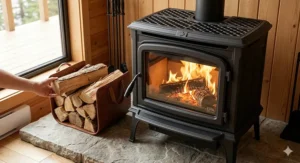
The Deco Nano is the Spark II’s stylish sibling — same heating capacity, but with a modern pedestal design that looks at home in a contemporary Canadian living room rather than only a rustic cabin.
Specs that matter: EPA certified at 1.8 g/h with a 45,000 BTU/h output, the Deco Nano heats up to 111 m² (1,200 sq. ft.) and accepts logs up to 43 cm (17 inches). The key differentiator here is the pedestal with integrated log storage underneath — practical for smaller Canadian homes where storage space is at a premium. The combustion chamber is deeper than others in its category, and the glass airwash system keeps the ceramic glass impressively clean even during extended burns.
Who this is for: If you’re a condo owner in a mid-rise or a townhouse dweller in cities like Calgary or Halifax who wants a stove that looks like a design choice rather than a utility appliance, the Deco Nano earns its price. The taller profile also radiates heat more effectively at standing height in open-plan rooms. This is also a strong candidate for alcove installations where floor space is tight.
What Canadian buyers say: The consensus praise is on aesthetics and ease of use. Some buyers mention the pedestal assembly takes patience but the end result is worth it.
✅ Modern design suits contemporary Canadian homes
✅ Built-in log storage maximises small spaces
✅ Certified for mobile home and alcove installation
❌ 1.8 g/h emission rate is slightly higher than the Deco II sibling
❌ Pedestal adds complexity during initial setup
Value verdict: In the $800–$1,000 CAD range, you’re paying a small premium over the Spark II for the aesthetic and log storage — worthwhile if those features matter to your space.
3. Drolet Savannah II
The Drolet Savannah II fills the mid-range gap that a surprising number of Canadian buyers fall into: they need more than 111 m² (1,200 sq. ft.) of heating but aren’t ready for the step up to a large-format stove.
Specs that matter: EPA 2020 certified at under 2.5 g/h, the Savannah II puts out approximately 55,000 BTU/h and is suited for spaces up to roughly 130 m² (1,400 sq. ft.). The pedestal design includes an ash lip and air intake damper, and like all modern Drolet stoves, the airwash system keeps the ceramic glass clear for those satisfying fire-watching moments. It’s also certified for mobile home and alcove installation — a recurring theme with Drolet that matters enormously for Canada’s diverse housing stock.
Who this is for: This is where I’d steer a first-time wood stove buyer in a suburban Canadian home who wants reliability without complexity. The Savannah II is non-catalytic — no catalyst to replace, no bypass damper to remember to open — just load, light, and adjust the air damper. For families in smaller older homes in cities like Sudbury or Fredericton, this straightforward operation is a genuine advantage, especially if you’re new to wood heating.
What Canadian buyers say: Reviewers consistently praise its ease of use and its effective heat output. It’s also noted as a strong choice for rural properties where simplicity and durability matter most.
✅ Ideal first stove — uncomplicated, reliable operation
✅ Mobile home certified for maximum installation flexibility
✅ Strong brand support and parts availability across Canada
❌ Emission data published as “under 2.5 g/h” rather than a precise figure — less transparency than some competitors
❌ Heating area ceiling of ~130 m² (1,400 sq. ft.) limits use in larger open-plan homes
Value verdict: In the $900–$1,100 CAD range, the Savannah II delivers reliable, no-fuss performance — ideal for buyers who prioritise durability over fine-tuned specs.
4. Drolet Deco II (Model DB03205)
Here’s where the Drolet lineup gets seriously impressive. The Deco II is the most efficient stove in this roundup relative to its size — and for most Canadian family homes, it’s the one I’d personally recommend without hesitation.
Specs that matter: EPA certified at just 1.26 g/h — well below even the stringent Montréal municipality requirement — with a 65,000 BTU/h output that comfortably heats up to 167 m² (1,800 sq. ft.). Maximum burn time is six hours, and it accepts logs up to 46 cm (18 inches). The pedestal includes log storage, and the cast iron door with adjustable hinges is built for decades of use. Made in Canada. Limited lifetime warranty.
Who this is for: If you’re in Québec City (where new CSA/EPA certification at 2.5 g/h becomes mandatory from September 1, 2026) or Montréal (where sub-2.5 g/h is already required), the Deco II’s 1.26 g/h rating gives you generous compliance headroom and future-proofs your investment. For a family in a 2,000 sq. ft. energy-efficient home in any Canadian province, the Deco II used as a primary or strong supplemental heat source represents an excellent cost-per-BTU calculation over a heating season.
What Canadian buyers say: Buyers who’ve owned cheaper stoves frequently comment on how much less firewood the Deco II consumes to achieve the same comfort level — a meaningful CAD saving over a Canadian winter.
✅ 1.26 g/h emission rate is future-proof for stricter provincial/municipal rules
✅ Six-hour burn time reduces overnight re-loading
✅ Strong ROI for families using it as primary heat
❌ Price reflects premium quality — not the place to start on a tight budget
❌ Larger footprint — measure your install space carefully before ordering
Value verdict: At $1,000–$1,300 CAD, the Deco II offers the best combination of emission performance, heat output, and long-term reliability in this guide.
5. Century Heating S250 (Model CB00025)
Century Heating is the brand name for SBI’s (Stove Builder International) value-tier line — and “value tier” here does not mean cutting corners on what actually matters.
Specs that matter: EPA certified at 1.8 g/h with a 45,000 BTU/h output covering up to 167 m² (1,800 sq. ft.), the S250 features a small firebox with a cast iron door, ceramic glass, a glass airwash system, and a stainless steel heat shield. Designed and made in Canada. The pedestal design with ash lip and air intake damper gives it a clean, professional appearance.
Who this is for: This is the stove I’d recommend to a Canadian buyer who needs to replace an old, uncertified unit on a realistic household budget. The S250 delivers certified clean-burn performance for roughly $600–$800 CAD — one of the lowest entry points for genuine EPA 2020 compliance on Amazon.ca. If you’re in BC and looking at the provincial Woodstove Exchange rebate program (which requires replacing a non-certified unit with a certified one), the S250 is an excellent rebate-eligible choice that minimises your out-of-pocket cost after the rebate.
What Canadian buyers say: Reviews highlight the value proposition strongly. A few note the firebox is truly small — confirm your typical log length before purchasing.
✅ Lowest price point for genuine EPA 2020 compliance in this guide
✅ Made in Canada — rebate-eligible in multiple provinces
✅ Airwash glass system is genuinely effective at this price
❌ “Small firebox” designation is accurate — not suitable as a sole heat source for a larger Canadian home
❌ Some buyers report the assembly instructions need improvement
Value verdict: At $600–$800 CAD, the S250 is the smartest budget pick for Canadians upgrading from an old, uncertified stove.
6. Century Heating FW3500 (Model CB00024) (Model CB00024)
If you have a large, open-plan Canadian home and you’re tired of your heating bill, the FW3500 is the stove you’ve been looking for.
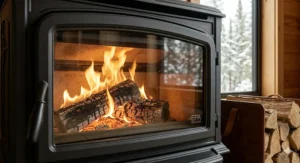
Specs that matter: EPA certified at 1.6 g/h, the FW3500 delivers a massive 110,000 BTU/h output capable of heating up to 325 m² (3,500 sq. ft.). The extra-large firebox is reinforced with a C-Cast heat shield, and the cast iron door with ceramic glass and airwash system keeps performance consistent through long, hard burns. Made in Canada by SBI. Non-catalytic combustion keeps maintenance simple.
Who this is for: Rural Canadians — think a farmhouse in southern Manitoba, an acreage in Alberta’s foothills, or a large cottage in the Muskoka region — who want to use wood as a genuine primary heat source rather than supplemental warmth. At 110,000 BTU/h, this stove can meaningfully reduce your propane or natural gas consumption through a Canadian winter, and at a 1.6 g/h emission rate, it does so cleanly enough to satisfy most provincial regulations with room to spare. The long-term ROI story here is compelling: a full cord of seasoned hardwood in Ontario or Quebec runs $350–$500 CAD, and this stove burns it efficiently.
What Canadian buyers say: Buyers in large rural homes describe it as genuinely transformative for their heating costs. A few note the weight and size require planning your chimney connection carefully.
✅ 110,000 BTU/h makes it a true whole-home primary heater
✅ 1.6 g/h emission rate is compliant even in stricter jurisdictions
✅ Extra-large firebox accepts longer logs — less splitting labour
❌ Size and weight demand professional installation planning
❌ $1,400–$1,800 CAD price range requires serious budget commitment
Value verdict: For large homes where wood is the primary heat source, the FW3500 pays for itself within a few Canadian winters in fuel savings.
7. US Stove US1269E — Cast Iron Wood Stove
Not every Canadian home needs a powerhouse — sometimes you just need a reliable, honest cast iron stove that gets an apartment-over-garage or a workshop warm without fuss.
Specs that matter: The US1269E produces 54,000 BTU/h from a classic cast iron body and heats up to roughly 84 m² (900 sq. ft.). It’s EPA-certified with a clean-burning interior design, accepts logs up to 48 cm (19 inches), and includes an integrated cooking surface on top — a genuinely useful feature for Canadians dealing with extended power outages during ice storms or blizzards. The 2-piece cool-touch safety handle is a smart detail for households with children.
Who this is for: The US1269E is the stove I’d suggest for a detached garage workshop in Saskatchewan, a small hunting camp in northern Ontario, or a secondary dwelling that needs warmth on a limited budget. It’s also the most “traditional” stove in this roundup aesthetically, which suits heritage-style Canadian homes. The cooking surface top is worth noting for emergency preparedness — during ice storms that knock out power for days across Eastern Canada, being able to heat soup on your wood stove is not a trivial advantage.
What Canadian buyers say: Reviewers appreciate the classic look and the cooking surface. Some note the 900 sq. ft. ceiling is accurate — don’t expect it to carry a full modern house through winter.
✅ Integrated cooking surface — real emergency preparedness value
✅ Budget entry point for basic EPA-certified heating
✅ Classic cast iron aesthetic suits heritage Canadian homes
❌ 900 sq. ft. heating capacity limits use to small spaces
❌ Less sophisticated airwash system means more glass cleaning
Value verdict: In the $500–$700 CAD range, the US1269E is the most accessible entry point to EPA certified heating on Amazon.ca.
How to Choose an EPA Certified Wood Stove in Canada: 6 Key Criteria
1. Match BTU Output to Your Space (Not Your Ambitions)
The single most common mistake Canadian buyers make is oversizing their stove. A stove that’s too large for the space will be chronically under-fired — burning at low oxygen levels to avoid overheating — which actually increases emissions and creosote buildup in your chimney. Calculate your space in square metres and match to the stove’s rated coverage area. A rough guide: 45,000 BTU/h suits spaces up to ~110 m²; 65,000 BTU/h covers ~165 m²; 110,000 BTU/h serves ~325 m².
2. Verify the Emission Rate, Not Just the Certification
“EPA certified” is a category, not a single standard. Under the 2020 NSPS, cord wood-tested stoves must emit ≤2.5 g/h, but many modern stoves certified at 1.2–1.8 g/h exceed this significantly. In Quebec City (mandatory from September 2026) and Montréal, the ≤2.5 g/h limit is already law. Always check the actual g/h figure on the certification label — not just whether the stove is “certified.”
3. Understand CSA B415 vs. EPA — They’re Not Identical
Canada’s national standard, CSA B415.1-10, mirrors the EPA framework but includes wood furnaces and has a 4.5 g/h emissions ceiling that hasn’t yet been updated to match the 2020 EPA limits. Per Drolet’s regulatory guide, EPA-certified stoves meet the most stringent current standard everywhere in Canada except Nunavut. If you’re in a municipality with stricter rules (Montréal being the clearest example), choose a stove with a sub-2.5 g/h emission rating regardless of whether it’s EPA or CSA certified.
4. Non-Catalytic vs. Catalytic: Which Is Right for You?
Non-catalytic stoves (all seven models in this guide) achieve clean burn through a secondary combustion chamber and high firebox temperatures. They’re simpler to maintain — no catalyst to replace (typically every 5–6 seasons, adding $200–$400 CAD to lifetime cost). Catalytic stoves achieve lower emissions faster during cold starts and can produce more even heat at lower burn rates, making them attractive for extended, overnight burns. For most Canadian buyers using a stove primarily for supplemental or backup heat, non-catalytic is the practical, lower-maintenance choice. If wood is your primary heat source and you’re burning 10+ hours daily through a Canadian winter, investigating catalytic models may be worthwhile for fuel economy.
5. Check Your Provincial and Municipal Regulations Before Buying
Per the Government of Canada’s Canadian Council of Ministers of the Environment (CCME) code of practice, provinces set their own adoption timelines for EPA/CSA standards. British Columbia’s Woodstove Exchange program offers rebates for replacing non-certified stoves. Québec City mandates full certified compliance from September 1, 2026. Always contact your municipal building department before purchase — some areas require a permit and WETT (Wood Energy Technology Transfer) inspection before installation.
6. Factor in Amazon.ca Shipping and Installation Realities
Wood stoves are heavy — the FW3500, for example, ships at substantial freight weight. Amazon.ca Prime shipping applies to many of these models, but remote and northern communities (Yukon, Northwest Territories, Nunavut, rural northern Ontario) may face longer delivery windows and freight surcharges. Budget for professional installation: most Canadian insurers and municipalities require WETT-certified installation, which typically adds $500–$1,500 CAD depending on your chimney configuration and province.
Real-World Canadian User Profiles: Which Stove Fits Your Life?
Profile 1: The Toronto Condo Convert
Sylvie, 38, recently bought a detached Victorian in Leslieville (East Toronto). Her home is about 120 m² (1,290 sq. ft.) of living space across two floors, and she wants to reduce her natural gas bill without a major renovation. Her priority: a stove that looks good in a heritage-style living room and doesn’t require an engineering degree to operate.
Best match: Drolet Deco Nano. The modern pedestal aesthetic suits older Toronto homes that have been refreshed with contemporary interiors. The 1,200 sq. ft. rated capacity fits her main floor and lower level as a supplemental heat zone. Amazon.ca delivers it Prime-eligible to downtown Toronto, and at under $1,000 CAD, it fits a first-time stove buyer’s budget comfortably.
Profile 2: The Rural Alberta Family
The Hendersons in Ponoka County, Alberta heat a 250 m² (2,700 sq. ft.) farmhouse with propane and want to cut costs significantly. They have an existing masonry chimney, go through cold stretches below -30°C regularly, and burn through propane during a hard winter.
Best match: Century Heating FW3500. The 110,000 BTU/h output is the right tool for this job. At 1.6 g/h, it’s compliant with current Alberta requirements and future regulatory tightening. A cord of seasoned birch or spruce in Alberta runs roughly $350–$450 CAD — replacing significant propane consumption could recoup the stove’s cost within two to three heating seasons.
Profile 3: The BC Cabin Owner Using a Woodstove Exchange Rebate
Marcus in the Okanagan region of BC has a 90 m² (970 sq. ft.) seasonal cabin and a non-certified stove he needs to replace to maintain his home insurance coverage. He’s on a tight budget and eligible for BC’s Woodstove Exchange rebate.
Best match: Century Heating S250. It’s the most affordable EPA 2020-certified option in this guide. With BC’s rebate reducing the out-of-pocket cost, Marcus can achieve full compliance and modern heating efficiency for minimal net spend. The small firebox suits his cabin footprint perfectly, and it’s Prime-eligible on Amazon.ca for fast delivery to the Okanagan.
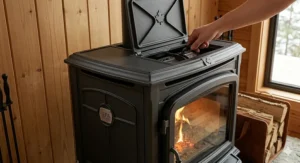
Understanding Wood Stove Emission Standards: What the Numbers Actually Mean for Canadian Air Quality
Wood smoke is not a harmless by-product of cosy evenings — it contains fine particulate matter (PM2.5), carbon monoxide, and volatile organic compounds. According to a Simon Fraser University study on residential wood burning in British Columbia, even healthy adults in wood-burning communities showed measurable cardiovascular effects from wood smoke exposure, and HEPA filtration demonstrated health benefits in those homes.
This is why the 2020 EPA NSPS tightening to ≤2.5 g/h (cordwood testing) matters so concretely. An older, uncertified stove releases 15–30 grams of smoke per hour. A modern EPA certified wood stove at 1.5 g/h produces roughly 95% less particulate matter. That’s not a marketing number — it’s the real-world difference between a clean burn and a house full of low-grade smoke.
The U.S. EPA’s Burn Wise guidance also stresses that even the cleanest stove performs poorly with wet wood or a smoldering fire. For Canadian users: always burn seasoned firewood with a moisture content below 20% (invest in a wood moisture metre — they cost under $30 CAD on Amazon.ca and pay for themselves in efficiency gains). Run your stove hot enough to maintain a lively fire; chronic low burns are the primary cause of creosote buildup and chimney fires in Canada’s cold-climate homes.
Montréal’s strict city ordinance — requiring EPA certification or CSA B415.1 compliance at under 2.5 g/h, and prohibiting any wood burning during smog alerts — reflects where Canadian urban regulation is heading. Per the City of Montréal’s official guidance, only certified appliances meeting these standards are permitted in all 19 of the city’s boroughs.
Long-Term Cost & Maintenance of an EPA Certified Wood Stove in Canada
The Real Cost of Ownership in CAD
A wood stove purchase is a 20–30-year investment if you buy quality and maintain it properly. Here’s what to budget beyond the purchase price:
Installation: WETT-certified installation typically runs $800–$2,000 CAD depending on chimney configuration, province, and whether you need a new liner. This is non-negotiable for most Canadian home insurance policies.
Annual chimney cleaning: Budget $200–$400 CAD per year in most Canadian cities. Modern EPA certified stoves with proper dry wood produce minimal creosote — but annual cleaning is still required by most home insurers and fire codes.
Firewood: A full cord of seasoned hardwood (maple, birch, oak) runs approximately $350–$550 CAD in most of southern Canada. Northern and remote communities pay more. A cord typically heats a medium-sized home for 1–3 months depending on climate, insulation, and stove efficiency.
Non-catalytic replacement parts: Modern non-catalytic stoves have very low ongoing parts costs — the primary consumables are door gaskets ($20–$60 CAD every few years) and refractory/firebrick replacements ($50–$200 CAD over the stove’s life). This is a meaningful advantage over catalytic stoves where catalyst replacement alone can run $250–$500 CAD.
10-Year Total Cost Comparison (Approx. CAD)
| Cost Item | Non-Catalytic EPA Stove | Older Uncertified Stove |
|---|---|---|
| Purchase (mid-range) | $900–$1,300 | $0 (existing) |
| Installation/WETT | $1,000–$1,500 | — |
| Annual firewood (3 cords) | $1,200–$1,600/yr | $1,500–$2,200/yr |
| Annual chimney cleaning | $250/yr | $350–$500/yr |
| Parts & maintenance | $100–$200 total | $500–$1,000 total |
| 10-Year Estimated Total | $16,000–$21,500 | $23,000–$37,000 |
The efficiency gains of a certified stove mean you burn less wood to achieve the same warmth — a cumulative CAD saving that typically recoups the initial purchase cost within 3–5 heating seasons.
Every comparison table MUST be followed by 2-3 sentences of written analysis. The numbers above reveal something important: the “free” old stove isn’t free at all. Its inefficiency costs you more firewood annually, more chimney cleaning (more creosote from incomplete combustion), and exposes you to compliance risk as provincial regulations tighten. An EPA certified wood stove is, counter-intuitively, the financially conservative choice over a 10-year horizon.
✨ Don’t Miss These Exclusive Deals!
🔍 Ready to upgrade your home heating? Click on any highlighted stove in this guide to check current pricing and Prime eligibility on Amazon.ca. Certified stoves are in demand across Canada — check availability before the pre-winter rush!
Common Mistakes When Buying an EPA Certified Wood Stove in Canada
1. Choosing by price alone without checking the emission rate. Not all certified stoves are equal. “EPA certified” spans 1.0 g/h to 2.5 g/h — a significant range. If you’re in Québec, BC’s stricter air quality zones, or planning a renovation in Montréal, buying the cheapest certified stove without checking the g/h rating could leave you non-compliant with local rules.
2. Ignoring the chimney situation. Many Canadian buyers focus entirely on the stove and overlook that a wood stove is only as good as its chimney system. An improperly sized, deteriorated, or unlocked liner will negate every efficiency gain the certified stove provides. Budget for a WETT inspection of your existing chimney before purchase, especially in homes over 20 years old.
3. Buying a stove too large for the space. As mentioned earlier, oversizing leads to chronic low burns, creosote buildup, and paradoxically worse air quality outcomes. The right stove is the one that burns hot and clean at normal operating temperatures for your space — not the one with the highest possible BTU rating.
4. Assuming Amazon.ca pricing and availability match Amazon.com. Canadian buyers sometimes see a product on Amazon.com and assume identical pricing on Amazon.ca. Exchange rate differences, import duties, and different freight arrangements mean Canadian pricing runs 15–30% higher for some products. Always verify on Amazon.ca, and factor in Canadian tax on top of the listed price.
5. Skipping the WETT inspection for insurance purposes. Most Canadian home insurers require a WETT-certified installation and inspection to maintain coverage when a wood-burning appliance is present. Skipping this step to save $500 CAD can result in a denied claim in the event of a fire — a false economy of the highest order.
FAQ: EPA Certified Wood Stoves in Canada
❓ What is the difference between EPA certification and CSA B415 certification in Canada?
❓ Is an EPA certified wood stove required in my Canadian province?
❓ Can I get a rebate for buying an EPA certified wood stove in Canada?
❓ Does wood stove efficiency drop in very cold Canadian winters?
❓ What wood should I burn in an EPA certified wood stove in Canada?
Conclusion: Invest in Clean Heat That Lasts Through Canadian Winters 🇨🇦🔥
The decision to install an EPA certified wood stove in a Canadian home isn’t just about staying warm — it’s about heating responsibly, staying compliant with regulations that are only going to get stricter, and making a financial investment that pays dividends in fuel savings and home value for decades.
For most Canadian buyers, the Drolet Deco II represents the sweet spot: a 1.26 g/h emission rate that future-proofs you against tightening regulations, 65,000 BTU/h for genuine family-home heating, and a six-hour burn time that carries you through the coldest nights. For budget-conscious buyers replacing an old stove, the Century Heating S250 delivers certified performance at the most accessible price point on Amazon.ca. And for anyone heating a large rural home or farmhouse, the Century Heating FW3500 is in a class of its own.
Whatever model suits your space and budget, the move from an uncertified to an EPA certified wood stove is one of the highest-impact upgrades a Canadian homeowner can make — for their air quality, their heating bill, and their conscience on a cold February morning.
Check current pricing and Prime availability on Amazon.ca by clicking any highlighted product in this guide.
✨ Don’t Miss These Exclusive Deals!
🔍 Take your home heating to the next level with these carefully selected EPA certified wood stoves. Click on any highlighted item to check current pricing and availability on Amazon.ca. Don’t wait — certified stoves sell out fast before Canadian winters!
Recommended for You
- Pellet Stove vs Wood Stove: 7 Best Picks for Canadian Homes in 2026
- 7 Best Wood Stove for Off-Grid Cabin in Canada 2026
- 7 Best Small Wood Stove for Tiny House Canada 2026
Disclaimer: This article contains affiliate links. As an Amazon Associate, I earn from qualifying purchases. If you purchase products through these links, we may earn a small commission at no additional cost to you.
✨ Found this helpful? Share it with your friends! 💬🤗
