
In This Article
Winter in Canada doesn’t mess around. We’re talking about -30°C mornings in Winnipeg, nor’easters hammering the Maritimes, and those brutal stretches in Alberta where the wind chill makes a cold day feel like a personal attack. When the furnace alone isn’t cutting it — or your hydro bill is quietly becoming its own monthly crisis — the question inevitably comes up: should I get a pellet stove or a wood stove?
Both are legitimate answers. But they’re very different animals.
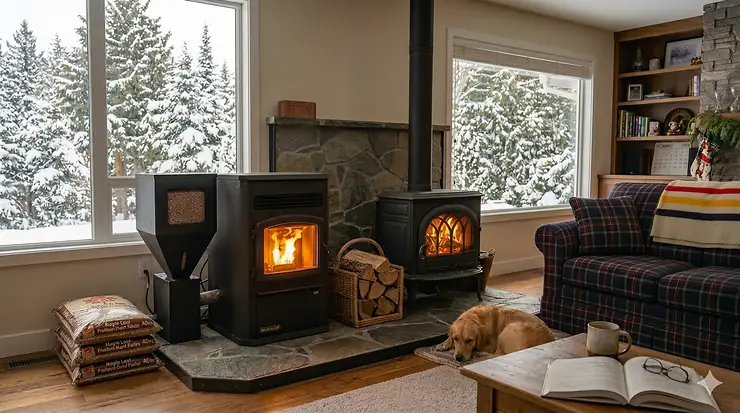
Here’s the short version: a pellet stove vs wood stove comparison really comes down to how you live. Pellet stoves are the automated, set-it-and-forget-it option — they feed fuel automatically from a hopper, hold a steady temperature via thermostat control, and burn cleanly with efficiency ratings pushing 75–83%. Wood stoves are older, simpler, and deeply satisfying in a way that technology can’t fully replicate — but they ask more from you. You’re managing the fire. You’re stacking wood. You’re cleaning creosote.
Neither is objectively “better.” But for your house, your schedule, and your particular corner of this massive country, one is probably a significantly smarter choice than the other.
In this guide, I’ve researched and reviewed seven real products — all available through Amazon.ca (CAD pricing throughout, because listing USD prices to Canadians should be a minor criminal offence) — and I’ll walk you through the full comparison so you can make a decision you’ll still be happy with when February rolls around. Again.
💡 Quick definition for newcomers: A pellet stove burns compressed wood pellets (made from recycled sawdust and biomass waste) fed automatically by a motorised auger from an onboard hopper. A wood stove burns split cordwood, managed manually with dampers and doors. Both connect to a venting system; pellet stoves can often vent horizontally through a wall, while wood stoves typically require a full chimney.
Quick Comparison: Pellet Stove vs Wood Stove at a Glance
| Feature | Pellet Stove | Wood Stove |
|---|---|---|
| Fuel source | Compressed wood pellets | Split cordwood |
| Efficiency | 75–83% | 70–80% |
| Automation | Thermostat-controlled, auto-feed | Fully manual |
| Power dependency | Requires electricity | None |
| Installation cost (CAD) | $2,000–$5,500 installed | $3,500–$9,000 installed |
| Annual fuel cost (CAD, est.) | $1,200–$1,800/season | $800–$1,400/season |
| Emissions | Very low (EPA/CSA certified) | Low–moderate (CSA B415.1) |
| Maintenance | Weekly cleaning, annual service | Monthly cleaning, annual sweep |
| Off-grid capability | ❌ (needs power) | ✅ |
| Best for | Convenience-focused homeowners | Self-sufficient, rural, off-grid |
The numbers here favour pellet stoves in efficiency and emissions — but notice that wood stoves come in meaningfully cheaper on annual fuel costs in many Canadian regions, especially where local firewood supply is plentiful. A cord of wood sourced locally in northern Ontario costs far less than a tonne of bagged pellets. That gap narrows considerably in urban centres like Toronto or Vancouver, where delivered firewood is a premium product.
What the table doesn’t tell you: If your power goes out for 36 hours during a January ice storm — and if you’ve been anywhere near the Maritimes or central Ontario in the past five years, you know this isn’t hypothetical — your pellet stove goes cold. Your wood stove keeps burning. That single fact changes the calculus for a lot of Canadian families.
✨ Don’t Miss These Exclusive Deals!
🔍 Take your home heating to the next level with these carefully selected products. Click on any highlighted item to check current pricing and availability on Amazon.ca. These stoves will keep your family warm through every Canadian winter — no matter how brutal.
Top 7 Pellet Stoves & Wood Stoves for Canada: Expert Analysis
1. ComfortBilt HP22 Pellet Stove — Best Overall Pellet Stove for Canada
Let’s start with the one that earns its reputation every single year. The ComfortBilt HP22 is the best-selling pellet stove in North America for good reason — it’s a genuinely excellent machine that manages to be powerful, reliable, and approachable all at once.
Key specs, with context: The HP22 outputs 50,000 BTU and heats up to approximately 260 square metres (2,800 sq ft) in mild conditions — realistic for a well-insulated bungalow in southern Ontario, though you’ll want to temper expectations if you’re in a drafty older home in Québec City. The 55 lb (25 kg) hopper holds enough pellets for up to 20 hours on the lowest setting, which in practice means you’re loading once a day during the heart of winter. The programmable 7-day internal thermostat is the feature that genuinely changes how you interact with this stove: set it to 21°C while you’re home and 16°C overnight, and it manages itself. You wake up to a warm house without doing a thing.
Who is this for? The HP22 is the move for suburban Canadian homeowners who want pellet heat without becoming pellet experts. It’s EPA and CSA certified — critical for Canadian insurance compliance — and the ash drawer only needs emptying weekly, which is about as low-maintenance as pellet stoves get. Canadian buyers specifically appreciate that it’s available directly through Amazon.ca with Prime shipping, avoiding cross-border headaches entirely.
Customer feedback: Canadian reviewers consistently highlight the HP22’s reliability through full winters and praise the programmable thermostat as a genuine game-changer. A few note the initial setup requires patience.
✅ EPA & CSA certified — Canadian insurance-compliant
✅ 7-day programmable thermostat, five heat settings
✅ Weekly ash emptying, not daily
❌ Heavy at 123 kg (272 lbs) — installation requires help
❌ One-year warranty feels short for the price point
Price range: $1,800–$2,400 CAD range — check current pricing on Amazon.ca. Outstanding value at this tier.
2. ComfortBilt HP22-N Pellet Stove — Best for Long Canadian Winters (Fewer Refills)
If the original HP22 is the sensible mid-size sedan, the HP22-N is the long-haul version with the extra fuel tank. The key difference is the dramatically enlarged 80 lb (36 kg) hopper — nearly double the standard model — which pushes continuous burn time to a remarkable 36 hours on the lowest setting.
Why this matters for Canada: Pellet stove refilling sounds trivial until you’ve done it daily for four months straight in a Saskatchewan winter. That extra hopper capacity means you can leave for a weekend trip in January, set the thermostat, and return to a home that hasn’t gone cold. For Canadians with weekend cottages, rental properties, or simply demanding work schedules, this is worth the price premium alone.
The HP22-N shares the same 50,000 BTU output and 260 sq m coverage as the base HP22, but sits taller to accommodate the larger hopper. The rear-mounted 75 mm (3″) standard exhaust port gives flexible installation options — you can vent horizontally through a wall or vertically through the roof, which is particularly useful in Canadian homes where chimney retrofits are expensive.
Who is this for? Families who want the full pellet-stove experience but hate the daily refilling ritual. Also an excellent choice for older Canadians or anyone for whom frequent bending-and-loading is a physical consideration.
Customer feedback: The extra hopper gets consistent praise. A few buyers noted the unit is noticeably heavier than the base HP22 — plan your installation accordingly.
✅ 80 lb hopper — up to 36 hours continuous burn
✅ Same EPA & CSA certifications as the HP22
✅ Flexible venting options for Canadian home layouts
❌ More expensive than the base HP22
❌ Bulkier footprint — measure your space carefully
Price range: $2,200–$2,800 CAD range. The premium over the base HP22 pays for itself in convenience within the first winter.
3. ComfortBilt HP50S Pellet Stove — Best Compact Pellet Stove for Smaller Canadian Homes
Not everyone needs to heat a 260 square metre open-concept farmhouse. Condominiums, basement suites, older bungalows, and smaller urban homes in cities like Halifax, Hamilton, or Victoria often clock in at 100–130 square metres — and for these spaces, the HP50S is a far smarter purchase than an oversized unit.
Key specs with meaning: 42,000 BTU output, 47 lb (21 kg) hopper, heats up to approximately 200 sq m (2,200 sq ft) under mild conditions. The European compact design keeps the footprint to just 52 cm wide × 61 cm deep (20.5″ × 24″), which is genuinely apartment-friendly. Five power settings let you dial back to minimal output for shoulder seasons — those weird warm spells in October before real winter lands. EPA and CSA certified, same as its bigger siblings.
What most buyers overlook: The HP50S burns pellets efficiently enough that the ash drawer only needs attention every few days, not daily — a notable achievement at this size class. The compact form factor also means it’s viable in spaces where the larger HP22 simply won’t fit without dominating the room.
Who is this for? Urban Canadians, condo owners (check strata bylaws first!), or anyone supplementing an existing heating system rather than replacing it outright. At the lower end of the ComfortBilt price range, it’s also the right entry point if you’re trying pellet heat for the first time.
✅ Compact European design — fits smaller Canadian homes
✅ EPA & CSA certified, 5 heat settings
✅ Lower price entry point into pellet heating
❌ 200 sq m coverage feels tight in -25°C conditions
❌ 47 lb hopper means more frequent refills than larger models
Price range: $1,200–$1,600 CAD range on Amazon.ca. Excellent value for supplemental heating.
4. Castle 12327 Serenity Pellet Stove — Best Smart Controller Pellet Stove
Here’s the one that punches above its weight class in intelligence. The Castle Serenity 12327 was engineered with a proprietary Smart Controller that offers three operational modes — manual, thermostat, and weekly programmable — giving it a level of scheduling flexibility that more expensive stoves sometimes lack.
Key specs with context: This is a compact unit with a 40 lb (18 kg) hopper designed for spaces up to about 140 sq m (1,500 sq ft). The vertical auger feed system runs on a timer-based cycle controlled by a digital microprocessor board — translation: the stove burns pellets in measured pulses rather than continuous feed, which improves fuel economy noticeably. The blower fan distributes heat throughout the room rather than creating a hot spot next to the stove, which matters a lot in Canadian homes where open floor plans and older heating layouts can create uneven temperatures.
What stands out: The weekly scheduling mode is genuinely clever. You can programme the stove to run low overnight, kick up before the alarm goes off, and idle during the hours you’re at work — treating it almost like a smart thermostat. For a Canadian household trying to minimise pellet consumption while maintaining comfort across a long winter, this kind of granular control matters.
Who is this for? Tech-savvy Canadians who appreciate intelligent automation, and those heating medium-sized rooms as primary zones rather than whole-home heating. Also worth considering for a home office or recreational room where you want controlled, independent heat.
✅ Three operational modes including weekly scheduling
✅ Compact footprint — space-saving design
✅ Vertical auger system improves pellet economy
❌ Smaller coverage area (1,500 sq ft) — not for large homes
❌ Surface gets genuinely hot — important safety consideration with children
Price range: Under $1,000 CAD on Amazon.ca — making it the most accessible entry point on this list. Available with Prime shipping.
5. Drolet HT-2000 (DB07200) High-Efficiency Wood Stove — Best Wood Stove for Canadian Homes
Now we switch fuel types entirely, and the Drolet HT-2000 is the wood stove that earns a spot on this list not through marketing, but through the kind of quiet reputation built over years of Canadian winters. Drolet is a Québec-based manufacturer — one of the genuinely Canadian brands in this space — and the HT-2000 reflects that heritage with a design built for cold-weather performance.
Key specs with real-world meaning: 100,000 BTU output, heating range of 93–223 sq m (1,000–2,400 sq ft) depending on insulation quality. It burns cordwood up to 61 cm (24″) long, which is a practical dimension — most Canadian firewood suppliers split to roughly this length. CSA certified for safety and emissions compliance. The cast-iron and steel construction means this stove will outlast furniture, cars, and probably the mortgage.
What most buyers overlook: The HT-2000’s efficiency earns it the “high-efficiency” designation through a secondary burn chamber that re-combusts exhaust gases before they leave the firebox — reducing creosote buildup in your chimney and squeezing more BTUs out of every piece of wood. In practice, this means you burn less wood for the same heat, and your annual chimney sweep is less alarming.
Who is this for? Rural Canadians with reliable firewood access, off-grid households in northern Ontario, BC interior, or the Prairies, and anyone whose power reliability makes electricity-dependent pellet stoves an unacceptable risk. If you’ve been cutting your own wood for years, this stove rewards that lifestyle rather than fighting it.
✅ 100,000 BTU — serious heating power for large spaces
✅ Canadian-made by Drolet (Québec) — CSA certified
✅ No electricity required — works during power outages
❌ Requires full chimney installation (adds significant cost)
❌ Active management required — not automated
Price range: $900–$1,400 CAD range on Amazon.ca. Factor in chimney installation costs separately.
6. US Stove Company 5500E King Wood Stove — Best Budget Wood Stove with Blower
The US Stove Company has been making wood stoves since 1869 — which means they’ve had roughly 157 years to get the fundamentals right. The 5500E King earns its place here as the most accessible traditional wood stove on Amazon.ca, combining solid construction with a built-in blower that frankly changes the heating dynamic of the whole room.
Key specs with context: Rated at 89,000 BTU with coverage up to approximately 186 sq m (2,000 sq ft), the 5500E features a built-in convection blower that forces warm air into the room rather than relying on passive radiation. For a Canadian living room or basement, that blower is the difference between “warm near the stove” and “actually comfortable throughout the space.” It accepts cordwood up to 56 cm (22″) and weighs about 113 kg (250 lbs) — heavy enough to feel substantial, light enough to not require structural reinforcement in most homes.
Canadian context: Check current availability on Amazon.ca, as shipping to remote or northern postal codes may have extended timelines or surcharges. This model does not carry CSA certification — verify with your local insurer before purchase, as some policies require CSA-certified appliances specifically.
✅ Built-in blower for whole-room heat distribution
✅ Competitive price for BTU output
✅ Accepts standard Canadian firewood lengths
❌ Not CSA certified — verify insurer requirements
❌ Manual management only — no thermostat capability
Price range: $700–$1,000 CAD range. Budget-friendly entry into serious wood heating.
7. ComfortBilt HP21 Pellet Stove Insert — Best for Existing Fireplace Owners
If you’ve got a wood-burning fireplace that mostly sits unused — gathering dust, heating your living room asymmetrically, looking gorgeous but performing poorly — the HP21 Insert is the conversion that transforms that fireplace from decorative liability to serious heating asset.
Key specs with meaning: The HP21 is designed to slot into an existing masonry or factory-built fireplace opening, using your fireplace’s existing flue while eliminating its most frustrating trait: the cold air draft. The 32,000 BTU output heats approximately 220 sq m (2,400 sq ft) with 76.3% efficiency — meaningfully better than the 10–15% efficiency of an open wood-burning fireplace. The 40 lb (18 kg) hopper, automated auger feed, and programmable thermostat bring it to full pellet-stove functionality without requiring a whole new venting installation.
Who is this for? Canadians who already have a fireplace — particularly common in older homes in Toronto, Vancouver, and Montréal — and want to retrofit it into a real heating system. The HP21 is also the most aesthetically integrated option on this list: it looks like a handsome fireplace insert rather than a freestanding box in the middle of your living room.
✅ Converts existing fireplace to efficient pellet heat
✅ 76.3% efficiency — massive upgrade over open fireplaces
✅ Programmable thermostat, automated feed
❌ Professional installation required for proper sealing
❌ Lower BTU than freestanding HP22 — not a standalone heat source for large homes
Price range: $1,500–$2,100 CAD range — check Amazon.ca for current availability. Prime eligible.
How to Choose a Pellet Stove vs Wood Stove in Canada: A Step-by-Step Framework
Choosing between these two options isn’t a product decision — it’s a lifestyle decision. Here’s how to think through it systematically.
Step 1: Assess your power reliability. If you lose power more than once or twice a winter — rural Ontario, Atlantic Canada, northern BC — a wood stove deserves serious weight in your decision. A pellet stove during a 3-day outage is a very expensive piece of furniture.
Step 2: Calculate your fuel access. Urban Canadian? Pellets are widely available at Canadian Tire, Home Depot, and farm-supply stores in 18 kg bags. Rural Canadian with land and a chainsaw? Firewood may cost you almost nothing. Run the actual fuel cost numbers for your postal code before deciding.
Step 3: Measure your square footage honestly. Not your total home square footage — the square footage you’re actually heating with this stove as a primary or zone source. An oversized stove in a small room cycles inefficiently and drives up pellet consumption.
Step 4: Check provincial and municipal regulations. British Columbia has wood-burning restrictions in the Lower Mainland during air quality advisories; the Metro Vancouver Airshed Management Program can restrict wood burning on specific days. Alberta and Ontario have their own clean-air bylaws. Pellet stoves generally face fewer restrictions due to lower particulate emissions, but check with your local authority. The Government of Canada’s residential heating guide is a useful starting point.
Step 5: Get a CSA-certified model. Canadian insurers routinely require CSA B415.1 certification for wood-burning and pellet-burning appliances. An uncertified stove can void your home insurance. Every model on this list (except the US Stove 5500E — see above) carries CSA certification.
Step 6: Budget the full installation. The stove price is only part of the cost. Add venting or chimney work, a fireproof hearth pad if required, and professional installation where warranted. Pellet stoves using direct-vent wall exits typically run $400–$800 CAD in installation costs; wood stoves requiring a full new chimney can add $3,000–$6,000.
Step 7: Consider your maintenance tolerance. Pellet stoves need weekly burn-pot cleaning, monthly hopper vacuuming, and an annual professional service ($150–$250 CAD). Wood stoves need monthly ash removal, regular glass cleaning, and an annual chimney sweep ($150–$300 CAD). Neither is burdensome, but they’re different rhythms.
Real Canadian Scenarios: Which Stove for Which Life?
The Mississauga Couple, Both Working Full-Time, 150 sq m Semi-Detached You want supplemental heat for the main floor, something that’s running when you get home from work at 6:30 p.m. without you having to manage it. You have no fireplace. The ComfortBilt HP50S is your answer. It’s compact, CSA certified, programmable, and won’t dominate the living room. Budget $1,500–$2,000 CAD for the stove and basic wall-vent installation.
The Family in Rural Manitoba, 220 sq m Home, Occasional Power Outages You’ve got a cord of birch already stacked in the yard, and your father-in-law has been telling you for years to get a wood stove. He’s right, but the Drolet HT-2000 will make him eat his words about Canadian-made quality — because this is it. High efficiency, serious BTU output, and it works when the grid doesn’t. Budget $1,500–$2,500 CAD including basic chimney work.
The Retired Couple in Victoria, BC, Older Heritage Home with Fireplace, 180 sq m You want cozy heat, beautiful flames, and minimal effort. Your existing fireplace is a liability — it drafts cold air and heats nothing efficiently. The ComfortBilt HP21 Insert converts that fireplace into a real heating system while keeping the aesthetic you love. Install it professionally, programme the thermostat, and enjoy the warmth.
The Calgary Homeowner Who Cuts Their Own Wood, Needs Primary Heat Source Big home, big property, no desire to depend on pellet supply chains or electricity. The Drolet HT-2000 or US Stove 5500E — but please verify CSA certification before committing, particularly the US Stove model. Self-sufficient heating with a stove that’ll outlast everything in the garage.
Pellet Stove Maintenance Schedule: What Nobody Tells You Before You Buy 🛠️
Pellet stoves are low-maintenance relative to wood stoves. But low-maintenance isn’t no-maintenance, and going into this without a clear schedule is how stoves develop performance problems that feel mysterious but are entirely preventable.
Daily (30 seconds): Check pellet level in hopper. Top up before the hopper empties completely — running dry mid-cycle can trip the auger jam sensor and require a manual restart.
Weekly (10–15 minutes): Clean the burn pot. Scrape ash from the combustion chamber. Empty the ash pan. If the glass has gone hazy, a quick wipe with a damp cloth clears it — leave it for weeks and it bakes on. Weekly cleaning is the single most important factor in consistent pellet stove performance.
Monthly (30–45 minutes): Vacuum the hopper interior and the auger tube with a shop vacuum. Check the door gasket — if it feels loose or compressed, it’s letting secondary air in and dropping efficiency. Inspect the exhaust vent pipe for soot accumulation.
Seasonally (end of heating season, ~1–2 hours): Full teardown cleaning of the heat exchanger tubes, exhaust manifold, and combustion fan. This is where many Canadian pellet stove owners skip a step — the heat exchanger tubes accumulate ash that’s invisible from normal access points but meaningfully reduces heat transfer. Clear them and your stove will perform like new next October.
Annually (professional service, $150–$250 CAD): Have a certified technician inspect the auger motor, combustion blower, igniter, and control board. Pellet stove igniters typically last 3–5 years; catching wear early is far cheaper than an emergency mid-January replacement.
Canadian note on pellet quality: Pellet quality varies more than you’d expect in Canada. Higher-quality pellets (look for the Pellet Fuels Institute Premium grade or equivalent) produce less ash, less clinker, and run your stove harder before triggering error codes. Cheap pellets from unnamed bulk suppliers can gum up the burn pot in a single season.
Wood Pellet Fuel Efficiency: The Science of What You’re Burning
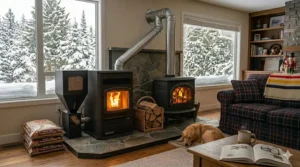
Wood pellets are more consistent than firewood — and that consistency is actually the core of their efficiency advantage. A standard premium hardwood pellet has a moisture content of under 6% and delivers roughly 18–19 GJ per tonne of energy. Seasoned firewood, by comparison, ranges from 14–16 GJ per cord depending on species, moisture, and split quality.
That’s not just a theoretical number. In a real Canadian winter, burning wet or poorly seasoned wood in a wood stove is the single biggest efficiency killer on the market. A stove rated at 75% efficiency on dry seasoned birch might deliver 50% efficiency in practice on wood that was stacked last September and is still holding 25% moisture. Pellet stoves sidestep this entirely — pellet quality is standardised, moisture is controlled, and the automated combustion system adjusts feed rate to maintain optimal burn conditions.
The Canadian Standards Association has been actively working to strengthen biomass heating standards, with CSA Group currently advancing the adoption of European standard EN 303-5 for small solid biomass combustors — a development that will open the Canadian market to more advanced pellet boiler technologies currently common in Sweden and Finland.
Natural Resources Canada notes that biomass space heating, including pellet stoves, qualifies as renewable energy under federal definitions and may be eligible for provincial rebate programmes — worth investigating in your province before purchasing.
Long-Term Cost & Maintenance in Canada: What the Real 5-Year Math Looks Like
Let’s run the actual numbers, because sticker price is a small fraction of what you’ll spend over five Canadian heating seasons.
| Cost Category | Pellet Stove (HP22) | Wood Stove (Drolet HT-2000) |
|---|---|---|
| Stove purchase (CAD) | $1,800–$2,400 | $900–$1,400 |
| Installation (CAD) | $500–$1,200 | $1,500–$5,000+ |
| Annual fuel cost (CAD) | $1,200–$1,800 | $600–$1,200* |
| Annual maintenance (CAD) | $200–$350 | $150–$300 |
| 5-year total (CAD, est.) | $10,000–$14,000 | $8,000–$14,500 |
| Electricity cost (pellet only) | $50–$100/yr | None |
*Wood fuel costs vary dramatically by region — rural Canadians with land access may spend near zero.
The honest conclusion: pellet stoves and wood stoves end up in similar 5-year cost territory for most urban and suburban Canadians. Where pellet stoves win is in the time cost — no wood stacking, no fire management, no creosote anxiety. Where wood stoves win is in resilience — no fuel supply chain dependency, no electricity requirement, and in many rural regions, genuinely lower fuel cost.
If Canadian pricing differs from US equivalents (it often does, by 15–25% due to exchange rates and import costs), avoiding cross-border shopping eliminates customs hassle, warranty headaches, and the genuine frustration of a warranty claim on a stove that shipped from Tennessee.
Common Mistakes When Buying a Pellet Stove or Wood Stove in Canada
Mistake 1: Buying for peak BTU rather than typical BTU. The hottest day of winter is not the day you optimise for. A stove running at 20–30% capacity most of the time because you bought the 50,000 BTU model for a 90 sq m home is cycling inefficiently and consuming more pellets than necessary. Size to your actual space.
Mistake 2: Ignoring CSA certification. In Canada, this is non-negotiable. The CSA B415.1 standard ensures the stove has been tested to Canadian safety requirements. Call your insurer before buying any stove and ask specifically whether it requires CSA certification. Most do.
Mistake 3: Underestimating installation costs. A wood stove without an existing chimney can require $3,000–$6,000 in chimney installation. This figure appears nowhere on the Amazon product page. It appears prominently on your contractor’s invoice.
Mistake 4: Buying cheap pellets. This is the slow-motion mistake that ruins pellet stoves in Canada. Low-grade pellets with high ash content clog the burn pot, trigger error codes, and shorten igniter life. Budget for premium-grade pellets — the annual cost difference versus budget pellets is modest; the maintenance cost difference is not.
Mistake 5: Ignoring provincial air quality restrictions. Metro Vancouver residents, in particular, need to be aware of the Lower Mainland’s air quality management guidelines governing wood-burning appliances. Pellet stoves face fewer restrictions due to lower particulate output, but high-emission burn days can prohibit operation of any solid-fuel appliance.
Canadian Regulations & CSA Safety Standards: What You Need to Know 🇨🇦
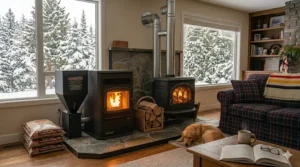
Canada has a well-developed regulatory framework for solid-fuel heating appliances, and navigating it confidently is part of buying the right stove.
CSA B415.1 is the key Canadian standard for performance testing of residential wood-burning appliances, including pellet stoves. Any model carrying this certification has been independently tested to Canadian safety and emissions requirements — not just the US EPA standard, which while rigorous, was developed for American regulatory frameworks.
The Canadian Standards Association (CSA Group) is actively advancing the adoption of European standard EN 303-5 for heating boilers burning solid biomass. Once adopted as a National Standard of Canada (anticipated Fall 2026), this will open the Canadian market to advanced European pellet boiler technology currently unavailable here.
Provincial wood-burning regulations vary. British Columbia’s Lower Mainland has the strictest controls, with Metro Vancouver’s Airshed Management Program imposing burn restrictions during high-pollution advisories. Ontario municipalities and Alberta have their own bylaws. Quebec’s Ministry of the Environment applies national emissions standards to new appliances.
Bilingual labelling: Under the federal Official Languages Act, appliances sold in Canada must carry instructions and safety warnings in both English and French. Most major brands (ComfortBilt, Castle, Drolet) comply with this standard. Verify before purchasing less well-known imports.
Insurance requirements: Most Canadian home insurance policies require CSA-certified appliances and professional installation for solid-fuel heaters. Failure to comply can void your policy in the event of a fire. Get written confirmation from your insurer before installing any stove.
FAQ
❓ Is a pellet stove worth it in Canada compared to a wood stove?
❓ How much do wood pellets cost per season in Canada?
❓ Do pellet stoves work during power outages in Canada?
❓ What CSA certification do I need for a pellet stove in Canada?
❓ Can I install a pellet stove without a chimney in Canada?
Conclusion: The Right Stove for a Very Cold Country
There is no universally correct answer in the pellet stove vs wood stove debate. But after reviewing the real products, the real costs (in real Canadian dollars), and the real conditions of a real Canadian winter, here’s what I’d tell you.
If convenience, clean air, and consistent automated heat are your priorities — and you live somewhere with reliable electricity and accessible pellet supply — a pellet stove is the better appliance. The ComfortBilt HP22 is the standout choice for most Canadian households: CSA certified, genuinely efficient, programmable, and available on Amazon.ca without cross-border drama.
If you’re rural, off-grid, or deeply uncomfortable with any dependency on electricity or fuel supply chains — or if you simply love the ritual of a real wood fire — a wood stove like the Drolet HT-2000 is the honest, durable, and deeply satisfying choice that will outlast everything else in your home.
The best stove is the one that matches how you actually live, in your actual house, in your actual part of this very large, very cold, endlessly interesting country.
✨ Ready to Upgrade Your Home Heating?
🔍 Click any highlighted product to check current pricing and availability on Amazon.ca. Whether you go pellet or wood, the right stove will change how you experience Canadian winter — for the better.
Recommended for You
- 7 Best Wood Stove for Off-Grid Cabin in Canada 2026
- 7 Best Small Wood Stove for Tiny House Canada 2026
- Best Wall Panel Heater Electric in Canada 2026: Top 7 Picks
Disclaimer: This article contains affiliate links. As an Amazon Associate, I earn from qualifying purchases. If you purchase products through these links, we may earn a small commission at no additional cost to you.
✨ Found this helpful? Share it with your friends! 💬🤗
