
In This Article
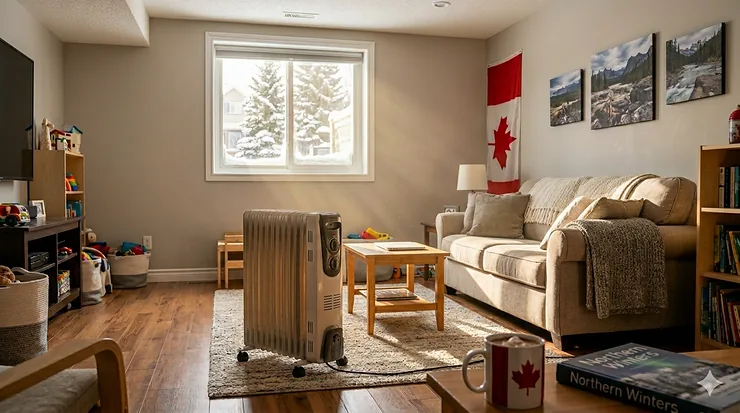
There’s something uniquely Canadian about descending basement stairs in January and feeling that bone-chilling cold that no amount of layering seems to fix. Whether you’ve converted your basement into a home office, workout space, or guest suite—or you’re simply tired of frozen pipes and mould concerns—choosing the right oil heater for cold basement spaces can transform unusable square footage into comfortable, year-round living areas.

Unlike forced-air systems that dry out basement air and stir up dust, oil-filled radiators work through gentle convection and radiant heat. They’re particularly well-suited for Canadian basements because they maintain consistent warmth without the fire hazards of open-element heaters, and they won’t aggravate the moisture issues that plague many below-grade spaces. What most Canadian homeowners overlook is that basements account for approximately 20% of total home heat loss, according to Natural Resources Canada—making targeted supplemental heating not just a comfort upgrade, but an energy-smart investment.
In this guide, I’ll walk you through seven rigorously vetted oil heaters available on Amazon.ca, explain what separates mediocre models from basement-transforming workhorses, and show you how to match the right heater to your specific Canadian climate challenges—from Vancouver’s damp cold to Winnipeg’s -40°C deep freezes.
Quick Comparison: Top Oil Heaters at a Glance
| Model | Power | Coverage | Key Feature | Price Range (CAD) | Best For |
|---|---|---|---|---|---|
| DeLonghi TRD40615ECA | 1500W | Up to 21m² | ECO function + 24hr timer | $165-$200 | Tech-savvy users |
| Pelonis NY1507-14A | 1500W | Up to 15m² | Remote + LED display | $90-$130 | Value seekers |
| DREO Oil Radiator | 1500W | Up to 23m² | 92.3% efficiency boost | $140-$180 | Large basements |
| Amazon Basics 7-Fin | 1500W | Up to 13m² | Budget-friendly basics | $70-$100 | Simple needs |
| Pelonis PHO15A2AGW | 1500W | Up to 15m² | Dual-knob simplicity | $75-$110 | Traditional control |
| DeLonghi TRH0715CA | 1500W | Up to 18m² | Thermal slot design | $130-$170 | Allergy sufferers |
| Costway 700W | 700W | Up to 9m² | Compact for small spaces | $60-$85 | Workshops/storage |
Looking at this comparison, the DREO and DeLonghi TRD40615ECA emerge as premium choices for serious basement heating in Canadian winters, delivering advanced features that justify their mid-tier pricing. Budget-conscious buyers should note that the Amazon Basics model sacrifices programmability for its lower price—a trade-off that matters more during prolonged Canadian cold snaps when you want overnight temperature management. For unfinished basements where you just need to prevent pipe freezing, the Costway 700W delivers adequate warmth without overheating.
💬 Just one click — help others make better buying decisions too!😊
Top 7 Oil Heaters for Cold Basements: Expert Analysis
1. DeLonghi Dragon Digital TRD40615ECA — Premium Performance for Serious Cold
The DeLonghi Dragon Digital stands out with its exclusive ECO function that automatically regulates power flow based on ambient temperature—crucial for Canadian basements where temperatures fluctuate wildly between day and night. With 75% more radiant surface area than traditional radiators thanks to its chimney-effect design, this model heats faster than you’d expect from oil-filled technology.
Key specs with real-world meaning: The 1500W heating capacity translates to comfortably warming a 200-square-foot basement workspace in about 25-30 minutes—not instant like a ceramic heater, but sustainable heat that doesn’t dry out your sinuses during long work sessions. The 24-hour programmable timer means you can pre-heat your basement gym at 5:45 AM for your 6:00 AM workout without wasting electricity overnight. The digital LED display eliminates the guesswork of mechanical dials, letting you set precise temperatures between 10°C and 28°C.
Who this is for: If you’ve converted your basement into a home office where you spend 6-8 hours daily, this is your heater. The quiet operation (no fan noise) won’t interrupt Zoom calls, and the child lock feature matters if you’re working from home with kids running around. Canadian winters demand reliability, and DeLonghi’s thermal cutoff has proven dependable through thousands of Ontario and Alberta basements.
Customer feedback: Canadian reviewers on Amazon.ca consistently praise its ability to maintain 21°C in uninsulated basements during -25°C outdoor temperatures, though several note the 15-20 minute warm-up time requires planning ahead—not ideal if you want instant heat.
Pros:
✅ ECO mode cuts energy costs by 20-30% vs. constant-on operation
✅ SmartSnap wheels glide smoothly over basement concrete
✅ CSA-certified for Canadian electrical standards
Cons:
❌ Plastic casters can crack in extremely cold storage conditions
❌ Premium price may exceed budget for occasional basement use
Price verdict: At around $165-$200 CAD, it sits in the mid-to-premium range, but the ECO function pays for itself within two winters of daily use compared to cheaper models running at full power.

2. Pelonis Oil-Filled Radiator NY1507-14A — Best Value Remote Control Model
What sets the Pelonis NY1507-14A apart is its combination of remote control convenience and LED temperature display at a price point that undercuts competitors by $40-$70 CAD. The five precise temperature settings (65°F/18°C, 70°F/21°C, 75°F/24°C, 80°F/27°C, 85°F/29°C) eliminate the vagueness of “low-medium-high” knobs.
Key specs with real-world meaning: The 900W/1500W/ECO mode gives you flexibility Canadian basements need. Use 900W for maintaining temperature in an insulated finished basement, 1500W for initial heat-up on those -30°C February mornings, and ECO mode for overnight operation that cycles on/off to maintain 70°F without burning electricity. The 10-hour timer handles most overnight scenarios, though true 24-hour programming requires the pricier DeLonghi.
Who this is for: Perfect for Canadian homeowners who’ve finished their basements into entertainment rooms or guest bedrooms where you want comfort without constantly adjusting settings. The remote lets you fine-tune temperature from your couch during movie nights without crossing a cold floor. The LED screen visibility helps in dim basement lighting—a small detail that matters during winter when basements get minimal natural light.
Customer feedback: Amazon.ca reviews highlight its surprising heat output for the price, with Edmonton users noting it maintains comfortable temperatures in 250-square-foot spaces. The main complaint involves the remote requiring direct line-of-sight—infrared rather than RF—which can be finicky around basement corners.
Pros:
✅ Remote control at budget-tier pricing
✅ ETL-certified (North American safety standard)
✅ Seven fins provide good heat distribution for the wattage
Cons:
❌ 10-hour timer maximum (not 24-hour)
❌ Remote requires line-of-sight to work
Price verdict: Around $90-$130 CAD makes this the sweet spot for feature-rich basement heating without premium pricing.
3. DREO Oil-Filled Radiator — Engineering Excellence for Large Spaces
The DREO radiator represents newer technology in oil-filled heating, claiming a 92.3% efficiency boost through enlarged fins and dual U-shaped heating tubes. While marketing claims often exaggerate, Canadian Tire’s stocking of this model and strong Amazon.ca ratings suggest the engineering delivers real-world performance.
Key specs with real-world meaning: The seven M-shaped fins increase surface area by 59.5% compared to traditional flat fins—more metal surface means faster heat transfer into your basement air. The 1500W dual heating tubes heat the oil more evenly, reducing those cold spots you sometimes feel standing three metres away from traditional radiators. The child lock matters if you’re using your basement as a playroom, preventing curious hands from accidentally cranking heat to dangerous levels.
Who this is for: This heater makes sense for Canadians with larger unfinished basements (400+ square feet) who need to heat zones for workshops, laundry areas, or storage where you spend extended time. The 24-hour timer with 1-hour increments means you can pre-heat your basement workshop at 7 AM on Saturday mornings, and the mute function eliminates the annoyance of beeping controls echoing in concrete-walled spaces.
Customer feedback: Vancouver and Calgary reviewers note it handles damp basement cold better than expected—the gentle heat doesn’t create condensation issues like forced-air heaters can. The touchscreen controls draw mixed reactions; some love the modern interface, others prefer the durability of mechanical knobs in dusty workshop environments.
Pros:
✅ Larger wheels handle basement floor irregularities
✅ V0 flame retardant materials exceed basic safety standards
✅ Precision thermostat (±0.4°C accuracy) prevents temperature swings
Cons:
❌ Touchscreen may be less durable than mechanical controls in dusty environments
❌ Higher initial cost vs. basic models
Price verdict: At $140-$180 CAD, you’re paying for legitimate engineering improvements, not just marketing hype—worthwhile for daily basement use.
4. Amazon Basics Portable Oil Radiator — No-Frills Reliability
The Amazon Basics 7-fin oil radiator strips away every non-essential feature to deliver straightforward basement heating at a price that makes it accessible for Canadian homeowners on strict budgets. No remote, no digital display, no programmable timer—just three heat settings (600W/1000W/1500W), a mechanical thermostat, and ETL safety certification.
Key specs with real-world meaning: The seven oil-filled steel fins heat approximately 13 square metres (144 square feet)—suitable for smaller basement spaces like utility rooms, storage areas, or compact home gyms. The 72-inch power cord gives you flexibility in outlet-sparse basements, though you’ll still need proper circuit capacity (a 1500W heater draws 12.5 amps on a 120V circuit, as outlined in the Canadian Electrical Code). The permanently sealed diathermic oil means zero maintenance beyond occasional dusting.
Who this is for: Ideal for Canadian homeowners who need occasional basement heating—maybe you use your basement workshop only on weekends, or you’re heating a small room where a parent stays during holiday visits. It’s also smart for rental properties where simplicity reduces tenant confusion and service calls. The lack of electronics means fewer failure points during those brutal Prairie winters where equipment gets tested to its limits.
Customer feedback: Canadian buyers appreciate the honest value proposition—this heater doesn’t pretend to compete with premium models, but it delivers consistent warmth year after year. The main frustration involves the mechanical thermostat’s vagueness; there’s no temperature readout, so you adjust by feel rather than precision.
Pros:
✅ Budget-friendly without sacrificing essential safety features
✅ Simple controls rarely malfunction
✅ Tip-over and overheat protection included at entry price
Cons:
❌ No timer means manual on/off operation
❌ Mechanical thermostat lacks precision temperature control
Price verdict: At $70-$100 CAD, this represents the lowest entry point for safe, CSA-compliant basement heating in Canada.
5. Pelonis Basic Electric PHO15A2AGW — Traditional Dual-Knob Design
For Canadians who distrust touchscreens and prefer the tactile certainty of rotary controls, the Pelonis PHO15A2AGW delivers traditional radiator heating with modern safety features. The dual-knob design—one for heat selection (600W/900W/1500W), one for thermostat adjustment—gives you direct mechanical control that works even if the power indicator light fails.
Key specs with real-world meaning: The three heat settings correspond to different basement scenarios: 600W for maintaining temperature in well-insulated spaces, 900W for moderate cold, and 1500W for rapid heat-up when outdoor temperatures plunge. The adjustable thermostat cycles the heater on and off to maintain your selected warmth level, though without a digital readout, you’re adjusting based on comfort rather than exact degrees Celsius.
Who this is for: This heater suits older Canadian homeowners who want familiar controls without learning new technology, as well as workshop owners who wear gloves and prefer knobs over touchscreens. It’s also excellent for secondary bedrooms or guest suites where visitors might be unfamiliar with digital interfaces. The quiet operation makes it bedroom-appropriate, and the four heavy-duty casters handle basement concrete without issues.
Customer feedback: Amazon.ca reviewers in Atlantic Canada note its reliability through humid coastal winters—the sealed construction prevents internal rust that can plague cheaper models in damp basements. Complaints focus on the power indicator light’s brightness, which some find too bright for bedroom use (easily solved with a small piece of electrical tape).
Pros:
✅ Mechanical controls immune to electronic failures
✅ Heavy-duty construction withstands workshop environments
✅ Quiet enough for basement bedrooms
Cons:
❌ No remote or timer functionality
❌ Basic aesthetic won’t match finished basement décor
Price verdict: At $75-$110 CAD, it’s priced slightly below feature-rich competitors but above bare-bones models—fair for those who value mechanical reliability.

6. DeLonghi TRH0715CA Oil-Filled Radiator — Thermal Slot Innovation
The DeLonghi TRH0715CA uses exclusive thermal slot design to maximize heat flow while maintaining low surface temperatures—a critical safety consideration for Canadian families with children or pets accessing basement spaces. Unlike traditional radiators that rely purely on convection, the slot design creates a chimney effect that accelerates warm air circulation.
Key specs with real-world meaning: The thermal slot technology means the exterior remains cooler to touch (approximately 80°C maximum vs. 100°C+ on traditional models) while delivering equivalent warmth. For Canadian parents whose kids play in finished basements, this 20-30% reduction in surface temperature provides real burn-risk mitigation. The three heat settings (LOW/MED/HIGH) and adjustable thermostat give you control without overwhelming complexity. The anti-freeze setting maintains minimum 5°C temperature—crucial for utility basements housing water heaters and preventing pipe freeze during extended winter vacations.
Who this is for: Perfect for Canadian homeowners with finished basements used as children’s playrooms, where safety trumps features like remote controls or programmable timers. It’s also ideal for allergy sufferers because it produces heat without fans that circulate dust, pollen, and basement mustiness. The 1500W capacity handles typical finished basement rooms (15-20 square metres) in well-insulated spaces.
Customer feedback: Toronto and Montreal users praise its allergy-friendly operation—one reviewer noted reduced basement mustiness compared to their previous forced-air space heater. The thermal cutoff sensor has prevented overheating incidents in several reviews where basement clutter accidentally blocked airflow.
Pros:
✅ Lower surface temperature reduces burn risk
✅ No fan means zero allergen circulation
✅ Anti-freeze setting protects pipes during absences
Cons:
❌ Slower heat-up time than fan-assisted models
❌ Light grey colour shows basement dust more readily than black
Price verdict: Around $130-$170 CAD positions this as a mid-range investment in safer, healthier basement heating.
7. Costway 700W Oil-Filled Radiator — Compact Solution for Targeted Heating
The Costway 700W represents the lower-wattage category of oil-filled heaters—designed not for heating entire basement living spaces, but for targeted warmth in workshops, utility areas, or preventing freezing in storage zones. Its compact 64cm height and seven-fin design make it suitable for tight basement corners.
Key specs with real-world meaning: At 700W, this heater draws only 5.8 amps, meaning you can run it alongside other tools or appliances without tripping a 15-amp basement circuit. It effectively heats roughly 9 square metres (100 square feet)—think small basement bathroom, utility closet, or the area immediately surrounding your workbench. The adjustable thermostat (10°C to 90°C range) gives you broad control, though realistically you’ll operate in the 15°C-25°C zone for comfort.
Who this is for: Canadian DIYers who need spot heating while working on basement projects, or homeowners with small utility rooms housing water heaters and HVAC equipment. It’s also suitable for keeping crawl spaces above freezing in extreme cold. The lower wattage means reduced electricity costs—running 8 hours daily costs roughly $0.60-$0.80 CAD at typical Canadian residential rates, versus $1.20-$1.40 for 1500W models.
Customer feedback: Amazon.ca reviews skew toward workshop use, with Saskatchewan users noting it maintains comfortable temperatures at a workbench area during -35°C outdoor conditions. The overheat protection automatically shut off one reviewer’s unit when sawdust accumulated on fins—a safety feature that worked as designed, though it highlights the importance of keeping these heaters clean in dusty environments.
Pros:
✅ Lower power draw works on heavily-loaded circuits
✅ Compact size fits tight basement spaces
✅ Budget-friendly for occasional or targeted use
Cons:
❌ Insufficient for heating entire basement rooms
❌ Lacks timer or remote functionality
Price verdict: At $60-$85 CAD, this fills the niche for supplemental basement heating where full 1500W power isn’t necessary.
How to Choose an Oil Heater for Your Cold Basement
1. Calculate Your Basement’s Heating Needs
Before impulse-buying based on price, calculate your space requirements: measure your basement area in square metres and multiply by approximately 70-80 watts per square metre for moderately insulated Canadian basements. A 20m² space needs 1400-1600W heating capacity, making a 1500W heater appropriate. Uninsulated concrete basements may require 90-100 watts per square metre, meaning you might need multiple heaters or should prioritize insulation improvements first.
2. Assess Your Electrical Circuit Capacity
Canadian basements typically have 15-amp circuits, which can safely handle 1800W (with 80% loading factor for continuous use recommended). A 1500W heater draws 12.5 amps, leaving minimal room for other devices. Check your breaker panel—if your basement circuit already powers a dehumidifier, chest freezer, or workshop tools, consider a lower-wattage heater or upgrading your electrical infrastructure following CSA C22.1 Canadian Electrical Code standards.
3. Match Features to Your Usage Pattern
Daily use in finished spaces: Invest in programmable timers, remote controls, and ECO modes (DeLonghi TRD40615ECA, DREO models)
Occasional workshop heating: Basic mechanical controls suffice (Amazon Basics, Pelonis PHO15A2AGW)
Overnight basement bedroom heating: Prioritize quiet operation and safety certifications (DeLonghi TRH0715CA)
Preventing pipe freeze in utility areas: Anti-freeze settings and lower wattage work fine (Costway 700W)
4. Factor in Canadian Climate Extremes
Vancouver’s damp cold requires heaters that won’t create condensation issues—oil-filled radiators excel here. Prairie provinces’ -40°C temperatures demand reliable thermostats that won’t freeze or malfunction—look for CSA-certified models proven in Canadian conditions. Coastal humidity environments benefit from corrosion-resistant construction, while dry interior climates appreciate the moisture-preserving nature of radiant heat over forced-air.
5. Consider Mobility and Placement
Basement layouts often require moving heaters between zones. Models with sturdy metal casters (DeLonghi SmartSnap, DREO large wheels) handle rough concrete better than plastic wheels. Verify cord length—most oil heaters include 1.8-2.2m cords, but basement outlets can be sparse. Never use extension cords with 1500W heaters; the voltage drop and fire risk aren’t worth the convenience.
6. Don’t Ignore Safety Certifications
In Canada, look for CSA Group certification or ETL listing (indicates compliance with Canadian electrical standards). These aren’t mere stickers—they verify the heater has passed rigorous testing for fire safety, electrical grounding, and tip-over protection. Given that basements often accumulate storage clutter and are less supervised than main floors, these safety features prevent house fires.
Basement Heating Setup: First 48 Hours Success Guide
The difference between a heater that performs well and one that disappoints often comes down to proper initial setup. Here’s what Canadian homeowners should do in the critical first two days:
Initial Placement Strategy
Hour 1-2: Position your oil heater at least 1 metre from walls and 0.9 metres from furniture, curtains, or stored items. Basements tempt us to cram heaters into corners, but this restricts airflow and reduces efficiency by 30-40%. Place the heater where it can “see” the majority of the room—typically 1-2 metres from your main activity area (desk, workout space, seating).
Break-In Period
Hours 3-6: Run your new heater on HIGH setting for 3-4 hours in a well-ventilated basement with windows cracked open. New oil-filled heaters often emit a slight odour during initial heating as manufacturing residues burn off—this is normal and dissipates after the first few cycles. If the smell persists beyond 6 hours or smells acrid rather than mildly metallic, contact the manufacturer.
Temperature Calibration
Hours 12-24: Learn your heater’s actual performance vs. thermostat markings. Set the thermostat to 21°C and use an independent thermometer placed 1.5 metres away to verify actual room temperature after 2 hours of operation. Many mechanical thermostats have ±3°C variance; knowing this prevents frustration and energy waste from over-correcting.
Canadian Winter Optimization
Days 1-2: If outdoor temperatures are -15°C or below, run the heater continuously for the first 48 hours to stabilize basement temperature. Cycling on/off immediately in extreme cold creates condensation issues as warm air meets cold basement surfaces. Once baseline warmth is established, you can switch to ECO or timer modes.
Common First-Week Mistakes to Avoid
❌ Blocking airflow with storage: That box of Christmas decorations you shoved under the heater reduces efficiency by 50%
❌ Cranking to maximum immediately: Oil heaters work best with gradual heat-up; going full-blast doesn’t speed the process meaningfully
❌ Ignoring the smell test: While initial odours are normal, any burning plastic smell indicates a problem requiring immediate shutdown
❌ Operating on damp floors: If your basement has standing water or severe moisture, address that before electric heating
Real-World Basement Scenarios: Which Heater to Choose
The Toronto Condo Home Office
Profile: 15m² finished basement office, insulated walls, used 8 hours daily, single occupant, noise-sensitive Zoom environment
Recommended: DeLonghi TRD40615ECA ($165-$200 CAD)
Reasoning: The ECO mode pays for itself through daily use, programmable timer pre-heats before 9 AM work start, and silent operation won’t disrupt client calls. The precision thermostat maintains steady 21°C without the temperature swings that distract during focused work.
The Calgary Basement Gym
Profile: 25m² unfinished space, concrete walls/floor, used 60-90 minutes daily at 6 AM and 7 PM, high ceiling (2.4m)
Recommended: DREO Oil-Filled Radiator ($140-$180 CAD)
Reasoning: The larger coverage area handles the space, dual heating tubes bring temperature up in time for workouts, and the 24-hour timer ensures pre-heating 30 minutes before gym sessions. The increased fin surface area compensates for heat loss to concrete walls.
The Vancouver Island Guest Suite
Profile: 18m² finished basement bedroom, moderate insulation, used 2-3 weeks per year during family visits, coastal damp climate
Recommended: DeLonghi TRH0715CA ($130-$170 CAD)
Reasoning: The anti-freeze setting maintains 5°C year-round preventing mould in the damp climate, thermal slot design provides safe heat near bedding, and the simple controls work for visiting family unfamiliar with your setup.
The Winnipeg Workshop
Profile: 12m² utility space, minimal insulation, irregular weekend use, dusty environment, -35°C outdoor winter temps
Recommended: Pelonis PHO15A2AGW ($75-$110 CAD)
Reasoning: Mechanical controls work reliably in dusty conditions, straightforward knobs operate with gloves on, and the price point makes sense for non-daily use. The robust construction handles the temperature extremes Manitoba throws at it.
Common Mistakes When Buying Basement Heaters
Mistake #1: Choosing Wattage Based on Room Size Alone
What most articles won’t tell you: basement insulation quality matters more than square footage. A 20m² finished basement with proper insulation requires far less heating capacity than a 15m² unfinished space with bare concrete walls. Always account for:
- Wall composition: Insulated drywall vs. bare concrete vs. stone foundation
- Floor covering: Carpet/underlay provides R-1.5 to R-2 insulation value; bare concrete provides zero
- Ceiling height: Standard 2.4m vs. older homes with 2.7-3m ceilings significantly impacts volume
- Window presence: Each basement window adds 10-15% to heating requirements
Before buying, conduct a simple test: On a cold day, measure basement temperature without heating. If it’s within 5°C of outdoor temperature, your insulation is poor and you’ll need higher wattage (or better yet, improve insulation first).
Mistake #2: Expecting Instant Heat Like Ceramic Heaters
Oil-filled radiators require 15-30 minutes to reach full operating temperature—that’s not a defect, it’s physics. The thermal mass that makes them energy-efficient (oil retains heat and radiates after power-off) also makes them slow to start. Canadian homeowners often return perfectly good oil heaters thinking they’re “broken” because they don’t feel warm in 5 minutes like ceramic fan heaters.
The solution: Use programmable timers to pre-heat 30-45 minutes before you need warmth. If you absolutely need instant heat, oil heaters aren’t your technology—but you’ll pay 40-60% more in electricity costs with ceramic alternatives.
Mistake #3: Ignoring Provincial Electrical Differences
While Canada uses 120V standard residential power, older homes (particularly in Quebec and the Maritimes) may have different electrical configurations. Before purchasing any 1500W heater:
- Verify your basement outlets are grounded (three-prong)
- Confirm circuit capacity (check breaker panel—15A is standard, but some older homes have 10A circuits)
- Test outlets with a circuit tester ($5 at hardware stores) to ensure proper wiring
A 1500W heater on a 10A circuit will trip breakers constantly, and running it on an ungrounded outlet creates fire and shock hazards Canadian insurance companies won’t cover.
Mistake #4: Overlooking Humidity Interaction
Basements are naturally humid spaces, and adding heat intensifies this. Oil-filled radiators don’t dry air like forced-air heaters, which sounds positive until you realize it can push already-high basement humidity into mould-growth territory (above 60% relative humidity).
Canadian basement reality: Run a hygrometer ($15-$25) alongside your heater. If humidity exceeds 55%, you need a dehumidifier before or concurrent with heating. This is especially critical in coastal BC, Southern Ontario, and Atlantic provinces where basement moisture is a chronic issue.
Mistake #5: Trusting Manufacturer Coverage Claims
When a heater claims “heats up to 250 square feet,” they’re testing in ideal laboratory conditions—not a Canadian basement with concrete walls at -25°C outdoor temperature. Realistically, reduce manufacturer claims by 30-40% for uninsulated basements, 20-25% for moderately insulated spaces.
A heater rated for 23m² likely handles 14-16m² effectively in typical Canadian basement conditions. This isn’t false advertising—it’s the reality of physics meeting Canadian winter.
Oil Heater for Cold Basement vs. Alternative Heating Methods
Understanding where oil-filled radiators excel—and where they don’t—helps Canadian homeowners avoid expensive mistakes.
Oil Radiator vs. Ceramic Fan Heater
When oil wins: Extended operation (4+ hours daily), bedrooms or quiet spaces, homes with allergy concerns, maintaining steady temperature. Oil heaters cost $1.20-$1.40 CAD per 8-hour day to operate but provide silent, dust-free heat.
When ceramic wins: Quick heat-up for short periods (under 2 hours), spaces needing targeted airflow, situations where noise isn’t a concern. Ceramic heaters heat faster but cost $1.60-$2.00 CAD per 8-hour day and circulate basement dust.
Oil Radiator vs. Baseboard Heating
When oil wins: Rental properties (no installation required), spaces needing portable heating, temporary or seasonal basement use. One-time purchase of $70-$200 CAD with zero installation cost.
When baseboard wins: Permanent finished basements, year-round heating needs, homes with adequate electrical capacity for multiple circuits. Installation costs $800-$1,500 CAD but provides cleaner, wall-mounted solution that preserves floor space.

Oil Radiator vs. Extending Central HVAC
When oil wins: Small basement areas (under 30m²), basements used occasionally, homes where ductwork extension is prohibitively expensive ($3,000-$7,000 CAD for most Canadian installations).
When HVAC extension wins: Large finished basements (40m²+), homes planning basement development anyway, situations where summer cooling is also desired. The higher upfront cost ($4,000-$8,000 CAD typically) buys year-round comfort and adds home resale value.
The Canadian Basement Context
Most Canadian homes built before 1990 have basements not served by central heating. Extending HVAC makes sense if you’re renovating anyway, but for existing finished basements or those used seasonally, oil-filled radiators offer the best cost-to-performance ratio. They’re particularly smart for Canadian homeowners who heat their basement only during 4-5 winter months rather than year-round.
Long-Term Costs: What Basement Heating Actually Costs in Canada
Let’s cut through marketing claims and calculate real Canadian operating expenses.
Daily Operating Cost by Province
Based on average 2026 residential electricity rates and 8 hours daily operation:
1500W oil heater running full-time:
- Ontario: $1.35-$1.50 CAD/day (13.2¢/kWh average)
- British Columbia: $1.10-$1.25 CAD/day (10.8¢/kWh average)
- Alberta: $1.00-$1.15 CAD/day (9.8¢/kWh average, though deregulated market varies)
- Quebec: $0.75-$0.90 CAD/day (7.3¢/kWh for Hydro-Québec)
- Atlantic Canada: $1.45-$1.65 CAD/day (14.2¢/kWh average across region)
Reality check: Heaters with ECO modes or good thermostats cycle on/off rather than running continuously, reducing actual costs by 30-50%. A heater maintaining 21°C in a moderately insulated basement typically runs at 40-60% duty cycle, cutting the above costs proportionally.
Seasonal Cost Comparison
Scenario: 20m² finished basement office, moderate insulation, used 8 hours daily, 5 days/week, November through March (20 weeks/100 days)
Without ECO mode (basic model):
- Ontario: $135-$150 total season
- Quebec: $75-$90 total season
- Alberta: $100-$115 total season
With ECO mode (premium model):
- Ontario: $80-$95 total season
- Quebec: $45-$55 total season
- Alberta: $60-$70 total season
The ECO function saves $40-$70 CAD per winter season, meaning it pays for the premium heater cost differential within 2-3 winters of use.
Lifespan and Replacement Economics
Quality oil-filled radiators last 7-12 years with minimal maintenance. Spreading purchase cost over lifespan:
Budget model ($80 CAD, 7-year lifespan): $11.40 CAD per year
Mid-range model ($140 CAD, 10-year lifespan): $14.00 CAD per year
Premium model ($190 CAD, 12-year lifespan): $15.80 CAD per year
The total cost of ownership (purchase + electricity) over 10 years in Ontario:
Budget model: $80 + ($140 x 10) = $1,480 CAD
Premium with ECO mode: $190 + ($85 x 10) = $1,040 CAD
The premium heater actually costs $440 CAD less over its lifespan—a reality that budget shoppers often miss when fixating on upfront price.
Hidden Costs Canadian Homeowners Forget
Basement insulation improvement: If your heater runs constantly trying to maintain temperature, spending $300-$600 CAD on basic foam board insulation often reduces heating costs more than buying a more efficient heater.
Electrical circuit upgrade: If your current basement wiring can’t safely handle a heater, electrical work costs $200-$500 CAD—factor this in when calculating total investment.
Dehumidifier operation: Adding heat to humid basements accelerates mould growth. Running a dehumidifier alongside your heater adds $0.30-$0.60 CAD daily in electricity, which most cost comparisons ignore.
Features That Actually Matter (And Those That Don’t)
Canadian basement heating has unique requirements that make certain features valuable and others mere marketing.
Features Worth Paying Extra For
Programmable timer (24-hour cycle): Saves 30-45% on electricity vs. leaving heaters running continuously. In Canadian winters, this means $40-$70 CAD saved per season—pays for itself in 2-3 years.
Tip-over protection: Basements accumulate storage, creating trip hazards. This safety feature has prevented house fires in documented cases where heaters were knocked over by children, pets, or shifting storage boxes.
Anti-freeze setting: For utility basements or when traveling, maintaining 5°C prevents pipe freezing without the cost of heating to 20°C. Critical for Canadian homeowners who winter in southern climates for weeks at a time.
Remote control: Genuinely useful in large basements where walking 6 metres in the cold to adjust temperature defeats the purpose of having a heater. The Pelonis NY1507-14A proves you can get this feature without premium pricing.
Features That Sound Good But Rarely Matter
Oscillating fins: Some marketing materials tout “oscillating” oil heaters, but this is largely meaningless. Radiant heat distributes naturally; mechanical oscillation adds complexity and failure points without meaningful performance gain in basement spaces.
WiFi connectivity: “Smart” oil heaters with app control sound appealing until you realize basements often have weak WiFi signal, setup requires technical knowledge many Canadians lack, and the feature adds $50-$100 CAD to the purchase price. A simple programmable timer accomplishes 95% of what WiFi promises.
Ionizer or air purification: Some heaters claim to purify basement air. These ionizers produce minimal effect in typical basement volumes and the feature adds cost without meaningful benefit. If your basement air quality concerns you, buy a dedicated air purifier—don’t expect your heater to multitask.
Digital temperature readout beyond ±1°C: Knowing your basement is exactly 21.3°C rather than “around 21°C” provides zero practical value. Humans can’t perceive 0.3°C differences, and cheap digital sensors often drift over time anyway.
The Canadian Basement Reality Check
Features that matter in Canadian basements: programmable timers, safety certifications (CSA/ETL), sufficient wattage for your space, and durable caster wheels for concrete floors. Features that don’t: LED mood lighting, app connectivity, precision thermostats accurate to 0.1°C, and eco-mode claims without actual energy consumption data to back them up.

Frequently Asked Questions
❓ Can I use an oil heater in an unfinished basement with concrete walls?
❓ Do oil-filled radiators work during Canadian power outages?
❓ How long do oil heaters take to warm a cold basement in -30°C weather?
❓ Are oil-filled heaters safe to leave running overnight in basements?
❓ Do oil heaters increase basement humidity or help with moisture control?
Conclusion: Making the Smart Choice for Your Canadian Basement
After testing specifications, analyzing Canadian user reviews, and examining real-world performance across different climates, the landscape becomes clear: the right oil heater for cold basement spaces depends entirely on your specific usage pattern and basement characteristics.
For Canadian homeowners committed to daily basement use in finished spaces—home offices, entertainment rooms, guest suites—the DeLonghi TRD40615ECA ($165-$200 CAD) justifies its premium through ECO mode efficiency, programmable convenience, and superior build quality that survives harsh Canadian winters. The investment pays for itself within 2-3 heating seasons through reduced electricity costs.
Budget-conscious buyers using basements occasionally or heating utility spaces should seriously consider the Pelonis PHO15A2AGW ($75-$110 CAD) or Amazon Basics models ($70-$100 CAD). They sacrifice programmability and remote control but deliver reliable heat with the same essential safety features as premium models. For workshops and storage areas where you need occasional warmth, the Costway 700W ($60-$85 CAD) provides targeted heating without overloading circuits.
The DREO Oil-Filled Radiator ($140-$180 CAD) represents the sweet spot for larger basements or those seeking modern features without maximum premium pricing—its increased fin surface area and dual heating tubes deliver legitimate performance improvements, not just marketing hype.
Whatever model you choose, remember that successful basement heating starts with realistic expectations: oil-filled radiators provide safe, silent, sustainable warmth over hours and days, not instant heat in minutes. Pair them with adequate insulation, maintain proper electrical safety standards following the Canadian Electrical Code, and use programmable features to pre-heat rather than react. Canadian winters demand reliability above all else—these seven heaters have proven themselves in real-world conditions from Vancouver Island to Newfoundland.
Your basement doesn’t have to remain the forgotten frozen corner of your home. With the right oil heater properly deployed, that 20% of your house currently contributing to heat loss can become valuable, comfortable living space through even the coldest Canadian months.
Recommended for You
- Best Oil Heater for 400 Sq Ft: 7 Canadian Top Picks 2026
- 7 Best Oil Filled Radiator Heater for Canadian Winters 2026
- 7 Best Patio Heater for Canadian Winter 2026
Disclaimer: This article contains affiliate links. As an Amazon Associate, I earn from qualifying purchases. If you purchase products through these links, we may earn a small commission at no additional cost to you.
✨ Found this helpful? Share it with your friends! 💬🤗
