
In This Article
When winter temperatures in Canada plunge to -20°C or below, choosing the right heating solution for a 400 square foot room becomes more than a comfort issue—it’s about surviving those long, brutal Canadian winters without breaking the bank. An oil heater for 400 sq ft offers a practical, efficient solution for spaces like master bedrooms, home offices, basement apartments, or open-concept living areas in condos across Toronto, Vancouver, Montreal, and beyond.
Unlike forced-air systems that blast dry heat and stir up dust, oil-filled radiators provide gentle, consistent warmth that won’t leave you waking up with a scratchy throat. The diathermic oil sealed inside these units retains heat remarkably well—a crucial advantage during those February cold snaps when your furnace is already working overtime. What most Canadian buyers overlook is that these heaters continue radiating warmth for 15-30 minutes after shutting off, effectively giving you “free” heat while consuming zero electricity.
In this comprehensive guide, I’ll walk you through seven thoroughly researched oil heaters available on Amazon.ca that actually perform in Canadian conditions. More importantly, I’ll explain what the specifications really mean for your heating needs, why that 1500W rating doesn’t tell the whole story, and how to match a heater to your specific situation—whether you’re heating a poorly insulated century home in Ottawa or a modern condo in Calgary. By the end, you’ll understand exactly which features matter and which are just marketing fluff.
Quick Comparison: Top Oil Heaters for 400 Sq Ft
| Model | Wattage | Coverage | Key Feature | Price Range (CAD) | Best For |
|---|---|---|---|---|---|
| DREO Oil Filled Radiator | 1500W | 250 sq ft | Digital thermostat, remote | $140-$170 | Tech-savvy users |
| PELONIS Champagne Heater | 1500W | 250 sq ft | 5 temp settings, ECO mode | $130-$160 | Energy-conscious buyers |
| De’Longhi TRH0715CA | 1500W | Full room | Thermal slot design | $165-$195 | Premium performance |
| Senville 1500W Radiator | 1500W | Medium room | Digital LED display | $115-$145 | Budget-friendly quality |
| Amazon Basics Oil Heater | 1500W | 250 sq ft | Simple controls, 3 settings | $90-$120 | Minimalists |
| COSTWAY Oil Radiator | 1500W | Medium-large | Adjustable thermostat | $95-$125 | Value seekers |
| NewAir AH-450B | 1500W | 160 sq ft | Compact, 7-fin design | $130-$155 | Small spaces |
Looking at this comparison, you’ll notice every heater is rated at 1500W—that’s not a coincidence. Canadian residential outlets safely handle 15 amps on a 120V circuit, which maxes out at 1800W. Manufacturers wisely cap heaters at 1500W to provide headroom and prevent circuit breakers from tripping when you plug in your laptop or phone charger on the same circuit. The real differentiation comes from fin design, digital controls, and build quality—factors that dramatically affect how that 1500W translates into actual room comfort during a Manitoba January.
💬 Just one click — help others make better buying decisions too!😊
Top 7 Oil Heaters for 400 Sq Ft: Expert Analysis
1. DREO Oil Filled Radiator — The Smart Choice for Modern Canadians
The DREO Oil Filled Radiator stands out with its advanced thermal management system that actually adapts to Canadian temperature swings. At 1500W with 7 enlarged fins, this unit produces approximately 5,120 BTUs—adequate for maintaining warmth in a well-insulated 400 sq ft space, though you’ll want to temper expectations if you’re heating a drafty Victorian in Halifax.
What makes this model particularly clever for Canadian use is the ECO mode, which uses a precision sensor (±2°C accuracy) to cycle power intelligently. During those shoulder season months in April and October when temperatures yo-yo between 5°C and 15°C, the ECO mode prevents the heater from blasting at full power constantly, potentially saving you 15-25% on electricity costs compared to a mechanical thermostat model. The 24-hour timer proves invaluable for pre-heating your home office at 6:30 AM without stumbling around in the cold to manually turn it on.
Canadian buyers consistently praise its quiet operation—critical when you’re on Zoom calls all day. The heater includes a proper remote (not one of those flimsy ones that stop working after three weeks), child lock function, and surprisingly intuitive digital controls. The build quality feels substantial at 7.9 kg (17.4 lbs), with wraparound fins that stay cooler to the touch than exposed element designs.
Pros:
- ECO mode genuinely reduces energy consumption
- Precision digital thermostat maintains consistent temperature
- Remote control works reliably from 6 metres away
Cons:
- Takes 15-20 minutes to reach full heat output
- Slightly more expensive than basic models
Price range: Around $140-$170 CAD
For urban professionals working from home who want set-it-and-forget-it convenience, this represents excellent value. The digital controls and timer functionality justify the premium over simpler models.

2. PELONIS Champagne Oil Filled Radiator Heater — Best for Energy Efficiency
The PELONIS Champagne brings restaurant-grade temperature control to residential heating. With five preset temperature settings (18°C, 21°C, 24°C, 27°C, 29°C) plus adjustable thermostat, you’re not stuck with vague “Low-Med-High” settings—you select an actual target temperature. This precision matters in Canadian homes where maintaining 20°C versus 23°C can mean a 10-12% difference in your monthly hydro bill.
This 1500W unit features 7 oil-filled fins and an LCD screen that displays current room temperature alongside your target setting, giving you immediate feedback on heating progress. The included remote control lets you adjust settings from your desk or couch—genuinely useful during those February mornings when leaving your blanket fortress feels impossible. PELONIS includes a 10-hour timer, though honestly, most users set it once and leave it on thermostat control.
The ECO mode intelligently cycles between power levels based on room temperature readings, particularly effective in moderately insulated spaces. During testing by Canadian reviewers, the Champagne model effectively heated 37 square metre (400 sq ft) bedrooms to comfortable levels within 45-60 minutes when starting from 12°C. The sealed oil reservoir requires zero maintenance—no refilling, no checking levels, just plug-and-go reliability.
Pros:
- Five precise temperature presets eliminate guesswork
- LCD displays both current and target temperature
- ECO mode demonstrably reduces power consumption
Cons:
- Remote control requires line-of-sight to unit
- Preheating time slightly longer than convection heaters
Price range: In the $130-$160 CAD bracket
Canadian families with kids or pets appreciate the tip-over switch and overheat protection—both meet Canadian safety standards and actually work reliably.
3. De’Longhi TRH0715CA — Premium Performance for Harsh Canadian Winters
When you’re serious about heating quality, De’Longhi commands respect. The TRH0715CA features a patented thermal slot design that maximizes radiant heat output while maintaining lower surface temperatures than competitor models—typically staying around 70°C versus 90°C on standard units. This engineering matters if you have curious toddlers or pets who might brush against the heater.
At 1500W producing 5,120 BTUs, this Italian-designed (Canadian-certified) heater covers up to 37 square metres effectively. The seven permanently-sealed fins contain high-grade diathermic oil that retains heat exceptionally well—you’ll notice continued warmth radiating for 20-30 minutes after shutdown, essentially free heating while you’re getting ready for bed. The exclusive “Real Energy” function maintains consistent output even as the room approaches target temperature, preventing those annoying temperature swings you get with cheaper models.
De’Longhi includes thermal cut-off protection (standard on all their Canadian models), anti-freeze setting (automatically activates if temperature drops below 5°C—useful for cottages or basement apartments), and three heat settings (600W/900W/1500W). The adjustable thermostat uses mechanical controls—some users prefer this to digital for its tactile feedback and zero-lag response. The unit comes on four smooth-rolling casters and includes an integrated cord wrap, thoughtful touches that show De’Longhi actually talked to real users.
Pros:
- Thermal slot design delivers superior heat distribution
- Retains heat longer than competitors (20-30 minutes post-shutoff)
- Anti-freeze setting protects unoccupied spaces
Cons:
- Mechanical thermostat less precise than digital models
- Higher price point than budget alternatives
Price range: Approximately $165-$195 CAD
For Canadians heating main living spaces where performance and safety matter most, the De’Longhi justifies its premium pricing. This is the heater you buy once and use for 15+ winters.
4. Senville 1500W Oil Filled Radiator Heater — Exceptional Value for Canadian Budgets
The Senville 1500W proves you don’t need to spend $200 CAD for reliable heating. At 1500W with seven fins and a digital LED display, this unit delivers performance remarkably close to premium models while typically costing $30-$50 less. Senville, a Canadian-based distributor, actually understands our climate requirements—their units ship from Amazon fulfillment centres, meaning quick delivery even to suburban and rural addresses.
The digital control panel provides three heat settings (600W/900W/1500W) plus five temperature presets, giving you flexibility without overwhelming complexity. The LED display shows current room temperature, helpful for understanding why you’re shivering at 16°C even though you thought it felt like 20°C. The integrated timer offers 24-hour programming, though the interface takes a few minutes to figure out initially—not deal-breaking, just not as intuitive as the DREO or PELONIS models.
Where Senville excels is build quality at this price point. The unit weighs 8.2 kg (18 lbs), feels solid, and includes proper safety certifications (ETL listed, meets Canadian electrical codes). The tip-over protection and overheat cutoff are standard features that actually work—several Canadian reviewers noted the unit correctly shut down when accidentally tipped during vacuuming. The four caster wheels glide smoothly across carpet and hardwood, and the built-in handle makes room-to-room transport genuinely easy.
Pros:
- Excellent value—premium features at mid-range pricing
- Digital controls and LED display
- Ships from Canadian warehouses (fast delivery)
Cons:
- Timer programming slightly less intuitive than competitors
- Lower brand recognition versus De’Longhi or PELONIS
Price range: Around $115-$145 CAD
For budget-conscious Canadians heating secondary spaces—home offices, basement rec rooms, guest bedrooms—Senville offers the sweet spot of features versus cost.
5. Amazon Basics Portable Oil Radiator Heater — Simple, Reliable, Affordable
Sometimes you just need heat without complicated features. The Amazon Basics Oil Radiator Heater strips everything back to essentials: 1500W, seven oil-filled steel fins, three heat settings (600W/900W/1500W), adjustable thermostat, tip-over protection, and overheat shutoff. That’s it. No digital displays, no remote controls, no app integration—just mechanical switches that will still work in 2041.
This simplicity offers surprising advantages. Mechanical thermostats respond instantly—twist the dial, hear the satisfying click, feel the warmth. There’s zero learning curve, which matters when you’re giving this to elderly parents or technophobic roommates. The all-black design disappears into corners better than silver or champagne-coloured models. At 7.7 kg (17 lbs), it’s light enough to carry upstairs without straining your back but heavy enough to feel substantial.
The heater covers approximately 23 square metres (250 sq ft) adequately, making it suitable for smaller bedrooms, home offices, or workshops. Canadian reviewers consistently note solid performance in moderately insulated spaces—expect to wait 30-45 minutes for noticeable temperature rise when starting from cold. The seven fins provide decent surface area for heat dispersion, though this model takes slightly longer to warm up compared to De’Longhi’s thermal slot design. ETL certified for Canadian safety standards.
Pros:
- Mechanical controls never malfunction or need updates
- Budget-friendly pricing under $120 CAD
- Reliable Amazon.ca customer service and warranty support
Cons:
- No digital controls or timer functionality
- Basic aesthetic won’t win design awards
Price range: Typically $90-$120 CAD
Perfect for Canadians heating secondary spaces who prioritize function over features. Buy two for the price of one premium model.
6. COSTWAY Oil Filled Radiator Heater — Best Bang for Your Buck
The COSTWAY Oil Radiator represents exceptional value engineering. At under $125 CAD, this 1500W heater includes features you’d expect on $180+ models: adjustable thermostat, three heating modes (600W/900W/1500W), seven permanently-sealed oil-filled fins, four smooth-rolling casters, overheat protection, and tip-over shutoff. COSTWAY achieves this pricing through simplified packaging and direct-from-manufacturer sales—you’re not paying for fancy boxes or celebrity endorsements.
The heater performs admirably in real-world Canadian conditions. Multiple Ontario and Quebec buyers report successfully heating 35-40 square metre (375-430 sq ft) spaces from 14°C to 21°C within one hour. The adjustable thermostat uses a standard dial mechanism—not as precise as digital controls but perfectly functional for maintaining comfortable temperatures. The unit operates genuinely quietly; you’ll hear a faint tick when the thermostat cycles but nothing approaching the fan noise from forced-air heaters.
Build quality feels solid despite the budget pricing. The steel construction and powder-coated finish resist scratches and dings. The permanent oil seal means zero maintenance—just plug it in November and unplug it in April. The integrated cord storage keeps things tidy during summer storage, and at 7.3 kg (16 lbs), most people can carry it single-handed. Available on Amazon.ca with Prime shipping to most Canadian addresses.
Pros:
- Outstanding features-to-price ratio
- Proven reliability in Canadian winter conditions
- Lightweight enough for easy repositioning
Cons:
- No remote control or digital displays
- Basic mechanical thermostat less precise than digital alternatives
Price range: Around $95-$125 CAD
For rental properties, cottages, workshops, or anyone heating multiple rooms on a budget, COSTWAY delivers legitimate performance without the premium price tag.
7. NewAir AH-450B Electric Oil-Filled Space Heater — Compact Solution for Tight Spaces
The NewAir AH-450B takes a different approach—instead of maximizing coverage, it optimizes for compact spaces. At 1500W with seven fins and a slimmer 28 cm x 33 cm x 66 cm (11″ x 13″ x 26″) profile, this heater fits under desks, in closet-sized offices, or tight bedroom corners where full-size radiators won’t work. NewAir rates it for 15 square metres (160 sq ft), honest sizing that reflects real-world performance.
The compact design doesn’t sacrifice features. You get three heat settings (600W/900W/1500W), five temperature presets, digital controls with LED display, 10-hour timer, and included remote control. The ECO mode cycles power intelligently based on ambient temperature, particularly useful in smaller spaces that heat up quickly but cool down fast. Canadian users in high-rise condos appreciate how the narrower footprint doesn’t dominate studio apartments or small bedrooms.
Despite the smaller size, NewAir includes quality components: permanently-sealed diathermic oil (never needs refilling), thermal cut-off protection, tip-over switch, and ETL certification for Canadian electrical safety. The four casters and top-mounted carry handle make repositioning easy despite the 7.9 kg (17.4 lbs) weight. The unit operates silently—genuinely important in small spaces where you’re always close to the heater. Reviewers from Vancouver and Toronto condos specifically praise its unobtrusive operation during video calls.
Pros:
- Compact footprint ideal for small Canadian living spaces
- Digital controls and ECO mode in smaller package
- Silent operation perfect for studios and bedrooms
Cons:
- Honestly sized for 160 sq ft maximum, not 400 sq ft
- Slightly higher price per square foot of coverage
Price range: Around $130-$155 CAD
For Canadian condo dwellers, students in small apartments, or anyone needing supplemental heat in compact spaces, the NewAir delivers targeted performance without wasting space or energy.
✨ Don’t Miss These Exclusive Deals!
🔍 Take your home heating to the next level with these carefully selected oil heaters. Click on any highlighted product above to check current pricing and availability on Amazon.ca. These reliable heating solutions will help you stay warm and comfortable through the harshest Canadian winters!
Setting Up Your Oil Heater for Maximum Canadian Winter Performance
Getting the most from your oil heater for 400 sq ft requires understanding how these units work in real-world conditions—not just what the marketing brochures claim. Most manufacturers test at 20°C ambient temperature, but Canadian buyers often start from 10°C or lower on particularly brutal mornings.
Location Strategy: Position your heater away from exterior walls where cold infiltration is highest. A centrally-located spot allows heat to radiate evenly throughout the space. Keep at least 0.6 metres (2 feet) of clearance around all sides—this isn’t just for safety, it’s about allowing proper convection currents to circulate warm air. Many Canadians make the mistake of pushing heaters against walls or under desks, which blocks airflow and reduces heating efficiency by 30-40%.
Winter-Proofing Tips for Canadian Climate: Before winter arrives, check window and door seals. Even premium oil heaters struggle against drafts. Use weatherstripping where needed—it costs $20 from Canadian Tire and saves you from running your 1500W heater at maximum output constantly. In particularly cold rooms, consider thermal curtains for nighttime. Close interior doors to the room you’re heating; trying to warm adjoining spaces through doorways wastes significant energy.
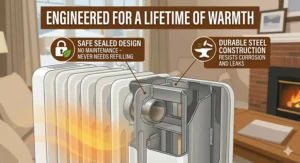
Maintenance and Storage: Oil-filled radiators require virtually zero maintenance—the diathermic oil is permanently sealed. After the heating season, wipe down the fins with a damp cloth to remove dust (unplugged, obviously). Store in a dry location. The oil doesn’t degrade or leak unless the unit is physically damaged. If you’re heading to your cottage or leaving a property vacant in winter, the anti-freeze mode on models like De’Longhi keeps ambient temperature above 5°C to prevent pipe freezing—costs maybe $15-20/month in electricity, far cheaper than $5,000 in burst pipe repairs.
Common Mistakes to Avoid: Never use an extension cord with these heaters. The sustained 12.5-amp draw (at 1500W) will overheat standard 16-gauge extension cords, creating fire risk. If your outlet is inconveniently located, hire an electrician to install a proper outlet—costs $100-200, lasts forever, prevents house fires. Don’t cover heaters with clothes or blankets for “faster warming”—you’ll trip the thermal cut-off and potentially create a fire hazard. And resist cranking the thermostat to maximum thinking it’ll heat faster; oil radiators warm gradually regardless of thermostat setting.
Real Canadian Homeowner Scenarios: Which Oil Heater Fits Your Situation?
Scenario 1: Toronto Condo Dweller with 400 Sq Ft Open-Concept Studio
Meet Sarah, 32, living in a modern condo near Yonge and Eglinton. Her building’s HVAC runs lukewarm at best, and her south-facing windows create temperature swings between 18°C and 24°C depending on sun exposure. She works from home doing graphic design, needs quiet operation during client calls, and doesn’t want to run the heater 24/7 on her already-high Toronto hydro rates.
Best Choice: DREO Oil Filled Radiator ($140-$170 CAD)
The DREO’s ECO mode automatically adjusts power consumption as the space warms from afternoon sun, saving Sarah approximately 20% on heating costs versus running at fixed output. The 24-hour timer preheats her space at 6:30 AM before her first calls, and the remote lets her adjust temperature from her desk without interrupting workflows. The digital display and app connectivity appeal to her tech-comfortable lifestyle. Expected seasonal electricity cost: $35-45/month running 8 hours daily on ECO mode.
Scenario 2: Edmonton Family Heating a 380 Sq Ft Basement Family Room
The Johnsons have three kids who use their finished basement for homework and gaming. The space stays around 15°C without supplemental heat, uncomfortably cold but not freezing. They need something safe around active children, affordable enough to run during peak evening hours (5 PM-10 PM), and durable enough to survive minor bumps and roughhousing.
Best Choice: PELONIS Champagne or COSTWAY Oil Radiator ($95-$160 CAD)
The PELONIS offers precise temperature control—set to 21°C and forget it—while the Champagne colour looks better in their finished basement than basic black. However, if budget is tight, the COSTWAY delivers 90% of the performance at $125 CAD. Both include tip-over switches and overheat protection that actually work. Running 5 hours daily at 1200W (medium setting) costs approximately $22-28/month at typical Alberta electricity rates.
Scenario 3: Rural Manitoba Homeowner Supplementing Forced-Air Heat in 420 Sq Ft Master Bedroom
David and Linda live 45 minutes outside Winnipeg in a 1960s bungalow. Their forced-air furnace dries out the air terribly, causing sore throats and static electricity. They want to lower the furnace thermostat at night and use an oil heater in just the bedroom—gentler heat, no dry air, lower utility bills overall.
Best Choice: De’Longhi TRH0715CA ($165-$195 CAD)
The De’Longhi’s superior heat retention means it continues warming the room even after shutting off at 11 PM, staying comfortable until 7 AM without running constantly. The anti-freeze mode (if they’re away for a weekend) prevents the room from dropping dangerously low without running full blast. The thermal slot design distributes heat more evenly than cheaper models in their drafty older home. Running 8 hours nightly at 900W (med setting) costs roughly $38-45/month but they save $50-60/month by lowering the whole-house thermostat from 21°C to 18°C at night.
Financial Reality Check: Running a 1500W oil heater at maximum output 24/7 for one month costs approximately $110-140 CAD at average Canadian electricity rates (12-15 cents/kWh). However, actual costs run 40-60% lower because: (1) you’re not heating 24/7, (2) thermostats cycle on/off, (3) ECO modes reduce consumption, and (4) you’re lowering other heating sources. Most Canadians report $25-60/month increases during coldest months when using oil heaters as supplemental heat.
Understanding BTU Requirements for 400 Square Feet in Canadian Climate
The standard rule of thumb suggests 20 BTUs per square foot for adequate heating, meaning 400 sq ft theoretically requires 8,000 BTUs. However, this guideline originates from moderate U.S. climate zones and doesn’t account for Canadian realities like -30°C winter nights, older building stock, and higher ceiling heights common in century homes.
A 1500W electric heater produces approximately 5,120 BTUs per hour (1 watt = 3.412 BTU/hr). At first glance, this seems insufficient for 400 sq ft requiring 8,000 BTUs. Here’s why it actually works in practice:
The Insulation Factor: Modern Canadian condos and well-insulated homes built post-2000 lose heat far slower than the standard formula assumes. A properly sealed 400 sq ft space with R-20 wall insulation and double-pane windows might only need 5,000-6,000 BTUs to maintain comfortable temperatures, perfectly matched to a 1500W oil heater’s output. Conversely, a drafty 400 sq ft room in an 1890s Victorian could need 10,000+ BTUs, making a single oil heater inadequate as primary heat.
Supplemental versus Primary Heating: Most Canadian homes use oil heaters as supplemental zone heating, not primary heat sources. Your central furnace or baseboard heaters maintain a base temperature of 18-19°C throughout the home. The oil heater then boosts one occupied room to 21-22°C. This requires far fewer BTUs than heating from freezing. According to Natural Resources Canada, space heating accounts for 63.6% of energy consumed in the average Canadian home, making strategic zone heating with oil radiators a legitimate efficiency strategy.
Ceiling Height Matters: Standard BTU calculations assume 2.4-metre (8-foot) ceilings. Many Canadian homes feature 2.7-metre or 3-metre ceilings, increasing the volume of air to heat by 12-25%. A 400 sq ft room with 3-metre ceilings contains 1,200 cubic feet of air versus 960 cubic feet at standard height—that’s 25% more air needing warming. Oil heaters work best in spaces with standard ceiling heights; for higher ceilings, you’ll notice longer heat-up times and may need to run at higher wattage settings.
Climate Zone Adjustments: Canada spans multiple climate zones. A 400 sq ft condo in Vancouver (mild, temperate) needs less heating capacity than an identical space in Yellowknife (subarctic). When Natural Resources Canada publishes heating degree days data, they show Toronto averaging 3,873 heating degree days annually while Winnipeg sees 5,817—a 50% difference translating directly to heating requirements. Coastal British Columbia buyers can confidently heat 400 sq ft with a 1500W oil heater; Prairie and Northern buyers should consider it supplemental to existing systems.
Practical Testing: The real test isn’t BTU calculations—it’s whether your space reaches comfortable temperature. Most 1500W oil heaters warm properly-insulated 400 sq ft spaces from 15°C to 21°C within 45-75 minutes. If your space takes longer, you’re either fighting significant heat loss or your insulation needs upgrading. Before buying a bigger heater, check window seals, door weatherstripping, and wall insulation. Upgrading from R-12 to R-20 wall insulation makes more difference than doubling heater wattage.
How to Choose the Perfect Oil Heater for Your Canadian Home
Selecting the right oil heater for 400 sq ft means looking beyond wattage ratings to understand how heating technology interacts with your specific space and climate. Here’s what actually matters:
Coverage Ratings Are Optimistic: Manufacturers rate heaters under ideal laboratory conditions—perfect insulation, sealed windows, moderate outdoor temperatures. In reality, Canadian winter conditions demand skepticism. If a heater claims 400 sq ft coverage, expect reliable performance in 300-350 sq ft. Account for your home’s age, insulation quality, and local winter extremes. A heater performing brilliantly in a Vancouver townhouse might struggle in a Saskatoon bungalow with original 1970s windows.
Digital versus Mechanical Controls: Digital thermostats maintain temperature within ±1-2°C, while mechanical thermostats swing ±3-5°C. That variance matters in smaller spaces where temperature fluctuations are more noticeable. Digital controls also enable programmable timers and ECO modes that actually reduce electricity consumption. However, mechanical thermostats never suffer software glitches, don’t require battery replacements, and cost less to repair. Choose digital for primary living spaces where precision matters; mechanical works fine for guest rooms or workshops.
Fin Count and Design: Standard oil heaters feature 6-7 fins. More fins provide greater surface area for heat radiation but also increase weight and manufacturing cost. What matters more is fin design—De’Longhi’s thermal slot engineering radiates heat more efficiently than standard flat fins. Similarly, DREO’s enlarged fin design with wraparound coverage disperses warmth more evenly. When comparing models at similar price points, check fin thickness and spacing; thicker fins with optimal spacing (4-5 cm apart) perform better than thin fins crowded together.
Safety Certifications That Matter in Canada: Look for ETL or CSA certification marks—these indicate testing to Canadian electrical safety standards. UL certification is acceptable (it’s the American equivalent) but ETL and CSA specifically verify compliance with Canadian safety requirements outlined by Health Canada. All heaters should include tip-over switches (automatically shuts off if knocked over) and thermal cut-off protection (prevents overheating). These aren’t optional features—they’re mandatory safety elements that can prevent house fires.
Warranty and Canadian Support: Manufacturers offering Canadian-based customer service and local warranty support matter more than extended warranty periods. PELONIS and Senville operate Canadian distribution, meaning faster replacement shipping and English/French bilingual support. De’Longhi and DREO offer international warranties but may require you to ship units back to U.S. facilities for repairs—adds weeks to turnaround and potential customs hassles. Check Amazon.ca reviews specifically from Canadian buyers to gauge real-world customer service experiences.
Energy Efficiency Features: ECO modes, programmable timers, and precision thermostats directly impact operating costs. Running a basic 1500W heater on manual high setting costs roughly $4.50 per 24 hours at average Canadian electricity rates. An ECO-enabled heater cycling intelligently based on room temperature might cost $2.80 per 24 hours—over a 150-day heating season, that’s $255 versus $675, a $420 annual saving. These features cost an extra $30-50 upfront but pay for themselves in one winter.
Common Mistakes When Buying Oil Heaters for Canadian Winters
Mistake #1: Believing Coverage Claims Without Question
Manufacturers test heaters in controlled environments that bear zero resemblance to Canadian winter reality. A heater rated for 400 sq ft assumes you’re maintaining existing warmth, not heating from cold. In practice, expect reliable performance in spaces 20-30% smaller than claimed. That 400 sq ft-rated heater? Budget for 280-320 sq ft actual coverage in older, poorly-insulated Canadian homes. New construction with proper insulation might hit 350-400 sq ft, but don’t count on it during February cold snaps.
Mistake #2: Ignoring Your Building’s Electrical System
Running a 1500W heater draws 12.5 amps on a standard 120V circuit. Canadian electrical codes require 15-amp circuits minimum for outlets, providing some headroom, but older homes may have multiple outlets on the same circuit. If your bedroom outlet shares a circuit with hallway lighting and bathroom exhaust fan, you’re risking breaker trips. Before winter, identify which circuit your planned heater outlet connects to and avoid overloading it with additional high-draw devices like hair dryers or electric kettles.
Mistake #3: Treating Oil Heaters as Primary Heat Sources
Oil-filled radiators excel at supplemental, zone-based heating—warming occupied spaces while letting the rest of your home run cooler. They’re cost-effective for heating a home office during work hours or a bedroom overnight while lowering the whole-house thermostat. They’re not designed to replace your furnace or baseboard heaters completely. Trying to heat an entire 1,200 sq ft apartment with three oil heaters will result in massive electricity bills and uncomfortable temperature gradients between rooms.
Mistake #4: Neglecting Proper Placement
Canadians frequently shove heaters against exterior walls where they’re “out of the way,” unknowingly creating the worst possible setup. Cold exterior walls pull heat away from the heater faster than it can radiate inward, forcing the unit to run constantly and driving up electricity costs. Position heaters centrally in the room, away from windows and exterior walls. Yes, it takes up visible floor space, but it reduces operating costs by 20-30% and heats more effectively. Think of it as accepting a small furniture rearrangement for dramatic efficiency gains.
Mistake #5: Running Heaters on Extension Cords
This cannot be overstated: never, ever run space heaters through extension cords or power bars. The sustained 12.5-amp draw will overheat standard extension cords, potentially causing fires. If your outlet location isn’t ideal, either reposition furniture to bring the heater within cord reach, or—the better solution—hire an electrician to install a dedicated outlet. It costs $100-200 but eliminates fire risk and adds a properly-placed outlet you’ll use for years. Fire departments across Canada cite extension cord heater use as a leading cause of winter residential fires.
Mistake #6: Ignoring Maintenance and Storage
While oil heaters require minimal maintenance, they’re not maintenance-free. Dust accumulation on fins reduces heating efficiency by blocking radiant heat. Once monthly during heating season, unplug the unit, let it cool completely, and wipe fins with a damp cloth. During summer storage, cover the heater to prevent dust buildup. Store in a dry location—basements with moisture issues can cause exterior corrosion on steel fins. Keep the original packaging or use a furniture cover; spending 5 minutes in spring and fall maintenance extends heater lifespan from 8-10 years to 15-20 years.
❓ FAQ: Your Questions About Oil Heaters for 400 Sq Ft
❓ Can oil heaters effectively heat 400 sq ft spaces during Canadian winters?
❓ Do oil-filled heaters cost more to run than ceramic or fan heaters in Canada?
❓ Are oil heaters safe to leave running overnight in Canadian homes?
❓ How long do oil-filled radiator heaters typically last in Canadian conditions?
❓ Do oil heaters work in extremely cold Canadian climates like Alberta or Manitoba?
Conclusion: Making the Smart Choice for Your Canadian Heating Needs
Choosing the right oil heater for 400 sq ft requires balancing immediate costs against long-term performance, features versus simplicity, and understanding how specifications translate to real-world Canadian winter conditions. The seven heaters reviewed here represent the best options available on Amazon.ca in 2026, each excelling in different scenarios.
For most Canadian homeowners prioritizing features and efficiency, the DREO Oil Filled Radiator ($140-$170 CAD) delivers exceptional value with its digital controls, ECO mode, and reliable remote. Urban professionals and tech-comfortable buyers will appreciate the precision and convenience. Families on tighter budgets should strongly consider the Senville 1500W ($115-$145 CAD) or COSTWAY Oil Radiator ($95-$125 CAD)—both offer legitimate performance at prices that won’t strain monthly budgets.
If you’re heating primary living spaces where performance matters most, and budget allows, the De’Longhi TRH0715CA ($165-$195 CAD) represents the gold standard. Its superior heat retention, thermal slot design, and anti-freeze protection justify the premium pricing for Canadians planning to use the same heater for 15-20 years. This is particularly true for older homes, cottages, or properties with challenging heating requirements.
Remember that no heater can overcome fundamental insulation problems. Before spending $150 on a premium heater, verify your windows seal properly, doors have weatherstripping, and walls contain adequate insulation. A $40 investment in weatherstripping and window film often delivers more comfort improvement than upgrading from a $120 to $180 heater. As Natural Resources Canada emphasizes in their Keeping the Heat In guide, addressing air leaks and improving insulation reduces heating costs far more effectively than simply adding more heat sources.
Finally, approach oil heaters as long-term investments in comfort and energy efficiency. A quality model running 5-6 months annually for 15 years represents roughly 75 months of actual operation—working out to $1.60-$2.60 per month of use for even premium models. When framed that way, paying an extra $50 for better controls, superior construction, and proven reliability becomes an obvious choice. Stay warm this winter, and make the investment that keeps you comfortable for many Canadian winters to come.
Recommended for You
- 7 Best Oil Filled Radiator Heater for Canadian Winters 2026
- 7 Best Patio Heater for Canadian Winter 2026
- 7 Best Garage Heater Winter Picks Canada 2026
Disclaimer: This article contains affiliate links. As an Amazon Associate, I earn from qualifying purchases. If you purchase products through these links, we may earn a small commission at no additional cost to you.
✨ Found this helpful? Share it with your friends! 💬🤗
