
In This Article
Somewhere under your floorboards, a copper line is quietly negotiating with January. You can’t see it and you never visit it. When it loses the argument, you find out from a ceiling stain or a water bill. That’s the sneaky thing about a crawl space heater to prevent frozen pipes: almost nobody shops for one until the plumbing has already failed.
The stakes are real. Insurance Bureau of Canada’s 2026 winter-storm guidance urges homeowners to insulate pipes near exterior walls, basements and crawl spaces and to know where the main water shut-off is. Standard policies generally cover freeze-related bursts only when the pipes sit in the heated part of the home and you’ve taken reasonable steps to maintain heat. A vented, unheated crawl space can be a grey area, so prevention beats paperwork.
Here’s the twist most guides skip: “heater” doesn’t have to mean a box blowing hot air under the house. Solid crawl space pipe protection stacks three layers: insulation, a thermostat-controlled heat source, and an early-warning sensor. A pipe freeze prevention heater is only as good as the plan around it.
This guide compares seven real products across those layers: heat cables, plug-in heaters and a temperature alert. It explains what each spec means in practice, where each one falls short, and which Canadian safety rules matter. Prices below are ranges in Canadian dollars at the time of research, so check current pricing before you buy.
Quick Comparison: Crawl Space Pipe Protection at a Glance
| Product | Type | Key Spec | Price Range (CAD) | Best For |
|---|---|---|---|---|
| Frost King HC6A | Heat cable kit, built-in thermostat | 6 ft, 120V, 7W/ft | C$40-C$60 | Short, exposed runs |
| JDZKOMKE 50FT Heat Cable | Pipe heating cable | 50 ft, 5W/ft, 120V | C$50-C$90 | Long runs on a budget |
| WarmlyYours PRO-Tect 30 ft | Heat cable, integrated thermostat | 30 ft, 7W/ft, cULus listed | C$100-C$150 | Certified DIY installs |
| HEATIT 30ft Self-Regulating Heating Cable | Self-regulating cable | 30 ft | C$70-C$120 | Long or fiddly pipe layouts |
| Caframo True North | Plug-in space heater | Anti-freeze mode at about 3°C, CSA | C$140-C$180 | Dry, enclosed spaces |
| Dr. Infrared Heater DR218 | Portable heater | 1,500W, IPX4 splash-resistant | C$160-C$230 | Damp spaces (with caveats) |
| GoveeLife WiFi Thermometer | Temperature alert sensor | App alerts, adjustable limits | C$80-C$110 | Early warning |
Looking at the table, the three heat cables solve the core problem most cheaply, because they warm the pipe itself rather than the whole cavity. The Caframo True North and Dr. Infrared Heater DR218 cost more up front and draw far more power, so they only make sense where air heating is the right tool. The GoveeLife WiFi Thermometer protects nothing by itself, but it can save you from a failed heat source you never noticed.
💬 Just one click — help others make better buying decisions too!😊
Top 7 Picks for a Crawl Space Heater to Prevent Frozen Pipes: Expert Analysis
1. Frost King HC6A — easiest budget entry for short runs
The Frost King HC6A earns its spot by being the least intimidating way into heat cable. It’s a 6 ft, 120V cable at 7W/ft, about 42W in total, with a built-in thermostat that cycles it with ambient temperature. The maker rates it for protection down to roughly -39°C. That thermostat is the point: the cable draws power only when the space actually threatens the pipe. It’s a constant-wattage design rather than self-regulating, and listings show a CSA-listed grounded plug, which helps if an insurer ever asks.
Based on the spec comparison, this suits one exposed section, such as where a supply line leaves the foundation. It won’t cover a whole main. It’s rated for pipes up to about 1.5 in. and for indoor use. Reviewers across the Frost King range consistently call installation simple, and the most repeated complaint is a stiff cable that needs planning around bends. The range runs from 3 ft to 30 ft, so check the amazon.ca listing for the length you need.
Pros:
- ✅ Built-in thermostat limits wasted electricity
- ✅ CSA-listed plug and straightforward installation
- ✅ Thousands of reviews across the product line
Cons:
- ❌ Stiff cable is awkward around tight bends
- ❌ Short length limits it to spot protection
Expect around C$40-C$60. The value verdict is excellent if your trouble spot is short and well defined.
2. JDZKOMKE 50FT Heat Cable — cheapest way to cover a long run
When the vulnerable pipe is a long, ugly stretch along a rim joist, JDZKOMKE 50FT Heat Cable is the budget play. Listings describe a 50 ft, 120V cable at 5W/ft for metal and plastic pipes, claiming it keeps water flowing at -40°. That works out to about 250W across the full length. The lower 5W/ft is gentler per foot than the 7W/ft kits above. That’s friendlier to plastic lines, but it delivers less punch in a deep freeze.
My analysis here is straightforward: this is a value pick for homeowners who need distance more than polish. Roundup reviewers describe it as a best-value choice for longer runs. The verified review pool looks thinner than Frost King’s, though, so treat it as spec-led rather than battle-tested. Confirm on the listing that a thermostat is included and that the cable is rated for your pipe material. Pair it with pipe insulation to hold the heat where it’s needed.
Pros:
- ✅ 50 ft covers long runs in one piece
- ✅ Lower watt density suits plastic pipe
- ✅ Typically cheaper per foot than premium kits
Cons:
- ❌ Smaller review pool than established brands
- ❌ Thermostat details vary, so verify the listing
Expect around C$50-C$90. The value verdict is strong for long runs, provided you check what’s in the box.
3. WarmlyYours PRO-Tect 30 ft — certified, kit-style protection
WarmlyYours PRO-Tect 30 ft (model PTC120-7W-030) is the “show me the paperwork” option. It’s a plug-in, constant-wattage 7W/ft cable, so about 210W across the run. Its integrated thermostat switches the cable on below 3°C and shuts it off once the pipe reaches roughly 10°C. That 3°C trigger gives you a sensible buffer above freezing. The thermostat sits between the lead cable and the heating wire, so where you position it matters.
Retail listings rate it for 3/8-3/4 in. pipes up to 32 ft and 1-1.5 in. pipes up to 30 ft. The line is cULus listed with a two-year warranty on the listings I found. Who is it for? Someone who wants a certified, labelled product and is willing to pay for it. I couldn’t verify a large pool of customer reviews, so the case for it rests on specs and certification. Availability on amazon.ca varies by seller, so confirm the exact length before ordering.
Pros:
- ✅ cULus listing and plug-in simplicity
- ✅ Clear 3°C on / 10°C off thermostat logic
- ✅ Multiple lengths for different pipe sizes
Cons:
- ❌ Costs noticeably more than budget cables
- ❌ Limited verifiable review depth
Expect roughly C$100-C$150. The value verdict is fair if certification matters to you.
4. HEATIT 30ft Self-Regulating Heating Cable — adapts to uneven conditions
HEATIT 30ft Self-Regulating Heating Cable takes a different approach. Self-regulating cables use a conductive polymer core, so heat output rises as the cable cools and falls as it warms. Industry sources note they’ve displaced constant-wattage cable for most freeze protection because they tolerate installation variation and resist overheating. Output is adjusted section by section, which is useful when one pipe stretch sits in a draft and another hugs a warm wall.
That’s the on-paper advantage: fewer hot spots and less wasted electricity during mild snaps. The trade-offs are a lower power ceiling and usually a higher price per foot. A roundup recommends it for long pipe runs, but I couldn’t confirm deep review volume or full specs. Verify the wattage per foot, the thermostat arrangement and whether the cable can be cut to length before buying. It’s a smart pick for complicated layouts with fittings and valves.
Pros:
- ✅ Adjusts output to local pipe conditions
- ✅ Lower risk of overheating than basic cable
- ✅ Suits long, irregular pipe layouts
Cons:
- ❌ Specs and review depth are harder to verify
- ❌ Higher cost per foot than constant-wattage cable
Expect around C$70-C$120. The value verdict is good for tricky layouts, and middling for one straight run.
5. Caframo True North — Canadian-built heater with a true anti-freeze mode
If you want warm air rather than a pipe wrap, the Caframo True North (model 9206CABBX) is the most crawl-space-relevant heater I found. It’s a low-profile steel unit, about 24 x 28 x 11 cm (9½ x 11 x 4½ in.), with five settings. Its anti-freeze mode switches the heater on when the air drops to about 3°C. It carries dual overheat protection and CSA approval to Canadian and US standards, and the maker states it restarts after a power outage. It’s built in Ontario and covered by a five-year warranty.
Here’s the honest catch. Caframo describes it for indoor home use and says it shouldn’t be used in damp or humid conditions. A wet dirt-floor crawl space is exactly that, so this heater fits a dry, sealed or conditioned crawl space or an adjoining mechanical room, not a damp cavity. Owner feedback is generally positive on build quality and simple controls. Crawl-space use is a third-party suggestion, not a manufacturer endorsement.
Pros:
- ✅ Anti-freeze mode starts automatically near 3°C
- ✅ CSA approval and dual overheat protection
- ✅ Low, stable steel housing
Cons:
- ❌ Not intended for damp or humid spaces
- ❌ Heats air, so it’s inefficient in a vented crawl space
Expect around C$140-C$180. The value verdict is good in a dry, enclosed space and poor in a wet one.
6. Dr. Infrared Heater DR218 — splash-resistant, with a review warning
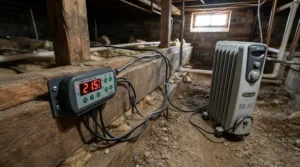
The Dr. Infrared Heater DR218 is a 1,500W portable heater with IPX4 splash protection, a steel housing, an adjustable thermostat and a rated coverage of about 150 sq ft. The IPX4 rating is its main appeal: it tolerates splashes better than most household heaters. At 120V, 1,500W draws 12.5 amps, which is most of a standard 15-amp circuit. Give it its own outlet, and never use an extension cord.
Here’s where review reading matters. Owners praise the all-metal case, strong output and low-fuss operation. A notable cluster of reviews, some with photos, describes wiring and thermostat problems, including melted components. One owner reported adding an external line-voltage thermostat. If you choose this heater for an unattended space, weigh that review pattern seriously and ask an electrician about the circuit. For many crawl spaces, a heat cable is the lower-risk path.
Pros:
- ✅ IPX4 splash resistance for damp-adjacent areas
- ✅ Strong 1,500W output and solid metal build
- ✅ Adjustable thermostat and overheat protection
Cons:
- ❌ Mixed reviews on wiring and thermostat durability
- ❌ High amperage demands a dedicated circuit
Expect roughly C$160-C$230. The value verdict is cautious: capable hardware, but a risky choice to leave running unattended.
7. GoveeLife WiFi Thermometer — the alert that tells you before it’s too late
The GoveeLife WiFi Thermometer doesn’t heat a thing, and that’s why it earns a place. It sends app alerts when the temperature leaves a range you set. An anti-false-alarm setting waits 1-10 minutes before notifying you, and the unit itself doesn’t sound an alarm. It’s marketed for fridges, freezers and pools rather than crawl spaces, so it’s a practical workaround rather than a purpose-built freeze alarm.
Set a low-temperature alert around 4°C and it becomes the tripwire for a failed heat cable or a tripped breaker. Two cautions apply. Wi-Fi can be unreliable in metal or concrete enclosures, and a power outage takes your router offline just when a freeze is most likely. If you already use Ring, the Ring Alarm Flood & Freeze Sensor alerts below 4.5°C, but it needs a Ring Alarm Security Kit and a subscription for notifications.
Pros:
- ✅ Customizable low-temperature phone alerts
- ✅ Anti-false-alarm delay reduces nuisance pings
- ✅ Affordable two-pack format
Cons:
- ❌ Wi-Fi may struggle in a crawl space
- ❌ No built-in siren or backup alert path
Expect around C$80-C$110. The value verdict is strong as a companion to any heat source.
What Is a Crawl Space Heater to Prevent Frozen Pipes?
A crawl space heater to prevent frozen pipes is any thermostat-controlled heat source, such as a plug-in anti-freeze space heater or an electric heat cable, that keeps water lines above 0°C beneath a house. It either warms the surrounding air or heats the pipe directly, and works best paired with pipe insulation and air sealing.
There are three families. Air heaters warm the cavity, which is simple but inefficient where cold air leaks in. Heat cables warm only the pipe, using a fraction of the power. Passive measures such as insulation and sealing reduce how much heat you need in the first place. A vented crawl space sits outside your home’s thermal envelope, so pipes there are exposed by design. Experienced builders point out that a leaky crawl space is hard to heat at all, which is why pipe-level protection tends to beat room-level heating.
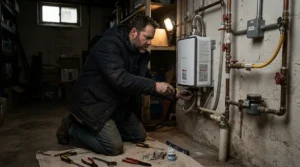
How to Choose a Crawl Space Heater to Prevent Frozen Pipes
- Map your exposure. Find where pipes run along foundation walls, near vents or through the rim joist. Those spots decide whether you need one short cable or a whole-run solution.
- Choose air heat or pipe heat. For a few vulnerable pipes, a cable is usually more efficient. Air heaters only make sense in a sealed, dry space.
- Demand certification. Look for marks from agencies recognized by the Standards Council of Canada, such as CSA, UL or ULC, or cULus for cables.
- Check the thermostat. An anti-freeze trigger near 3°C, as on the WarmlyYours PRO-Tect 30 ft and Caframo True North, protects you even when you forget.
- Assess moisture. Damp crawl spaces rule out some heaters. Check IP ratings and the manual’s humidity warnings.
- Do the amperage maths. A 1,500W heater pulls 12.5A at 120V, so give it a dedicated circuit and never use an extension cord.
- Add an alert. Pair any heat source with a sensor like the GoveeLife WiFi Thermometer so a silent failure doesn’t become a flood.
Pipe Insulation: Your First Line of Defence
Insulation is the unglamorous hero of crawl space pipe protection. Here’s the catch: it doesn’t create heat, it slows heat loss. On its own, pipe insulation only delays freezing. In a prolonged cold snap, the water still gets there eventually. Combined with a cable or heater, it keeps warmth where you want it and cuts running costs.
Foam sleeves and insulation tape cost little compared with anything else in this guide. Focus first on exposed pipes, particularly those near exterior walls and foundation openings. Seal drafts around gaps with caulk, since cold air sneaking in is a common culprit. Building-science advice for stopgap situations is to wrap pipes with thermostat-controlled heat cable first, then cover the whole bundle with insulation. Always follow the cable manufacturer’s instructions on insulation type and overlapping. For plastic pipe, confirm the cable is rated for it. Done properly, pipe insulation lets a modest cable do the work of a much larger heater.
Winterizing Crawl Space Heating: A Practical 30-Day Guide
It’s late October, which makes this the ideal window for winterizing crawl space heating before the first hard frost. Think of it as a four-week sprint.
Week 1: Inspect and seal. Photograph every pipe. Note where lines run near vents, the rim joist or the foundation wall. Caulk gaps and fix missing insulation.
Week 2: Insulate and install. Fit foam sleeves, then install your cable or heater following the manual exactly. Keep the Frost King HC6A‘s thermostat in the coldest part of the run it protects.
Week 3: Add monitoring. Place a sensor such as the GoveeLife WiFi Thermometer near the most exposed pipe and set the alert near 4°C. Confirm Wi-Fi reaches that corner before you rely on it.
Week 4: Test and rehearse. Locate your main water shut-off and make sure everyone in the household can find it. Check that plugs sit snugly and cords aren’t pinched.
Common first-month mistakes include forgetting to plug the cable in, burying the thermostat under insulation, using extension cords, and never checking that the alert actually reaches your phone. Revisit mid-winter and inspect every cable for damage.
Real-World Scenarios: Which Setup Fits Your Home?
The weekend cottage owner. The house sits empty for weeks, so IBC guidance says to shut off the water and drain the lines. Vacancy exclusions are common in home policies. For partial protection, pair insulation with a cellular freeze alarm, since Wi-Fi dies with the power. Budget: roughly C$150-C$300.
The family in a 1960s bungalow. One cold supply line runs along a north foundation wall. A Frost King HC6A, pipe insulation and a GoveeLife WiFi Thermometer cover the weak spot for under C$250 total. Check on a cold night that the alert actually arrives.
The renovator with a dry, sealed crawl space. A conditioned crawl space with a mechanical hub can justify the Caframo True North as a backup. Add a JDZKOMKE 50FT Heat Cable or HEATIT 30ft Self-Regulating Heating Cable for long runs, and keep pipe insulation on everything. Budget: roughly C$300-C$450.
Problem → Solution Guide: Common Crawl Space Freeze Problems
Problem: Pipes freeze only during power outages. Heat cables and heaters die with the grid. IBC advises shutting off the water supply and draining pipes if a furnace fails. A battery-backed or cellular alert gives you the warning window you need.
Problem: Drafts from foundation vents or the rim joist. Seal gaps first, because heating leaky air wastes electricity. Some guides suggest closing crawl space vents during extreme weather, but ask a qualified contractor, since moisture management matters too.
Problem: A damp, dirt-floor crawl space. Avoid heaters that prohibit humid use, like the Caframo True North. Choose cables designed for pipe freeze protection, or consider encapsulation with a vapour barrier to control moisture.
Problem: Plastic or PEX pipes. Not every cable suits plastic. The JDZKOMKE 50FT Heat Cable listing mentions metal and plastic, but always confirm the rating and watt density in the manual.
Problem: You don’t know if the heater is working. A sensor tells you. Silent failure is the real enemy, which is why monitoring belongs in every setup.
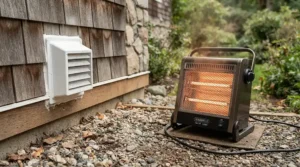
Freeze Warning Thermostats and Sensors: Your Early-Warning System
First, a clarification. A thermostat switches heat on and off, while an alarm tells you something is wrong. Both fall under freeze warning thermostats in everyday shopping language, and you want both. According to Wikipedia’s overview of freeze alarms, these devices track ambient temperature and alert you when it falls below a threshold you choose, often through Wi-Fi, cellular or phone-line communicators.
Thresholds matter. Heat cable thermostats typically switch on near 3°C. Many freeze alarms alert earlier, around 4.5°C for the Ring Alarm Flood & Freeze Sensor and near 7°C for preset units from Canadian specialists. That gap is useful: the alarm warns you while the cable is still working, rather than after it has failed.
Connection type is the make-or-break detail. Wi-Fi alarms fail when the router loses power, which in rural Canada is often exactly when the furnace quits. Cellular alarms such as CabinPulse keep texting on battery. For a primary residence with a reliable connection, the GoveeLife WiFi Thermometer is a sensible, affordable layer. For an off-grid or seasonal property, pay for cellular.
Pipe Freeze Prevention Heater vs Heat Cable vs Insulation
| Option | How It Protects | Typical Cost (CAD) | Weakness | Best For |
|---|---|---|---|---|
| Plug-in heater (Caframo True North, Dr. Infrared Heater DR218) | Warms the air | C$140-C$230 | High power draw, humidity limits | Dry, sealed spaces |
| Heat cable (Frost King HC6A, WarmlyYours PRO-Tect 30 ft) | Warms the pipe | C$40-C$150 | Needs correct installation | Targeted pipe runs |
| Insulation alone | Slows heat loss | Low | Delays, never prevents | Mild climates, base layer |
| Insulation + cable + alarm | Layered protection | C$150-C$350 | Higher up-front effort | Most homes |
In practice, the layered approach wins. A heat cable costs less to run than a space heater, protects the exact spot at risk, and doesn’t depend on heating a leaky cavity. The Caframo True North and Dr. Infrared Heater DR218 shine only when air temperature is the problem, such as a small sealed crawl space or mechanical room. Insulation costs the least and should be on every pipe regardless of what else you choose.
A heater is a blunt instrument: it treats the whole cavity to protect a few pipes. A cable is a scalpel. The cable approach consumes far less electricity, but it depends on correct placement and a working thermostat, which is why the monitoring layer matters so much.
Common Mistakes When Buying and Installing
- Shopping by wattage alone. More watts doesn’t mean better protection. A thermostat with a sensible trigger and good placement matter far more.
- Ignoring humidity. The Caframo True North manual warns against damp use, so read manuals before assuming a heater suits your crawl space.
- Using extension cords or power bars. Safety guidance in Canada is blunt about this: plug heaters directly into the wall.
- Skipping the alert. A heat cable that silently fails is worse than none, because you think you’re protected.
- Trusting insulation alone. It delays freezing; it doesn’t prevent it in a deep cold snap.
- Assuming insurance will cover everything. Coverage typically requires pipes in the heated part of the home plus reasonable precautions. Ask your insurer whether your crawl space qualifies.
Plumbing Damage Prevention: Long-Term Cost and Maintenance
Cheap protection is rarely about the sticker price. It’s about running cost, lifespan and how little a failure costs you. Consider electricity. At an assumed C$0.15/kWh, a 42W cable like the Frost King HC6A running 200 hours in a cold season uses about 8.4 kWh, around C$1.25. A 1,500W heater like the Dr. Infrared Heater DR218 uses roughly 150 kWh per 100 hours, around C$22. Your rate and runtime will differ, but the gap is large.
| Layer | Upfront Cost (CAD) | Running Cost | Role |
|---|---|---|---|
| Pipe insulation | Low | None | Reduces heat loss |
| Heat cable | C$40-C$150 | Low | Heats the pipe |
| Plug-in heater | C$140-C$230 | Moderate to high | Heats the air |
| Sensor/alarm | C$80-C$110 | Minimal | Detects failure |
The table shows why layering is economical. Insulation and a cable give the best protection per dollar, while a heater is a premium add-on. The real argument is avoided loss. After a severe January cold snap across three provinces, IBC reported more than C$180 million in damage, with about 70 per cent of cold-related claims involving personal property and frozen or burst pipes. Against numbers like that, a C$200 setup is cheap plumbing damage prevention.
Maintenance is light. Each autumn, inspect cables for cracks, confirm thermostats cycle, replace damaged insulation and recheck sensor batteries.
Safety, Regulations and Insurance: What Canadian Homeowners Should Know
Start with certification marks. Technical Safety BC advises choosing space heaters carrying approval from an agency recognized by the Standards Council of Canada, such as CSA, UL or ULC. In Ontario, the Electrical Safety Authority maintains a list of recognized marks. Heat cables carry cULus or CSA listings, like the WarmlyYours PRO-Tect 30 ft and Frost King HC6A.
Next, behaviour. Toronto Metropolitan University’s safety guidance recommends a tip-over switch, about one metre (three feet) of clearance from combustibles, no extension cords or power bars, and no use near water. Common guidance also says space heaters shouldn’t run unattended. A crawl space is unattended by nature, which is another reason many homeowners favour thermostat-controlled cables over portable heaters.
Finally, insurance. IBC says standard policies generally cover freeze damage when pipes are in the heated part of the home and you take reasonable steps to maintain heat. Vacant homes are often excluded, even with permission for vacancy. Call your insurer, ask how an unheated crawl space is treated, and confirm what documentation helps. For any permanent wiring, hire a licensed electrician and check local code.
FAQ
❓ Can I put a regular space heater in my crawl space?
❓ What temperature should a heat cable thermostat trigger at?
❓ Do I still need pipe insulation if I use heat cable?
❓ Will a freeze alarm work if the power goes out?
❓ Does home insurance cover frozen pipes in a crawl space?
Conclusion
The best crawl space heater to prevent frozen pipes isn’t always a heater. For most Canadian homes, the winning formula is layered: pipe insulation on every exposed line, a thermostat-controlled cable on the worst spots, and an alert that tells you when something fails. The Frost King HC6A handles short problem sections affordably, the JDZKOMKE 50FT Heat Cable and HEATIT 30ft Self-Regulating Heating Cable stretch protection across long runs, and the WarmlyYours PRO-Tect 30 ft adds certified peace of mind.
Air heaters have a narrower role. The Caframo True North is a credible stopgap in a dry, sealed space, and the Dr. Infrared Heater DR218 offers splash resistance, though its review pattern calls for caution when left unattended. The GoveeLife WiFi Thermometer completes the picture by catching silent failures before they become floods.
Whatever you choose, act before the deep freeze. Book a weekend this month, inspect your pipes, seal the draughts, and test every device. A well-protected crawl space costs a few hundred dollars and a Saturday afternoon. A burst pipe costs far more.
Recommended for You
- Crawl Space Heater For Cold Climate: 7 Proven Picks 2026
- Basement Heater For Canadian Winter: 7 Best Warm-Up Picks 2026
- Basement Heaters Under $150 CAD: 7 Smart Picks For 2026
Disclaimer: This article contains affiliate links. As an Amazon Associate, I earn from qualifying purchases. If you purchase products through these links, we may earn a small commission at no additional cost to you.
✨ Found this helpful? Share it with your friends! 💬🤗
