
In This Article
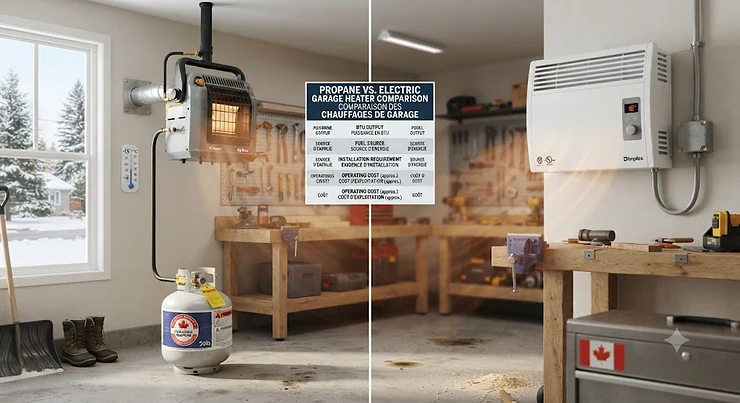
Somewhere around the third time you’ve dropped a socket wrench because your fingers stopped cooperating, the propane garage heater vs electric garage heater question stops being theoretical and starts feeling urgent. Canadian garages are brutal in January — uninsulated slab floors, a door that leaks air like a sieve, and a thermometer reading that makes the workbench feel like a walk-in freezer. The good news is that both fuel types can genuinely fix this, but they solve the problem in very different ways, with different upfront costs, different running costs, and — this part matters — very different safety considerations once carbon monoxide enters the conversation.
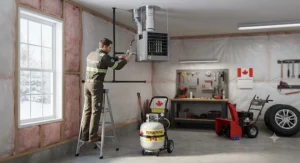
A propane heater, broadly speaking, burns liquid petroleum gas (LP gas) to produce fast, high-output heat that doesn’t care whether your garage has electrical service; an electric heater converts current into radiant or forced-air warmth with zero combustion byproducts but often demands a dedicated circuit to hit real garage-sized output. Neither is “better” in the abstract — it depends on your garage’s wiring, your ventilation, how often you’re out there, and how much risk tolerance you have for an open flame near a car with a half-empty gas tank.
This guide walks through seven real, currently available heaters — three propane, four electric — with honest spec interpretation, aggregated review sentiment, and Canadian-specific cost and safety analysis, so you can make the call with your eyes open rather than guessing from a product listing.
Quick Comparison Table
| Category | Propane Heaters | Electric Heaters | Best For |
|---|---|---|---|
| Typical output | 9,000–60,000 BTU | 12,000–19,000 BTU (5,000–5,600W) | Propane for large, uninsulated bays |
| Installation | None — tank hookup only | Often needs a dedicated 240V circuit | Electric for finished/wired garages |
| Upfront cost | Lower unit price, ongoing fuel cost | Higher unit price, lower running cost per hour | Depends on usage frequency |
| Ventilation need | Fresh air required, CO risk | None — zero combustion byproducts | Electric for tightly sealed garages |
| Portability | High (most units) | Moderate to low (hardwired models fixed) | Propane for mobile job-to-job use |
Looking at the table, propane wins on raw output-per-dollar and portability, while electric wins on safety simplicity and long-term running cost once you already have the circuit installed. If your garage is attached to your house and poorly ventilated, that ventilation row isn’t a footnote — it’s the row that should decide your purchase before price ever enters the conversation.
💬 Just one click — help others make better buying decisions too!😊
Top 7 Garage Heaters: Expert Analysis
1. Mr. Heater Big Buddy MH18B — indoor-safe propane with dual dial ignition
The Mr. Heater Big Buddy MH18B is the name that comes up first in almost every Canadian garage-heating forum thread, and there’s a reason for that staying power. It runs on a variable 4,000/9,000/18,000 BTU dial, connects to two 1 lb cylinders or a 20 lb tank with an optional hose, and covers roughly 42 square metres (450 sq ft) on high.
What most buyers overlook about this model is that it’s rated indoor-safe specifically because of its built-in oxygen depletion sensor (ODS) and accidental tip-over shutoff — features cheaper radiant propane heaters often skip entirely. Based on the spec comparison with forced-air units, the trade-off is heating speed: radiant heat warms objects and people directly rather than the whole air volume, so it’s better suited to a single-car bay or a workbench zone than a full two-car garage.
Reviewers consistently report multi-season reliability and praise the piezo ignition for working reliably even in sub-zero temperatures, though a recurring complaint in aggregated feedback is that recent production runs removed the built-in fan due to import-tariff-driven component changes, which noticeably slows how fast heat reaches the far corners of a garage.
Pros:
- ✅ CSA-recognized ODS and tip-over shutoff for indoor use
- ✅ Runs off cheap, widely available 1 lb cylinders
- ✅ Three heat settings stretch tank life on cold nights
Cons:
- ❌ Radiant-only heat is slower to fill a two-car bay
- ❌ Newer units shipped without the integrated fan
Priced in the C$150-C$200 range at the time of research, the Mr. Heater Big Buddy MH18B is the safest bet if you want propane heat but only trust it indoors because of that ODS system.
2. Comfort Zone CZ798 — budget milkhouse-style electric with dual heat settings
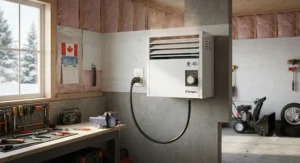
The Comfort Zone CZ798 is the plug-and-go answer for anyone whose garage already has a standard 120V outlet and no appetite for an electrician’s invoice. It runs on a 1,500W high setting (about 5,120 BTU) or a 1,300W low setting, drawing roughly 12.5A on a standard circuit.
Here’s what to weigh before buying: on a 15A breaker, that amperage draw is close enough to the ceiling that running anything else on the same circuit — a shop vac, a compressor — will trip it. The spec sheet won’t tell you this, but user reports suggest the all-metal milkhouse housing, rather than the heat output, is the real reason this model has stuck around for over a decade; there’s simply less to fail.
Aggregated review sentiment across major retailers describes years of trouble-free use in single-car garages and workshop corners, with the most common criticism being that its 14-15 square metre (150-200 sq ft) practical coverage undersells a two-car space badly.
Pros:
- ✅ No special wiring — works in any 120V outlet
- ✅ All-metal body with tip-over safety switch
- ✅ Simple dial controls that rarely fail
Cons:
- ❌ Coverage is realistically one bay, not two
- ❌ Near-maxes a 15A circuit on its own
At around C$70-C$100, the Comfort Zone CZ798 is the entry point for anyone testing whether electric heat suits their habits before committing to a 240V install.
3. GASLAND MHA18B — budget radiant propane rated to 450 sq ft
The GASLAND MHA18B delivers up to 18,000 BTU from a radiant burner design similar in spirit to the Big Buddy, but at a noticeably lower price point aimed at buyers who want propane heat without paying for brand recognition.
Based on the spec comparison, the LP regulator hose and ultra-quiet burner are the standout features here — reviewers consistently note that fan noise on cheaper forced-air units is a real annoyance during long garage sessions, and a fanless radiant design sidesteps that entirely. What most buyers overlook is that “quiet” also means “slower to circulate,” so this unit shines when you’re working within a few feet of it and struggles to warm a whole detached garage evenly.
A common theme in aggregated feedback is praise for value relative to big-brand alternatives, alongside honest acknowledgment that build quality — particularly the regulator hose fittings — doesn’t match the premium tier over years of heavy use.
Pros:
- ✅ 18,000 BTU output at a lower price than name brands
- ✅ Genuinely quiet radiant burner with no fan noise
- ✅ Includes LP regulator hose in the box
Cons:
- ❌ Regulator fittings feel less durable long-term
- ❌ Radiant-only heat leaves far corners cold
Sitting around C$90-C$120, the GASLAND MHA18B is the pick for a budget-conscious buyer who still wants real BTU output rather than a downsized “patio heater in a garage” compromise.
4. NewAir G56 — portable 240V electric with 5,600W output
The NewAir G56 steps electric heat up to genuinely garage-scale territory: 5,600 watts on a 240V/23.4A circuit, rated for up to roughly 74 square metres (800 sq ft) and delivering about 19,107 BTU of heating capacity — competitive with mid-range propane units, just without the flame.
What the spec sheet won’t tell you is that this heater still needs a NEMA 6-30R receptacle, meaning “portable” refers to moving the unit around your garage, not to plugging it into whatever outlet happens to be nearby. Reviewers consistently praise the sturdy steel-bodied construction and carrying handle, framing it as a genuine step up from lighter 120V milkhouse heaters once the 240V circuit is already in place.
A recurring theme in aggregated feedback is that buyers who skip verifying their receptacle type before ordering end up needing an electrician anyway, which somewhat undercuts the “portable” marketing if you’re starting from a bare 120V garage.
Pros:
- ✅ Near-propane-level output with zero combustion byproducts
- ✅ Adjustable thermostat with sturdy steel housing
- ✅ Movable within the garage once wired for 240V
Cons:
- ❌ Still requires a dedicated 240V/30A receptacle
- ❌ Not a true drop-in solution for 120V-only garages
Expect a price around C$180-C$230, making the NewAir G56 the natural mid-range electric competitor to the Big Buddy for anyone with the right outlet already installed.
5. Dyna-Glo Delux RMC-FA60DGD — 60,000 BTU forced-air propane heater
For raw heating power, the Dyna-Glo Delux RMC-FA60DGD is in a different league — a continuously variable 30,000 to 60,000 BTU forced-air unit with a 300+ CFM blower, rated to cover up to 125 square metres (1,350 sq ft), and compatible with 20, 40, or 100 lb propane tanks.
Based on the spec comparison, that blower is the real differentiator versus radiant propane units: forced air actively pushes heat across the whole garage rather than warming whatever happens to be in the direct line of sight. On a 100 lb tank, aggregated fuel-time data suggests roughly 7 to 70 hours of runtime depending on your chosen output level, which matters a great deal if you’re heating for full workdays rather than short bursts.
Reviewers consistently flag the continuous electronic ignition as a genuine upgrade over piezo-start units, especially in cold-start conditions, though a fair number of aggregated reviews note the unit is loud in operation and clearly built for job-site durability rather than quiet residential use.
Pros:
- ✅ 60,000 BTU output heats large, drafty two-car bays fast
- ✅ Continuous electronic ignition avoids delayed-ignition flare-ups
- ✅ Runs on readily available 20-100 lb propane tanks
Cons:
- ❌ Loud blower operation, not ideal near living spaces
- ❌ Outdoor/well-ventilated use only, not ODS-rated for sealed garages
Priced around C$220-C$270, the Dyna-Glo Delux RMC-FA60DGD is the choice for anyone heating a large, actively ventilated bay rather than a sealed single-car space.

6. Fahrenheat FUH54 — hardwired 5,000W ceiling-mount electric heater
The Fahrenheat FUH54 takes the opposite approach from portable units entirely: it’s a permanent, ceiling-mounted 5,000W heater on a 240V circuit, delivering 17,065 BTU with an automatic fan-delay system that only circulates air once the heating element is actually warm.
What most buyers overlook about this model is that the automatic fan delay isn’t just a comfort feature — by preventing cold-air circulation before the element heats up, it meaningfully cuts the wasted-energy window compared with instant-fan competitors. Here’s what to weigh: because it’s hardwired rather than plugged in, installation requires a qualified electrician, which adds a one-time cost the sticker price doesn’t reflect.
Aggregated review sentiment is mixed on noise and airflow strength in larger, draftier garages — several owners report the fan-forced output feels underwhelming for a full two-car bay unless the garage is reasonably well-insulated to begin with, while others in tighter, finished garages report strong satisfaction.
Pros:
- ✅ Permanent ceiling mount frees up floor and wall space
- ✅ Smart fan-delay reduces wasted-heat cycling
- ✅ Adjustable thermostat from 7°C to 57°C (45°F-135°F)
Cons:
- ❌ Requires professional hardwiring, adding install cost
- ❌ Airflow can feel weak in larger, uninsulated bays
At roughly C$220-C$270 before installation, the Fahrenheat FUH54 suits a finished, insulated garage where a permanent fixture beats another cord on the floor.
7. Dr. Infrared Heater DR-988 — premium 5,600W dedicated-circuit electric
The Dr. Infrared Heater DR-988 sits at the premium end of the electric lineup: 5,600W on a 208/240V circuit through a dedicated NEMA 6-30P plug, an adjustable thermostat from 3°C to 45°C (37°F-113°F), and a heavy-duty all-metal housing with aluminum fan blades built for wall, ceiling, or portable placement.
Reviewers consistently note the flexibility of mounting options as the standout advantage over fixed units like the Fahrenheat — you get near-permanent output with the option to relocate it later if you reorganize the garage. Based on the spec comparison, the ON/AUTO fan switch is a small but genuinely useful detail: AUTO mode cycles the fan only as needed, extending element life versus units that run the fan continuously regardless of demand.
A common thread in aggregated feedback is that this model draws a real distinction between “plug-in 240V” and “household 120V” buyers expect — more than one review mentions ordering without checking for the required NEMA 6-30R receptacle first, which is squarely a buyer-education gap rather than a product flaw.
Pros:
- ✅ Flexible portable, wall, or ceiling installation
- ✅ AUTO fan mode extends element lifespan
- ✅ UL and C-UL listed for verified safety compliance
Cons:
- ❌ Requires a dedicated 30A/250V receptacle
- ❌ Premium price versus comparable-output competitors
Expect to pay in the C$230-C$280 range for the Dr. Infrared Heater DR-988, which earns its premium tag through mounting flexibility rather than raw BTU advantage over the NewAir G56.
Top 7 Garage Heaters at a Glance
| Heater | Fuel | Output | Price Range (CAD) | Best For |
|---|---|---|---|---|
| Mr. Heater Big Buddy MH18B | Propane | Up to 18,000 BTU | C$150-C$200 | Indoor-safe portable heat |
| Comfort Zone CZ798 | Electric (120V) | 1,500W / 5,120 BTU | C$70-C$100 | No-wiring budget pick |
| GASLAND MHA18B | Propane | Up to 18,000 BTU | C$90-C$120 | Budget radiant propane |
| NewAir G56 | Electric (240V) | 5,600W / ~19,107 BTU | C$180-C$230 | Mid-range electric power |
| Dyna-Glo Delux RMC-FA60DGD | Propane | 30,000-60,000 BTU | C$220-C$270 | Large, drafty two-car bays |
| Fahrenheat FUH54 | Electric (240V, hardwired) | 5,000W / 17,065 BTU | C$220-C$270 | Permanent finished-garage install |
| Dr. Infrared Heater DR-988 | Electric (240V, dedicated plug) | 5,600W / ~19,000 BTU | C$230-C$280 | Flexible premium mounting |
The spread here tells its own story: propane dominates the raw-BTU-per-dollar comparison, especially the Dyna-Glo Delux RMC-FA60DGD, but every electric model on this list wins on zero-combustion safety and near-silent, odourless operation. If your garage is attached to a living space, that safety column should weigh more heavily than the price column ever will.
Real-World Scenarios: Which Garage Heater Fits Your Situation
If you’re a weekend hobbyist working on a project car for two or three hours at a time in a detached, unheated garage, the Mr. Heater Big Buddy MH18B or GASLAND MHA18B make sense — no wiring commitment, fast heat, and you’re not running it long enough for fuel cost to sting.
If you’re in a finished, attached garage that doubles as a home gym or workshop and you’re out there most evenings all winter, an electric option like the Fahrenheat FUH54 earns back its install cost through lower per-hour running expense and the total absence of ventilation concerns next to your living space.
If you’re a contractor or serious DIYer heating a large, drafty two-car bay for full workdays, the Dyna-Glo Delux RMC-FA60DGD‘s forced-air output is built for exactly that scenario — just budget for the ventilation and CO precautions a job-site-grade heater assumes you’ll follow. And if your garage sits somewhere in between — occasional use, but you want more punch than a plug-in 120V unit — the NewAir G56 or Dr. Infrared Heater DR-988 split the difference nicely, assuming the 240V receptacle is already there or budgeted for.
Problem → Solution: Common Garage Heating Problems, Solved
Problem: the heater trips your breaker constantly. Electric units like the Comfort Zone CZ798 draw close to a standard 15A circuit’s limit on their own; the fix is either dedicating that circuit to the heater alone or upgrading to a proper 240V unit like the NewAir G56 that’s designed for its own dedicated line.
Problem: heat rises and pools at the ceiling, leaving your feet cold. This is a radiant-versus-forced-air issue — units like the Mr. Heater Big Buddy MH18B warm what’s directly in front of them, so repositioning toward your work area (not the empty centre of the garage) makes a bigger difference than cranking the dial higher.
Problem: you smell propane faintly and aren’t sure if it’s normal. A faint smell during initial lighting can be normal off-gassing, but any persistent odour means stopping immediately, ventilating, and checking connections — propane’s distinctive smell is an intentionally added safety feature, not something to explain away.
Problem: the garage still feels cold ten minutes after starting a 60,000 BTU heater. Check your door seals first; a poorly sealed garage door can undo more heating capacity than any upgrade in heater wattage or BTU ever will.
How to Choose Between a Propane and Electric Garage Heater
- Check your electrical panel first. If you don’t already have spare 240V capacity, factor in electrician costs before falling in love with an electric model’s specs.
- Match BTU output to real square footage, not aspiration. A single-car bay rarely needs the Dyna-Glo Delux RMC-FA60DGD‘s 60,000 BTU ceiling; oversizing wastes fuel and money.
- Weigh ventilation reality honestly. An attached garage with a poorly sealed interior door is a worse candidate for open-flame propane than a detached, drafty outbuilding.
- Consider session length. Short, occasional use favours propane’s instant heat; daily multi-hour use tips the math toward electric’s lower per-hour cost.
- Factor in noise tolerance. Forced-air propane units and 240V electric fans both generate real operating noise — radiant propane like the GASLAND MHA18B is the quietest option here.
- Verify the receptacle type before ordering electric. NEMA 6-30R requirements catch more buyers off guard than any other spec on this list.
- Budget for a carbon monoxide alarm regardless of choice. Even electric setups near an attached garage benefit from one, given vehicle exhaust risk.
Propane Vs Electric Running Cost: What You’ll Actually Pay in Canada
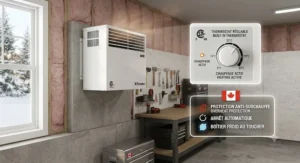
This is where the propane vs electric running cost comparison stops being theoretical. A 60,000 BTU propane heater like the Dyna-Glo Delux RMC-FA60DGD, run six hours per weekend across a typical November-to-March season, burns through roughly 8 to 10 twenty-pound tanks. At current fill or exchange pricing, that works out to somewhere in the C$200-C$300 range for the season — a number that scales down considerably for smaller units like the Mr. Heater Big Buddy MH18B run on its lower settings.
Electric running costs hinge entirely on your provincial rate, and that variation is significant: provincial electricity rates range from roughly 7-8 cents per kWh in Quebec to well over 15 cents in Alberta and Prince Edward Island. Running a 5,600W unit like the NewAir G56 for six hours weekly through the same season at Ontario’s blended rate lands in a broadly comparable range to propane, but Quebec residents on hydroelectric-driven rates will come out meaningfully ahead on electric, while Alberta households may find propane more competitive depending on local tank pricing.
| Cost Factor | Propane (60,000 BTU unit) | Electric (5,600W unit) |
|---|---|---|
| Fuel cost per season (6 hrs/week, Nov-Mar) | ~C$200-C$300 | Varies by province, ~C$150-C$320 |
| Upfront unit cost | Lower | Higher, plus possible wiring cost |
| Price volatility | Tied to propane market swings | Tied to provincial utility rates |
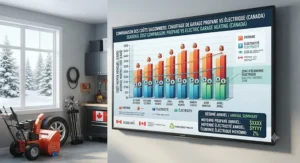
The table above makes one thing clear: neither fuel type has a fixed cost advantage across Canada — it depends entirely on where you live and how your local propane and electricity markets are priced that season.
Fuel Type Comparison for Garage Heating: Propane Vs Electric Vs Other Options
When people search fuel type comparison garage heating, they’re usually assuming it’s a two-horse race, but a few other options exist worth naming honestly. Natural gas heaters offer propane-like output with the convenience of a fixed line rather than tank swaps, but only work if your garage already has a gas line run to it — a renovation cost that dwarfs any heater’s price tag. Kerosene forced-air heaters, common on job sites, produce more fumes and odour than propane and are rarely recommended for anything but well-ventilated, non-residential-adjacent spaces.
Diesel-fired air heaters, increasingly marketed for garages and trailers, trade fuel availability for even stronger ventilation requirements than propane. For the overwhelming majority of Canadian homeowners, though, the practical choice remains between propane and electric — the other options solve niche problems (existing gas infrastructure, job-site fuel logistics) that don’t apply to a typical residential two-car garage.
Garage Heater Fuel Options Beyond Propane and Electric
Worth a brief, honest mention: wood-pellet and solid-fuel garage heaters exist and appeal to rural buyers already heating with wood, but they demand chimney venting most garages simply don’t have, plus daily fuel-loading effort neither propane nor electric requires. Dual-fuel heaters — units that switch between propane and natural gas with a conversion kit — are worth investigating only if you’re already planning a gas line install for other reasons, since the conversion hardware adds cost without adding capability most garage owners will use.
Carbon Monoxide Safety: What Every Garage Heater Owner Must Know
Carbon monoxide safety isn’t a footnote on this comparison — it’s arguably the single biggest factor separating propane and electric heaters in practice. Health Canada’s guidance on preventing carbon monoxide exposure is explicit that kerosene, propane, and oil space heaters should never be used in enclosed areas unless specifically designed and certified for indoor use — which is exactly why the ODS system on the Mr. Heater Big Buddy MH18B matters so much more than it might first appear on a spec sheet.
Electric heaters like the NewAir G56, Fahrenheat FUH54, and Dr. Infrared Heater DR-988 sidestep CO risk entirely because there’s no combustion happening at all — a meaningful advantage for anyone heating an attached garage with a shared interior door to living space. That said, an attached garage carries CO risk from vehicle exhaust regardless of which heater you choose, which is why a certified CO alarm belongs in every garage, full stop, independent of your fuel-type decision.
Non-ODS-rated propane units, including forced-air models like the Dyna-Glo Delux RMC-FA60DGD, are explicitly designed for outdoor or actively ventilated use — running one in a sealed garage with the door shut is precisely the scenario Canadian health authorities warn against every winter.
Propane Tank Availability: Refills, Exchanges, and Storage in Canada
Propane tank availability across Canada is genuinely convenient compared to a lot of consumables — most gas stations, hardware chains, and Canadian Tire locations offer either a tank exchange network or a direct refill service for standard 20 lb cylinders, and exchange tanks come pre-inspected and leak-tested, which matters for anyone uneasy about handling propane hardware themselves.
Refilling an existing tank at a dedicated station is typically cheaper per pound than a straight exchange, but exchange programs win on convenience and speed, especially outside regular business hours. One safety note that’s easy to overlook: propane tanks should never be stored inside an attached garage or basement — keep them outdoors, upright, and away from direct heat sources, which somewhat complicates the “just grab the spare tank” convenience story for propane owners who don’t have covered outdoor storage.
For rural or northern buyers, availability drops off compared to urban centres, which is worth factoring in if you’re choosing between the GASLAND MHA18B and an electric alternative purely on the basis of how often you’ll realistically be able to refuel.
Common Mistakes When Buying a Garage Heater
The most frequent mistake is buying by BTU number alone without checking square footage ratings against your actual garage size — a 9,000 BTU unit in a two-car bay will run constantly and still underwhelm. A close second is ordering a 240V electric heater like the Fahrenheat FUH54 without confirming panel capacity first, leading to an unplanned electrician visit that erases any price advantage over propane.
Buyers also commonly underestimate ventilation needs for non-ODS propane units, assuming “the garage door was open for a bit” counts as adequate ventilation — it doesn’t, particularly in an attached garage. Finally, skipping a CO alarm purchase alongside any fuel-burning heater is a mistake reviewers and safety authorities alike flag repeatedly, and it’s the cheapest insurance on this entire list.
What to Expect: Real-World Performance
On paper this means comparing BTU numbers, but in practice, a propane unit like the Mr. Heater Big Buddy MH18B on high will noticeably raise the temperature within arm’s reach in under ten minutes, while the far corners of a two-car garage lag well behind. Forced-air propane, like the Dyna-Glo Delux RMC-FA60DGD, closes that gap dramatically thanks to its blower, at the cost of real operating noise that makes conversation or music genuinely difficult nearby.
Electric units behave more predictably room-to-room since there’s no flame-direction dependency, but the trade-off shows up at start-up: a 5,600W unit like the NewAir G56 takes noticeably longer to make a cold garage feel comfortable than an 18,000 BTU propane unit at full output, even though their rated BTU-equivalents look similar on paper.
Long-Term Cost & Maintenance
Propane heaters need periodic hose and regulator inspection — the fittings on budget units like the GASLAND MHA18B are the first component to show wear, and a cracked hose is a safety issue, not just a performance one. Annual burner cleaning keeps combustion efficient and reduces the risk of incomplete burning, which is directly tied to CO production.
Electric heaters carry lower ongoing maintenance overall — no fittings to inspect, no burner to clean — but hardwired units like the Fahrenheat FUH54 should have their electrical connections checked periodically by a qualified electrician, especially in a garage environment where dust and moisture both take a toll on connections over years of use. Total cost of ownership over five winters typically favours electric slightly once install costs are amortized, assuming consistent, frequent use rather than occasional weekend sessions.
Frequently Asked Questions
❓ Is a propane heater or electric heater better for a garage?
❓ How much does it cost to run a propane heater vs electric heater in a garage?
❓ Can I use a propane heater in an attached garage?
❓ Do I need a carbon monoxide detector with an electric garage heater?
❓ What size heater do I need for a two-car garage?
Conclusion
The propane garage heater vs electric garage heater decision really comes down to three honest questions: what wiring you already have, how ventilated your space actually is, and how often you’ll be out there this winter. Propane wins on portability and raw output-per-dollar, especially in a detached, drafty garage where an electrician’s visit isn’t practical. Electric wins on safety simplicity and predictable running costs once the circuit is in place, particularly for attached garages where combustion byproducts are a real concern.
Neither choice is wrong — the seven heaters above cover the realistic range of Canadian garage situations, from a plug-and-go Comfort Zone CZ798 for occasional weekend use to a job-site-grade Dyna-Glo Delux RMC-FA60DGD for full workdays in a large bay. Match the heater to your garage’s actual conditions rather than to whichever spec sheet sounds most impressive, and add a carbon monoxide alarm to the cart regardless of which fuel type you land on.
✨ Ready to stop shivering through your winter projects? 🔥🧰
Check current prices on today’s picks and see how quickly your garage actually starts feeling like a workspace again!
Recommended for You
- Electric Garage Heater for Canadian Winters: 7 Best Picks (2026)
- Ceiling Mount Garage Heaters: 7 Top Picks for Canada (2026)
- 7 Best Garage Heaters Under $200 CAD in 2026
Disclaimer: This article contains affiliate links. As an Amazon Associate, I earn from qualifying purchases. If you purchase products through these links, we may earn a small commission at no additional cost to you.
✨ Found this helpful? Share it with your friends! 💬🤗
