
In This Article
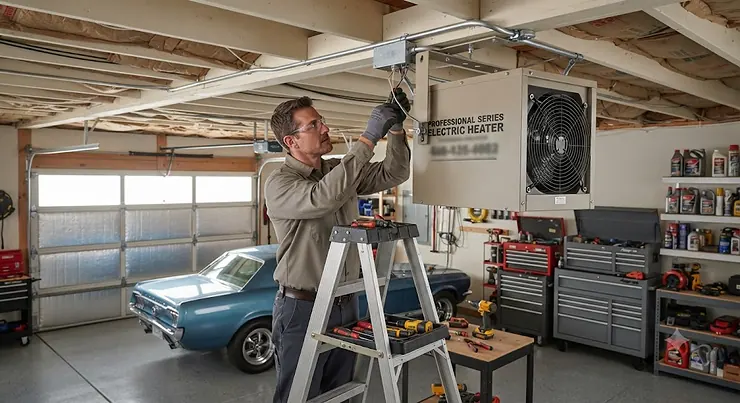
Here’s the thing nobody tells you before you start shopping for garage heat: the floor is prime real estate, and a heater sitting on it is just something else to trip over, wheel a snowblower around, or accidentally kick a cord loose from. A ceiling mount garage heater solves that problem by getting the whole appliance up and out of the way, radiating warmth down over your workbench, your car, or whatever project is currently eating your weekend.
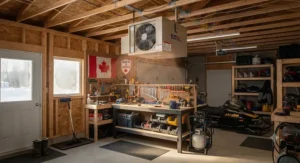
What is a ceiling mount garage heater? It’s an electric or gas-fired unit heater permanently or semi-permanently installed near the ceiling, using a fan to push heated air downward and outward across the room, freeing up floor and wall space that a portable or baseboard heater would otherwise occupy.
This guide walks through seven real, currently available options — spanning simple 5,000-watt electric units to a natural-gas unit heater built for larger detached garages — plus the practical stuff most listings skip entirely: how high to mount one, which direction to aim it, and how much ceiling clearance your specific garage actually needs. For the fundamentals of how these units work mechanically, BCcampus’s open HVAC textbook has a solid primer on unit heater design that’s worth a skim if you’re new to the category. One thing worth setting expectations on up front: an overhead garage heater is not a drop-in furnace replacement for most Canadian garages — it’s supplemental, task-focused heat, and picking the right wattage or BTU rating for your specific space matters more than any single feature on the spec sheet.
Quick Comparison Table
| # | Product | Fuel/Type | Output | Best For |
|---|---|---|---|---|
| 1 | Fahrenheat FUH54 | Electric, 240V | 2,500/5,000W | Budget hardwired workhorse |
| 2 | NewAir G56 | Electric, 240V | 5,600W | DIY flexible mounting |
| 3 | Comfort Zone CZ220 | Electric, 240V | 5,000W | Remote-controlled convenience |
| 4 | Dr. Infrared Heater DR-988 | Electric, 240V | 5,600W | Wide thermostat range |
| 5 | Dimplex RCH5031CXW Connex | Electric, 240V | 5,000W | Quiet, Canadian-engineered build |
| 6 | Stelpro Spider SGH4002R | Electric, 240V/208V | 4,000/3,000W | Professional-grade, Quebec-built |
| 7 | Mr. Heater Big Maxx MHU45NG | Natural gas, power-vented | 45,000 BTU | Large detached garages |
Looking at this lineup, six of the seven are electric units that plug into the same basic 240-volt circuit category, while the Mr. Heater Big Maxx MHU45NG stands apart as a gas-fired option that needs a gas line and venting instead of just a bigger breaker. Among the electric picks, the split really comes down to control style — the Comfort Zone CZ220 and Dr. Infrared Heater DR-988 favour convenience features like remotes and digital thermostats, while the Stelpro Spider SGH4002R leans toward contractor-grade simplicity with an external thermostat sold separately. If your garage is detached and larger than a typical two-car bay, the gas option is worth a serious look despite the extra installation complexity.
💬 Bookmark this comparison — you’ll want it handy once you get to the mounting height and circuit sizing sections below.
Top 7 Ceiling Mount Garage Heaters: Expert Analysis
1. Fahrenheat FUH54 — dual heat settings on a proven classic
The standout feature here is simplicity: a two-stage 2,500/5,000-watt selector switch that lets you dial back output on milder days instead of running a single-speed unit at full blast. At full 5,000W (240V), the FUH54 puts out roughly 17,065 BTU/h — enough to noticeably warm a typical insulated two-car garage, though a poorly sealed or uninsulated bay will eat into that effective output fast. Based on the spec comparison, this is the pick for buyers who want a no-frills, hardwired unit rather than remotes or digital displays; it includes a built-in adjustable thermostat and a mounting bracket that lets you tilt the housing to direct airflow where you need it. Fahrenheat (a Marley Engineered Products brand) has sold variations of this unit heater for decades, and aggregated reviews for the FUH-series consistently describe it as reliable and straightforward to wire, with the recurring caveat that at full 5,000W draw it needs a dedicated 30-amp circuit — something more than a few buyers admit they didn’t check before ordering. What most buyers overlook is that the lower 2,500W setting isn’t just an energy-saver; it also lets the unit run on a lighter-gauge circuit in some installations, which your electrician should confirm against your panel’s actual capacity.
Pros:
- ✅ Simple two-stage output for flexible day-to-day heat
- ✅ Decades-long manufacturer track record in this category
- ✅ Tiltable bracket for adjustable airflow direction
Cons:
- ❌ Full 5,000W setting demands a dedicated 30-amp circuit
- ❌ No remote or digital thermostat display
Expect to pay somewhere in the C$180-C$250 range at the time of research — a solid value pick if you just want heat without extra features.
2. NewAir G56 — flexible floor, wall, or ceiling mounting
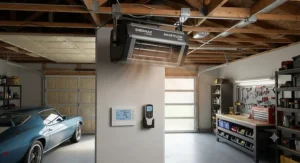
What sets the G56 apart is genuine mounting flexibility: it ships with both a floor stand and wall/ceiling brackets, so you can run it as a portable unit this winter and permanently mount it overhead next season without buying a second heater. Rated at 5,600W on a 240V circuit, it produces around 19,107 BTU/h, and the digital thermostat with LED display lets you set a target temperature rather than guessing at a dial position. Here’s what the spec sheet won’t spell out clearly: because it’s designed to also work as a freestanding unit, the housing and swivel bracket are built a bit more ruggedly than heaters designed exclusively for permanent ceiling installation, which is a real advantage if you might move garages or want to loan it out seasonally. On paper, this makes the G56 the most adaptable pick here for renters or anyone not ready to commit to permanent wiring in one spot. Aggregated buyer feedback on the G56 consistently highlights the included remote and digital readout as genuinely useful, with occasional notes that the fan runs louder on high than some dedicated ceiling-only competitors — a reasonable trade-off for the added mounting versatility.
Pros:
- ✅ Works as floor-standing, wall-mounted, or ceiling-mounted
- ✅ Digital thermostat with remote control included
- ✅ Highest wattage-to-flexibility ratio in this lineup
Cons:
- ❌ Fan noise on high setting is more noticeable than dedicated units
- ❌ Floor-stand hardware is extra bulk if you only plan to ceiling-mount
Pricing typically falls in the C$200-C$280 range, which is reasonable given you’re effectively getting two heater form factors in one purchase.
3. Comfort Zone CZ220 — remote-controlled dual-knob convenience
The headline feature is the dual-knob control panel paired with an included remote, letting you adjust both fan speed and thermostat setting without climbing a ladder every time you want to tweak the heat. At 5,000W and 240V, it delivers the same 17,065 BTU/h class as the Fahrenheat unit above, but the ball-and-socket mounting bracket makes tilt adjustment for airflow direction noticeably easier to fine-tune after installation. Based on the spec comparison, this is the pick for anyone who wants remote convenience without stepping up to a fully digital interface — the CZ220 keeps things analog and mechanically simple, which tends to mean fewer electronic components that can fail in a cold, occasionally damp garage environment. It’s ETL listed, confirming it’s been independently tested against North American electrical safety standards, and the overheat protection cuts power automatically if airflow gets blocked. Reviewers consistently mention the remote as a genuine quality-of-life upgrade over dial-only competitors, while a recurring criticism is that the remote’s range can be inconsistent through a garage’s metal framing or insulation — worth testing early in your return window if that matters to your layout.
Pros:
- ✅ Remote control plus dual-knob analog interface
- ✅ ETL-listed with automatic overheat protection
- ✅ Ball-and-socket bracket simplifies airflow adjustment
Cons:
- ❌ Remote signal can struggle through metal or insulated walls
- ❌ Ceiling-mount only — no portable or floor-stand option
You’ll generally find it in the C$160-C$230 range, making it a competitively priced middle-ground option in this category.
4. Dr. Infrared Heater DR-988 — wide 37-113°F thermostat range
The distinguishing feature is thermostat range: the DR-988’s built-in dial spans 37°F to 113°F (about 3°C to 45°C), noticeably wider than the fixed-range thermostats on some competitors, which matters if your garage sometimes needs to just stay above freezing rather than reach full comfort temperature. Rated at 5,600W and 240V, it produces roughly 19,110 BTU/h, and — like the NewAir G56 — it’s designed to work both as a portable unit on its included stand and as a wall- or ceiling-mounted fixture. What most buyers overlook is that the wide thermostat range makes this a genuinely useful frost-protection tool for a garage that sits empty most of the week, not just a comfort heater for when you’re actively working out there. Dr. Infrared Heater has built a reputation primarily in the residential infrared space heater market, and this industrial-style unit carries that same emphasis on straightforward dial controls over digital displays. Aggregated review sentiment for the DR-988 consistently praises the wide thermostat range and dual mounting options, with a recurring theme in feedback being that the portable base stand feels like an afterthought compared to the more robust ceiling bracket — a fair trade if you’re buying it specifically to mount overhead anyway.
Pros:
- ✅ Unusually wide 37-113°F thermostat adjustment range
- ✅ Genuine dual-purpose portable-or-mounted design
- ✅ Strong option for frost protection in an unheated garage
Cons:
- ❌ Portable base stand is less sturdy than the mounting bracket
- ❌ Analog dial thermostat lacks precision of digital competitors
Expect a price in the C$180-C$250 range — competitive with the NewAir G56, so the deciding factor often comes down to thermostat style preference.
5. Dimplex RCH5031CXW Connex — quiet, Canadian-engineered build quality
Dimplex leads with refinement here: the RCH5031CXW is designed by Dimplex, a company headquartered in Cambridge, Ontario as part of Glen Dimplex Americas, and it shows in the low-profile white housing and noticeably quieter fan-forced operation compared to some of the more industrial-looking units in this lineup. Rated at 5,000W on 240V (dropping to roughly 4,160W if wired at 208V, which matters in some commercial or multi-unit residential settings), it delivers about 17,060 BTU/h through a built-in electronic thermostat rather than a basic mechanical dial. The unit is also compatible with Dimplex’s Connex line of proportional remote controls, sold separately, which allow finer temperature modulation than a simple on/off relay thermostat — a genuinely useful upgrade path if precision matters to you down the line. Based on the spec comparison, this is the pick for anyone prioritizing quiet, refined operation and a manufacturer with deep experience specifically in the Canadian electric heating market, rather than the loudest possible BTU-per-dollar number. Aggregated buyer feedback consistently describes the RCH5031CXW as noticeably quieter than comparable 5,000W units, with occasional comments that the white housing shows garage grime more visibly than darker-finished competitors.
Pros:
- ✅ Noticeably quieter fan-forced operation than most competitors
- ✅ Electronic thermostat with optional Connex remote compatibility
- ✅ Backed by a manufacturer with deep Canadian heating expertise
Cons:
- ❌ White housing shows dust and grime more than darker units
- ❌ Connex proportional remote is a separate purchase
Typically priced around C$220-C$300, it commands a modest premium over the Fahrenheat and Comfort Zone options, largely justified by the quieter operation and thermostat precision.
6. Stelpro Spider SGH4002R — professional-grade Quebec-built construction
The Spider series stands out through its manufacturing pedigree: Stelpro designs and builds this unit in Quebec specifically for the North American electric heating trade, and the SGH4002R’s selectable 4,000W (240V) or 3,000W (208V) output reflects a product built to spec out consistently across both residential and light-commercial electrical services. Its compact 13.75-by-13.75-inch housing is smaller than most of the other units on this list, which is a real advantage in a garage with limited joist bay clearance or a lower-than-average ceiling. Unlike the Dimplex and Comfort Zone units, the SGH4002R doesn’t include a built-in thermostat — it’s designed to pair with an external line-voltage thermostat (Stelpro sells compatible models separately), which is standard practice in the electrical contracting world but a genuine extra step for a DIY buyer used to plug-and-play units. Based on the spec comparison, this is the pick for buyers who want contractor-grade construction and don’t mind sourcing a matching thermostat, or who are already having an electrician install the unit anyway. Aggregated reviews and trade feedback on Stelpro’s Spider line consistently highlight build durability and the compact footprint, with the external-thermostat requirement showing up as the most common point of confusion for first-time buyers.
Pros:
- ✅ Compact 13.75-inch housing fits tighter ceiling spaces
- ✅ Dual-voltage 240V/208V flexibility for different services
- ✅ Contractor-grade build quality from a dedicated Canadian manufacturer
Cons:
- ❌ No built-in thermostat — requires a separate purchase
- ❌ Less beginner-friendly than plug-and-play competitors
Pricing generally runs C$260-C$340 before a separate thermostat purchase — a premium reflecting its professional-grade construction and dual-voltage design.
7. Mr. Heater Big Maxx MHU45NG — 45,000 BTU natural gas for bigger garages
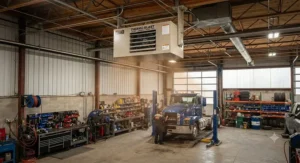
This is the outlier in the lineup, and deliberately so: the Big Maxx MHU45NG burns natural gas rather than drawing electricity, delivering 45,000 BTU/h through a power-vented design that uses a 4-inch intake/exhaust pipe instead of requiring a full masonry chimney. That output is roughly two-and-a-half times what the strongest electric unit here produces, making it the realistic choice once you’re heating a larger detached garage, workshop, or a bay housing an RV or boat rather than a standard two-car space. Electronic ignition means no standing pilot light to babysit, and Mr. Heater rates the unit at roughly 80% thermal efficiency, which is respectable for this class of suspended unit heater. What most buyers overlook is that a gas unit heater is a fundamentally different installation project than any electric option on this list — it needs a gas line run to the mounting location, proper venting per the manufacturer’s clearance diagrams, and in most Canadian municipalities, a permit and inspection by a licensed gas fitter, not just an electrician. Aggregated buyer and trade feedback on the Big Maxx line consistently describes it as a significant step up in heat output per dollar of ongoing fuel cost compared to running multiple electric units, with the main recurring criticism being the higher upfront installation complexity and cost relative to a plug-in or hardwired electric heater.
Pros:
- ✅ 45,000 BTU output dwarfs every electric option here
- ✅ Power-vented design avoids full chimney requirements
- ✅ Lower ongoing fuel cost per BTU than electric resistance heat
Cons:
- ❌ Requires a licensed gas fitter and permit in most areas
- ❌ Significantly higher installed cost than any electric unit
Budget roughly C$700-C$950 for the unit itself, plus professional installation costs for the gas line and venting — a real investment, but one that scales far better for large or detached garages than stacking multiple electric heaters ever could.
Full Spec Comparison: All 7 Ceiling Mount Garage Heaters at a Glance
| Product | Voltage/Fuel | Output | Control Type | Best For |
|---|---|---|---|---|
| Fahrenheat FUH54 | 240V electric | 2,500/5,000W | Built-in dial thermostat | Simple hardwired reliability |
| NewAir G56 | 240V electric | 5,600W | Digital + remote | Portable-or-mounted flexibility |
| Comfort Zone CZ220 | 240V electric | 5,000W | Dual-knob + remote | Analog remote convenience |
| Dr. Infrared Heater DR-988 | 240V electric | 5,600W | Wide-range dial | Frost protection, dual mounting |
| Dimplex RCH5031CXW Connex | 240V electric | 5,000W | Electronic, Connex-ready | Quiet, refined operation |
| Stelpro Spider SGH4002R | 240V/208V electric | 4,000/3,000W | External thermostat | Compact, contractor-grade builds |
| Mr. Heater Big Maxx MHU45NG | Natural gas | 45,000 BTU | Wall thermostat | Large detached garages |
Scanning across this table, the real dividing line isn’t wattage — it’s whether you want plug-and-play simplicity or are prepared to involve a licensed tradesperson. The Fahrenheat FUH54, NewAir G56, Comfort Zone CZ220, and Dr. Infrared Heater DR-988 all fall into the more accessible DIY-adjacent category, provided your panel has capacity and you use a licensed electrician for the actual circuit. The Stelpro Spider SGH4002R and Mr. Heater Big Maxx MHU45NG both assume a higher baseline of professional involvement, whether that’s a compatible thermostat purchase or a full gas-fitting job.
Mounting Height Requirements and Garage Ceiling Clearance
Mounting height requirements aren’t a suggestion buried in the fine print — they directly determine how evenly a ceiling mount garage heater actually heats the room below it, and getting this wrong is one of the most common reasons buyers feel underwhelmed by a unit that’s specced correctly for their space. For electric fan-forced units in the 5,000-watt class similar to several products above, manufacturer installation guides typically call for mounting the heater at least 8 feet above the floor, with maximum heights varying by airflow pattern — units that discharge air horizontally generally top out around 8 feet, while those with adjustable vertical discharge can be mounted as high as 11 feet. Garage ceiling clearance requirements layer on top of that: expect guidance calling for roughly 14 inches of side clearance to walls and at least 3 feet of clearance in front of the discharge path to any flammable stored materials — a real consideration in a garage that doubles as storage.
Gas-fired suspended unit heaters, like the Mr. Heater Big Maxx MHU45NG, follow a related but distinct set of rules rooted in combustion safety rather than airflow pattern alone. Modine’s Hot Dawg installation manual — a widely referenced document in this product category — specifies keeping the bottom of the unit at least 7 feet above the floor in commercial settings unless properly guarded, with a minimum of 18 inches of clearance to combustible materials on most sides. The Canadian Electrical Code and its provincial adoptions govern the electrical side of these installations, and the Wikipedia overview of the Canadian Electrical Code is a useful starting point for understanding how it relates to (and differs from) the U.S. National Electrical Code your imported product manual may reference. Bottom line: don’t eyeball this. Every product in this guide ships with a specific installation manual stating exact height and clearance figures for that model, and those numbers should override any general rule of thumb, including the ones above.
Airflow Direction: Getting Even Heat From an Overhead Garage Heater
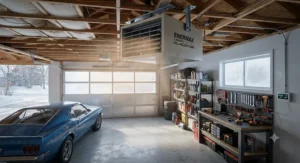
Airflow direction is the single most under-discussed spec on any overhead garage heater, and it’s the difference between a garage that heats evenly and one with a hot spot directly under the unit and cold corners everywhere else. Most fan-forced ceiling units, including the tiltable brackets on the Fahrenheat FUH54 and Comfort Zone CZ220, are designed so the discharge airflow should “wipe” across exposed walls and open floor space rather than blasting straight down or directly at a single fixed point — a principle borrowed from commercial unit-heater design where louvers are deliberately angled to avoid creating a single stagnant heat column. Here’s what most installation photos online won’t show you: many manufacturers recommend a slight downward-and-outward tilt, angling the discharge toward the center of the room’s working area rather than toward the nearest wall, so the warm air has room to circulate before it cools and sinks.
For units like the NewAir G56 and Dr. Infrared Heater DR-988 with swivel mounting brackets, this means you can and should adjust the angle after your first few hours of use — stand in different parts of the garage and feel where the warm air actually reaches, then fine-tune from there rather than assuming the factory-default angle is optimal for your specific room dimensions and ceiling height. Gas-fired units like the Mr. Heater Big Maxx MHU45NG use adjustable horizontal deflector blades for the same purpose; Modine’s own guidance for this style of equipment specifies keeping deflector blades open at least 30 degrees from vertical to ensure heated air actually reaches floor level rather than stratifying near the ceiling — a real risk in any garage with a taller-than-average roofline.
Practical Usage Guide: Installing and Maintaining Your Overhead Garage Heater
Getting a ceiling mount garage heater installed safely starts with your electrical panel, not the heater itself. Before ordering any 5,000-6,000W unit, confirm your garage sub-panel or main panel has capacity for a dedicated 240V circuit sized to the manufacturer’s amperage rating — the Fahrenheat FUH54 at full output draws about 20.9 amps, which typically calls for a 30-amp breaker and appropriately rated wire, and your electrician needs to verify that against your actual panel rather than a generic online chart. Second, map out your mounting location relative to garage doors, workbenches, and any parked vehicle’s roofline, since airflow direction (discussed above) only works if the unit isn’t fighting against a physical obstruction directly below it.
Once installed, maintenance for electric units is refreshingly low: wipe down the intake grille every month or two to prevent dust and garage debris from restricting airflow, since a clogged intake forces the motor to work harder and can trip built-in overheat protection unnecessarily. For gas units like the Mr. Heater Big Maxx MHU45NG, annual inspection of the venting and burner assembly by a licensed gas fitter isn’t optional — it’s the difference between years of safe, efficient operation and a slow, invisible degradation in combustion efficiency. A common first-month mistake across both fuel types: buyers mount the heater, then stack seasonal storage boxes directly beneath or in front of the discharge path, which is both a fire risk with electric coil heaters and a serious safety issue with any open-flame or vented gas appliance.
Real-World Scenarios: Matching a Ceiling Mount Garage Heater to Your Garage
Consider three genuinely different Canadian garage situations. A condo or townhouse owner with a small, single-car attached garage and no plans for major electrical work is the clearest case for the Comfort Zone CZ220 or Fahrenheat FUH54 — both are straightforward 5,000W units that a licensed electrician can wire onto a single dedicated circuit without major panel upgrades. A homeowner with a detached two-and-a-half-car garage used as an active workshop, who wants the flexibility to eventually relocate the heater or run it portable during a renovation, fits the NewAir G56 or Dr. Infrared Heater DR-988 far better, since both are genuinely designed for dual portable-or-mounted use. And a rural property owner with a large detached shop or barn-style garage housing equipment, an RV, or a boat is the realistic target buyer for the Mr. Heater Big Maxx MHU45NG — at that scale, running two or three electric units to match 45,000 BTU of gas heat would mean a far larger electrical service upgrade than the gas line and venting the Big Maxx requires.
Problem → Solution: Common Overhead Garage Heater Issues
Garage still cold despite an installed heater? The most frequent cause is simple undersizing relative to an uninsulated or poorly sealed space — a 4,000-5,000W electric unit was never going to keep pace with an uninsulated detached garage in a Prairie winter, and the honest fix is either upgrading to a higher-output option like the Mr. Heater Big Maxx MHU45NG or improving wall and door insulation before adding more heating capacity. Heater tripping the breaker repeatedly? That almost always points to a circuit that’s undersized or shared with other loads rather than a defective unit — a licensed electrician needs to confirm your panel’s actual capacity against the heater’s nameplate amperage before you assume the appliance itself is at fault. Uneven heating with a persistent cold corner? Revisit the airflow direction guidance above; in many cases this is solved simply by adjusting the discharge tilt rather than buying a second heater. Musty or burning-dust smell on first seasonal startup? That’s typically just accumulated dust burning off a coil that’s been dormant since last spring, and it should clear within a few minutes — but a smell that persists or intensifies warrants shutting the unit off and having it inspected.
How to Choose a Ceiling Mount Garage Heater
- Confirm your electrical capacity before comparing features. Have a licensed electrician verify your panel can support a dedicated 240V circuit before you fall in love with any specific wattage.
- Match output to garage size and insulation, not just square footage. An insulated single-car garage needs far less than an uninsulated detached two-and-a-half-car space — when in doubt, size up rather than down.
- Decide between electric and gas early. Electric units like the Comfort Zone CZ220 suit smaller spaces with simpler installs; gas units like the Mr. Heater Big Maxx MHU45NG make more sense once you need serious BTU output.
- Check whether the thermostat is built in or sold separately. The Stelpro Spider SGH4002R requires an external thermostat purchase — factor that into your total cost comparison.
- Verify the mounting height and clearance figures in the actual manual. Don’t rely on a general rule of thumb; every product ships with model-specific numbers that account for its airflow pattern.
- Weigh portability if you might move or renovate. The NewAir G56 and Dr. Infrared Heater DR-988 both offer genuine dual portable-or-mounted flexibility other units lack.
- Factor in noise if the garage is small or attached to living space. The Dimplex RCH5031CXW Connex is a noticeably quieter option worth the modest premium in that scenario.
Electric vs Gas-Fired Overhead Garage Heaters
| Factor | Electric Ceiling Heater | Gas-Fired Unit Heater |
|---|---|---|
| Typical output | 2,500-5,600W (8,500-19,000 BTU) | 30,000-125,000+ BTU |
| Installation | Dedicated 240V circuit, electrician | Gas line, venting, licensed gas fitter |
| Upfront cost | Lower unit and install cost | Higher unit and install cost |
| Running cost per BTU | Generally higher (resistance heat) | Generally lower where natural gas is available |
| Best-fit garage size | Single or two-car, attached | Larger detached garages, shops, barns |
The gap here isn’t really about which fuel heats better — a natural gas unit heater and an electric resistance heater both convert their input energy to heat quite efficiently. The real difference, as Natural Resources Canada’s commercial gas unit heater program notes, is that natural gas typically costs less per unit of delivered heat than electricity in most Canadian markets, which matters enormously once you’re running a heater for hours at a time in a larger space. For a typical two-car attached garage used a few hours a week, that cost gap rarely justifies the installation complexity of going gas; for a large detached shop run daily through winter, it usually does.
Ceiling Mount vs Floor-Standing Garage Heaters: Why Space-Saving Workshop Heaters Win
| Consideration | Ceiling Mount Garage Heater | Floor-Standing Space Heater |
|---|---|---|
| Floor/workspace footprint | None — fully overhead | Occupies floor space permanently |
| Trip and cord hazards | Minimal once installed | Higher, especially with extension cords |
| Airflow coverage | Wide, directional discharge | Localized, often blocked by objects |
| Theft/damage risk in shared spaces | Lower — permanently fixed | Higher — easily moved or bumped |
| Setup complexity | Requires mounting and often an electrician | Simple plug-in, no installation |
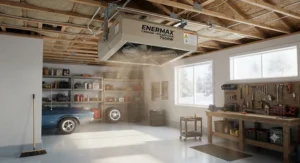
A space saving workshop heater earns that description because every one of the seven products above gets the heating element entirely out of your working footprint — no floor unit to work around while you’re maneuvering a ladder, a car jack, or a table saw. As a ceiling mounted shop heater, a unit like the NewAir G56 or Dimplex RCH5031CXW Connex also sidesteps the extension-cord tangle that floor heaters create in garages where the nearest outlet isn’t conveniently placed. The trade-off is upfront installation effort: a floor-standing heater is plug-and-play, while every ceiling mount option here needs at least a licensed electrician’s time, and the gas-fired Mr. Heater Big Maxx MHU45NG needs considerably more. For anyone using their garage as an actual workshop rather than pure car storage, that one-time installation cost buys back permanent floor space every single day afterward.
Common Mistakes When Buying an Overhead Garage Heater
The single most common mistake is buying based on wattage or BTU alone without confirming your electrical panel or gas service can actually support it — a 5,600W heater on an undersized circuit, or a 45,000 BTU gas unit without adequate gas line capacity, is a problem waiting to surface at the worst possible moment. A close second is assuming any unit labelled “ceiling mount” ships with a thermostat included; as the Stelpro Spider SGH4002R demonstrates, some professional-grade units expect you to source a compatible thermostat separately, and skipping that line item in your budget leads to an unpleasant surprise at checkout. Buyers also frequently skip reading the specific mounting height and clearance section of their model’s manual, defaulting instead to whatever height “looks about right,” which is precisely how uneven heating and airflow complaints happen. Finally, treating a portable-capable unit like the NewAir G56 or Dr. Infrared Heater DR-988 as purely a floor heater — never taking advantage of its ceiling-mount hardware — means paying for flexibility you’re not actually using.
Long-Term Cost & Maintenance of a Ceiling Mounted Shop Heater
Running a 5,000W electric ceiling mounted shop heater for roughly an hour a day works out to 5 kWh daily, which across a Canadian winter adds a real but generally modest amount to your electricity bill, varying meaningfully by province given the wide range in residential electricity rates across the country. Gas-fired options like the Mr. Heater Big Maxx MHU45NG carry a considerably higher upfront installed cost but tend to cost less per BTU delivered over a heavy-use winter, particularly in a larger detached space run for several hours most days. Maintenance across the electric lineup is consistent and low: clean intake grilles every month or two, and have a licensed electrician re-check circuit connections every few years, since vibration and thermal cycling can gradually loosen wire terminations in any hardwired appliance. For the gas unit, annual professional inspection of the burner, heat exchanger, and venting isn’t a suggestion — it’s the maintenance item that catches small combustion or venting issues before they become safety problems, and it’s typically far cheaper than the repair bill (or worse) that comes from skipping it for several seasons running.
Safety, Circuits & Canadian Code Compliance for Garage Heaters
Every electric unit in this lineup needs a circuit sized and installed according to the Canadian Electrical Code, adopted provincially with local amendments, and that work should be done by a licensed electrician who pulls the appropriate permit — not wired in as a DIY project onto an existing outlet, regardless of how straightforward the heater’s own instructions make it look. For gas-fired equipment like the Mr. Heater Big Maxx MHU45NG, the stakes are higher still: improper venting or an inadequate gas line connection is a genuine carbon monoxide risk, which is exactly why most Canadian municipalities require a licensed gas fitter and a permitted inspection before the unit goes into service. This is also a good moment to double-check your garage’s carbon monoxide detection, especially if you’re installing any gas-fired appliance — Ontario’s fire code changes now require carbon monoxide alarms more broadly across residential properties, and even where a garage itself isn’t a listed requirement, having a detector in an adjacent living space is a cheap, sensible precaution whenever combustion equipment is present nearby. None of this paperwork is bureaucratic friction for its own sake — it’s the layer that catches wiring and venting mistakes before they become house fires or CO incidents, and skipping it can also void a home insurance claim if something does go wrong.
Frequently Asked Questions
❓ What is the best ceiling mount garage heater for a small garage?
❓ How high should a ceiling mount garage heater be installed?
❓ Do I need an electrician to install a ceiling mount garage heater?
❓ Is a gas or electric overhead garage heater cheaper to run?
❓ Can a ceiling mount garage heater be moved later?
Conclusion
Choosing among ceiling mount garage heaters really comes down to three questions: how much space you’re actually heating, whether your existing electrical service (or gas line) can support the option you want, and how much installation complexity you’re willing to take on. Budget-conscious buyers with a standard attached garage do well with the Fahrenheat FUH54 or Comfort Zone CZ220; anyone who wants the flexibility to run portable now and mount permanently later should look at the NewAir G56 or Dr. Infrared Heater DR-988; buyers prioritizing quiet, refined operation have a clear pick in the Dimplex RCH5031CXW Connex; contractors and DIYers comfortable sourcing their own thermostat get compact, professional-grade construction from the Stelpro Spider SGH4002R; and anyone heating a large detached garage, shop, or barn should seriously price out the Mr. Heater Big Maxx MHU45NG against running multiple electric units.
None of these decisions need to be made in isolation — a licensed electrician’s or gas fitter’s quick assessment of your specific garage, done before you order anything, will tell you more about what actually fits your space and panel than any spec sheet alone ever could.
🔍 Ready to compare current prices and availability? Check every pick above on Amazon.ca before the cold weather sets in!
Recommended for You
- 7 Best Garage Heaters Under $200 CAD in 2026
- Safest Bathroom Heater for Wet Rooms: 7 Picks for Canada (2026)
- 7 Best Bathroom Heaters With Timer and Thermostat (2026)
Disclaimer: This article contains affiliate links. As an Amazon Associate, I earn from qualifying purchases. If you purchase products through these links, we may earn a small commission at no additional cost to you.
✨ Found this helpful? Share it with your friends! 💬🤗
