
In This Article
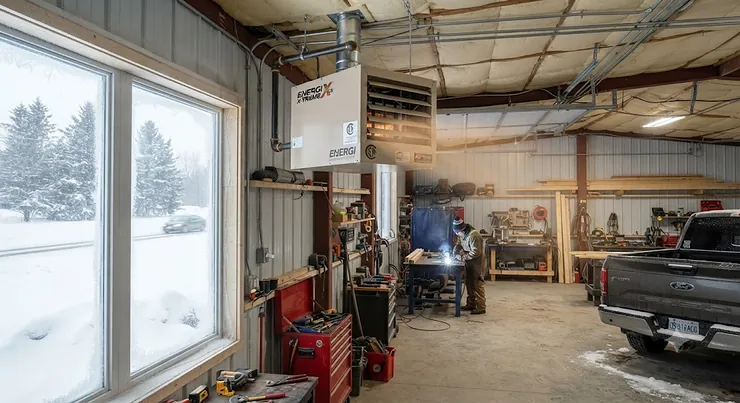
A natural gas shop heater for large garage use is a permanently piped, forced-air or infrared heating unit that draws fuel from a home’s or property’s existing gas line rather than a portable tank, delivering continuous, high-BTU heat suited to two-car-plus bays, detached shops, and pole barns. If you’ve ever tried heating a genuinely large garage with an electric space heater and watched your breaker panel revolt, you already understand why natural gas dominates this category — it’s the only fuel source that can realistically sustain 50,000 to 300,000+ BTU of output hour after hour without you babysitting a tank or a circuit breaker.
This matters more in Canada than almost anywhere else. Winnipeg mechanics, Calgary hobbyists, and Ontario weekend woodworkers are all fighting the same battle against design temperatures that regularly dip below -20°C (-4°F), and a garage that isn’t seriously heated simply stops being usable for four or five months a year. Natural gas workshop heating solves that problem at a fuel cost that, unlike propane or electricity, doesn’t spike every time you refill a tank or run a few extra circuits — provided the space is actually piped for gas, which is the whole crux of this article.
We researched real product specifications, aggregated review sentiment, and Canadian gas-code guidance to assemble seven genuinely useful options spanning budget ceiling-mounted units up to serious 300,000 BTU commercial-grade heaters. Because these are combustion appliances, ventilation and carbon monoxide awareness aren’t optional extras — Natural Resources Canada’s guidance on combustion gases and spillage in the home is written for furnaces but applies directly to any fuel-burning heater sharing air with people.
Below, you’ll find honest analysis of specs, real-world BTU output versus marketing claims, heater sizing for square footage math you can actually use, and a full breakdown of gas line installation cost and permit requirements so you know what you’re really signing up for before a single wrench turns. Whether this is your first large garage heating solutions purchase or you’re upgrading from an underpowered propane setup, the goal is a shortlist grounded in real specs, not sales copy.
Quick Comparison: Top Picks at a Glance
| Category | Product | BTU Output | Best For |
|---|---|---|---|
| Best Overall | Mr. Heater Big Maxx MHU80NG | 80,000 BTU | 3- to 4-car attached garages |
| Best Budget | Mr. Heater Big Maxx MHU50NG | 50,000 BTU | Single- or two-car shops |
| Best High-BTU Pick | Reznor UDXC-300 | 300,000 BTU (174,300–249,000 output) | Large detached shops, pole barns |
| Best Radiant Pick | SunStar SIS125 Infrared Tube Heater | 125,000 BTU | Tall-ceiling bays with frequent door traffic |
That table tells most of the story at a glance: BTU output has to scale with real square footage, but the “right” pick depends just as much on ceiling height, how often the door opens, and whether you’re heating an attached bay or a fully detached shop. The Mr. Heater Big Maxx MHU80NG earns the overall nod because Home Depot Canada lists it as rated for roughly a 3- or 4-car garage footprint, which covers the majority of Canadian buyers shopping this category. Meanwhile, the Reznor UDXC-300 exists for a completely different job — a detached shop with 4-metre ceilings where anything under 150,000 BTU would spend all day just fighting infiltration losses.
💬 Just one click — help others make better buying decisions too!😊
The Best Natural Gas Shop Heater for Large Garage Use: Top 7 Picks
1. Mr. Heater Big Maxx MHU50NG — budget-friendly entry point for mid-size shops
The MHU50NG’s standout feature is genuine affordability without sacrificing the ceiling-mounted, code-compliant design that separates a real shop heater from a portable job-site unit. Rated at 50,000 BTU, the manufacturer states it can heat up to roughly 1,667 square feet (155 m²) under ideal insulated conditions, and it runs on a built-in high-velocity electric fan pulling air across the heat exchanger with electric spark ignition and a self-diagnostic control module. In practice, that coverage number assumes a reasonably tight, insulated space — an uninsulated two-and-a-half-car garage will fall meaningfully short of that figure once you account for heat loss through an old sectional door. Reviewers consistently describe it as reliable and easy for a licensed installer to hook up quickly, with the most common critique being that the low-profile design still needs a genuine 8-foot minimum ceiling clearance, which catches some buyers with lower garage ceilings off guard. For a single-car-plus garage or a smaller two-car bay that’s reasonably sealed up, this is the lowest-risk way to get into permanently piped natural gas heat.
Pros:
- ✅ Genuinely affordable entry into ceiling-mounted natural gas heat
- ✅ Includes NG-to-LP conversion kit for future fuel flexibility
- ✅ Self-diagnostic spark ignition simplifies troubleshooting
Cons:
- ❌ Undersized for anything beyond a modest two-car footprint
- ❌ Requires a full 8 feet of ceiling clearance to install
At the time of research, expect a price somewhere in the C$1,050–C$1,300 range before installation — a reasonable budget floor for real natural gas heat, provided your garage matches its actual coverage.
2. Mr. Heater Big Maxx MHU80NG — sized for genuine 3- to 4-car garages
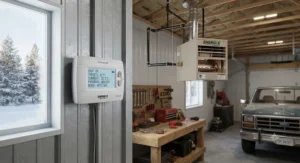
Step up to the MHU80NG and the standout feature is straightforward: Home Depot Canada rates this unit to heat up to approximately 2,667 square feet (248 m²), or roughly a 3- or 4-car garage footprint, which is exactly the sweet spot most people mean when they say “large garage.” At 80,000 BTU, it uses the same electric spark ignition and built-in high-velocity fan design as its smaller sibling, but the added output means it can actually recover temperature quickly after the overhead door opens and closes during a repair session. Because it’s sold directly through Home Depot Canada with a 1-inch mounting clearance requirement and a minimum 10-foot ceiling height, it’s a genuinely accessible option for Canadian buyers rather than something you’re importing or special-ordering. Aggregated customer sentiment on the Big Maxx line broadly praises consistent heat output and dependable cold-weather ignition, with the recurring complaint being that a dedicated line-voltage thermostat is sold separately and easily overlooked when budgeting the full install. This is the unit most home mechanics with a genuine multi-bay garage should default to before jumping straight to a commercial-grade unit they don’t need.
Pros:
- ✅ Rated for roughly a 3- to 4-car garage footprint
- ✅ Sold directly through Home Depot Canada for easy sourcing
- ✅ Same reliable spark ignition system as the smaller MHU50NG
Cons:
- ❌ Thermostat sold separately, adding to real install cost
- ❌ Needs a full 10-foot ceiling height to mount correctly
Pricing for this size class typically lands around C$1,400–C$1,750 at the time of research, which puts it comfortably in the mid-range for anyone genuinely heating a multi-vehicle bay.
3. Dyna-Glo Delux 150,000 BTU Natural Gas Forced Air Heater — most raw output per dollar
What sets this unit apart from the ceiling-mounted Big Maxx models is portability paired with genuinely massive output: at 150,000 BTU, the manufacturer rates it for up to 3,500 square feet (325 m²), and its compact footprint means it sits on the floor rather than requiring permanent ceiling mounting. Thermostat control across a 35–95°F (1.7–35°C) range, interrupted spark ignition, and built-in overheat and fuel auto-shutoff protections make it a genuinely capable unit for a large open bay, though its portable, floor-standing design is a meaningfully different animal from a fixed commercial ceiling unit — this is closer to a job-site or seasonal heater than a permanent installation. Reviewers who’ve used comparable Dyna-Glo forced-air units for large garages and workshops consistently note fast, noticeable heat output, with the most common criticism being that a unit this size still needs a hard-piped or properly regulated hose connection to a natural gas source, which isn’t a plug-and-play affair. For anyone who wants maximum BTU for the lowest sticker price and doesn’t mind a floor-standing unit rather than a ceiling-mounted one, this is the clear value leader on raw output.
Pros:
- ✅ Massive 150,000 BTU output at a genuinely low price point
- ✅ Thermostat-controlled operation across a wide temperature range
- ✅ Portable floor-standing design needs no ceiling mounting
Cons:
- ❌ Not a fixed installation — still needs a proper gas hookup
- ❌ Floor-standing footprint takes up usable shop space
Expect a price around C$550–C$700 at the time of research, making it the most aggressive value play on this entire list relative to BTU output.
4. Modine Hot Dawg HD125 — best low-profile pick for tight ceiling clearance
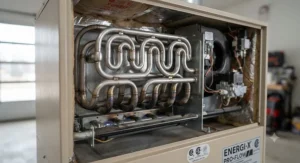
The Hot Dawg’s defining trait is its low-profile cabinet, engineered to install just one inch below the ceiling — a genuine advantage in older Canadian garages with limited overhead clearance where a bulkier unit simply won’t fit. Rated at 125,000 BTU input with roughly 100,000 BTU of actual usable output at 80% thermal efficiency, it throws heat up to 56 feet (17 m) and can be mounted as high as 16 feet, which suits a genuinely large open bay with a vaulted or raised ceiling. The permanently lubricated motor means less routine maintenance than older unit heaters with grease fittings, and CSA certification confirms it meets Canadian appliance safety standards for combustion equipment — worth checking for, since not every imported unit heater carries it. Aggregated review sentiment on the Hot Dawg line is strongly positive around long-term reliability in workshop settings, with the most repeated critique being that licensed installation is mandatory and non-negotiable, which adds meaningfully to the total project cost beyond the heater’s price tag. For a shop with awkward ceiling height or joist spacing, this low-profile design is often the only unit that physically fits.
Pros:
- ✅ Ultra-low-profile cabinet fits tight ceiling clearance
- ✅ CSA certified with strong long-term reliability reputation
- ✅ 56-foot heat throw suits genuinely large open bays
Cons:
- ❌ Requires mandatory licensed installation, adding to total cost
- ❌ 80% actual output means some input BTU is lost to inefficiency
At the time of research, pricing sits around C$2,700–C$3,100 — a premium reflecting genuine commercial-grade build quality and brand reputation.
5. Reznor UDXC-300 — best high-efficiency pick for large detached shops
There’s no subtlety to this unit’s appeal: rated at 300,000 BTU input with a two-stage output range of 174,300 to 249,000 BTU, the UDXC-300 is built for spaces where smaller ceiling units simply can’t move enough heat fast enough — think detached three-bay shops, farm garages, or any space with ceilings well above the standard 2.4 metres (8 ft). What genuinely sets it apart is 82–83% thermal efficiency, described by the manufacturer as best in its class, meaning considerably less of every dollar of gas gets wasted compared to standard-combustion units like the smaller Big Maxx models. Power-vented operation with a field-convertible separated combustion option, a 3,843 CFM airflow rating, and an alphanumeric error-code display for troubleshooting all point toward genuinely commercial-grade engineering rather than a residential afterthought. Reviewers and installers who work with large detached shops consistently flag this unit as delivering noticeably lower operating costs over a full winter compared to older, less efficient unit heaters, though the trade-off is a heavier upfront investment and a genuinely complex install that demands an experienced gas fitter. For anyone heating a true large-format shop where fuel costs actually matter over a full season, the efficiency premium pays for itself.
Pros:
- ✅ Best-in-class 82–83% thermal efficiency cuts fuel costs
- ✅ Two-stage output matches heat to actual demand
- ✅ Commercial-grade build for genuinely large detached shops
Cons:
- ❌ Highest upfront cost of any unit on this list
- ❌ Complex power-vented install needs an experienced gas fitter
Pricing runs around C$4,200–C$4,700 at the time of research — a serious investment that only makes sense once your square footage genuinely calls for it.
6. SunStar SIS125 Infrared Tube Heater — best radiant option for tall, draughty bays
Unlike every forced-air unit on this list, the SIS125’s standout feature is that it heats objects and people directly through radiant infrared energy rather than heating and circulating air — a meaningful advantage in a large bay where the door opens and closes constantly. Rated at 125,000 BTU across a 30-, 40-, or 50-foot tube length, it requires a minimum mounting height of 82 inches below the unit and just 6 inches of ceiling clearance, plus a vacuum system pulling combustion byproducts through the chamber for what the manufacturer calls increased radiant efficiency. Because radiant heat warms surfaces and people in its direct line of sight rather than the entire air volume, it keeps working almost immediately even when a forced-air unit would be losing ground every time the overhead door goes up — a genuine advantage for anyone in and out of the garage constantly. Reviewers who run tube heaters in workshops and warehouses consistently report that the lack of fan noise is a standout quality-of-life improvement over forced air, while the most common critique is that tube heaters need a genuinely tall ceiling to install correctly, ruling them out for standard 8-foot garages entirely. For a detached shop with 10-foot-plus ceilings and a door that’s constantly in motion, this is arguably the smartest heating style on the list.
Pros:
- ✅ Radiant heat keeps working through frequent door openings
- ✅ Genuinely quiet operation with no forced-air fan noise
- ✅ Flexible 30-, 40-, or 50-foot tube length options
Cons:
- ❌ Needs a minimum ceiling height most standard garages lack
- ❌ Higher install complexity than a straightforward ceiling unit
Expect pricing in the C$2,300–C$3,200 range depending on tube length, at the time of research — a genuine premium for a fundamentally different, and often more comfortable, heating style.
7. Williams Monterey 3509622A — best no-power-required wall furnace
The Monterey’s defining trick is that it needs no electricity whatsoever — it’s a gravity-vented, top-vent wall furnace rated at 35,000 BTU with 66% AFUE efficiency, meaning it’ll keep running through a power outage when every forced-air unit on this list goes dark. Designed to heat rooms up to roughly 600 square feet (56 m²), it’s genuinely undersized for a true multi-car garage on its own, but its ceramic-coated combustion chamber and simple gravity venting make it a smart supplemental or zone-heating choice for an attached workshop room or office carved out of a larger garage. Because it mounts flush to a wall rather than the ceiling, it also suits a shop with limited or obstructed overhead clearance where none of the ceiling-mounted units on this list would physically fit. Aggregated review sentiment on Williams wall furnaces is positive around long-term durability and simplicity, with the most frequent criticism being that 66% AFUE is noticeably less efficient than the power-vented Reznor unit, meaning higher gas bills per BTU delivered over a full winter. For a smaller zone within a larger uninsulated shop, or as a backup that survives a grid outage, this is a genuinely different tool than the rest of this lineup.
Pros:
- ✅ Operates with zero electricity, even during power outages
- ✅ Wall-mounted design fits spaces with obstructed ceilings
- ✅ Simple gravity venting with minimal moving parts
Cons:
- ❌ 66% AFUE efficiency trails every power-vented unit here
- ❌ Undersized on its own for a genuine multi-car garage
At the time of research, pricing sits around C$1,750–C$2,050 — reasonable for a genuinely different use case rather than a direct competitor to the higher-BTU units above.
✨ Ready to Stop Freezing in Your Own Garage? 🔥
Whichever pick fits your space and ceiling height, click through to check today’s price and availability before the cold weather hits — natural gas heater stock tends to move fast once the first real cold snap arrives!
Natural Gas Shop Heater Comparison: Full Spec Breakdown
| Product | BTU Output | Style | Efficiency | Best For |
|---|---|---|---|---|
| Mr. Heater Big Maxx MHU50NG | 50,000 BTU | Ceiling-mounted forced air | Standard combustion | Single- or small two-car garages |
| Mr. Heater Big Maxx MHU80NG | 80,000 BTU | Ceiling-mounted forced air | Standard combustion | 3- to 4-car garages |
| Dyna-Glo Delux 150,000 BTU Natural Gas Forced Air Heater | 150,000 BTU | Portable floor-standing forced air | Standard combustion | Large open bays, seasonal use |
| Modine Hot Dawg HD125 | 125,000 BTU input / ~100,000 output | Low-profile forced air | 80% thermal efficiency | Tight ceiling clearance shops |
| Reznor UDXC-300 | 300,000 BTU (two-stage) | Power-vented forced air | 82–83% thermal efficiency | Large detached shops |
| SunStar SIS125 Infrared Tube Heater | 125,000 BTU | Radiant infrared tube | High radiant efficiency | Tall, draughty open bays |
| Williams Monterey 3509622A | 35,000 BTU | Gravity wall furnace | 66% AFUE | Zone heating, power-outage backup |
Lining these seven up side by side, the efficiency gap between the standard-combustion Big Maxx units and the power-vented Reznor UDXC-300 is the single biggest long-term cost variable on this table, even though it’s invisible on a showroom floor. The Dyna-Glo Delux 150,000 BTU Natural Gas Forced Air Heater wins on sheer BTU-per-dollar, but its portable, floor-standing design trades away the fixed, code-integrated installation that the ceiling-mounted units offer. Buyers choosing between the Modine Hot Dawg HD125 and SunStar SIS125 Infrared Tube Heater are really choosing between two different heating philosophies — moving warm air versus radiating heat directly — and that decision matters more than any single spec on this chart.
Real-World Scenarios: Matching a Heater to Your Garage and Shop
Every one of these seven units performs differently depending on who’s actually using it. First, the weekend hobbyist with an attached two-and-a-half-car garage used for small projects and seasonal storage — this is squarely Mr. Heater Big Maxx MHU50NG territory, since the space is small enough that 50,000 BTU comfortably outpaces heat loss without excessive gas spend once the room is reasonably sealed. Second, the home mechanic with a genuine attached four-car garage who spends entire winter weekends under a vehicle: this buyer needs the Mr. Heater Big Maxx MHU80NG‘s larger coverage rating, since a smaller unit would struggle every time the overhead door opens during a repair session. Third, the rural property owner with a detached, uninsulated pole-barn shop used for equipment storage and welding — here the Reznor UDXC-300 or the radiant SunStar SIS125 Infrared Tube Heater make far more sense, particularly the SunStar if the ceiling is tall enough and the door is constantly in motion. Matching the scenario to the unit, rather than defaulting to the biggest BTU number on the shelf, is consistently what separates a satisfied buyer from someone stuck with an oversized, inefficient heater burning through gas bills for no real benefit.
Gas Line Shop Heater Installation: What the Hookup Actually Involves
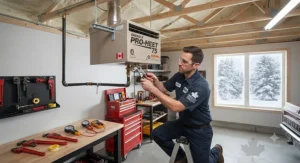
Installing a gas line shop heater is not a weekend DIY project, and understanding the actual steps helps set realistic expectations before you buy. A licensed gas fitter first calculates the total gas demand of your new heater alongside every other gas appliance already running off the same meter — furnace, water heater, range — to confirm the existing supply line and meter can handle the added load without derating everything else in the house. From there, the technician runs new piping (sized correctly in diameter and length per the gas code) from the meter or an existing line to the heater’s location, which might mean fishing pipe through a finished wall, running it along exposed framing in an unfinished garage, or trenching underground to a detached shop. Every joint gets pressure-tested before the line is buried or closed up, and the heater itself needs proper venting — either a dedicated flue for power-vented units like the Reznor, or specific clearance and combustion-air provisions for gravity-vented units like the Williams. Before any digging happens near a property line or underground utility run, a proper utility locate through your local “click before you dig” service is standard practice, and Enbridge Gas’s own guidance on safe digging around gas lines is worth a read even if you’re only supervising a contractor rather than digging yourself.
Buyer’s Decision Framework: Which Type Fits Your Situation
Picking the right natural gas shop heater for large garage conditions really just means matching one of these profiles to your actual space. If your garage is a standard attached two-car bay with reasonable insulation, choose the Mr. Heater Big Maxx MHU50NG because its 50,000 BTU rating and existing gas line proximity keep install costs manageable. If you’re heating a genuine 3- to 4-car attached garage, choose the Mr. Heater Big Maxx MHU80NG because its larger coverage rating matches that footprint without the complexity of a commercial power-vented unit. If fuel efficiency over a full Canadian winter matters more than upfront cost, choose the Reznor UDXC-300 because its 82–83% thermal efficiency will noticeably outperform standard-combustion units on your gas bill. If your shop has a tall ceiling and a door that’s constantly opening, choose the SunStar SIS125 Infrared Tube Heater because radiant heat keeps working when forced air would be losing ground. And if you need heat that survives a power outage or your ceiling can’t accommodate a mounted unit, choose the Williams Monterey 3509622A because gravity venting and wall mounting solve both problems at once.
How to Choose the Right Natural Gas Shop Heater for a Large Garage
- Measure your actual square footage and ceiling height first. A garage with a vaulted or raised ceiling needs meaningfully more BTU than the floor area alone would suggest.
- Confirm your existing gas line and meter can handle the added load. A licensed gas fitter needs to size this against every other appliance already on the same supply.
- Decide between forced air and infrared based on how the space is used. Frequent door traffic favours radiant heat; stationary work at a bench suits forced air just fine.
- Check the efficiency rating, not just the BTU number. An 82% efficient unit meaningfully outperforms a 66–70% unit on gas bills over a full winter.
- Verify CSA certification before buying. Appliances sold for the Canadian market should carry certification confirming compliance with Canadian gas-appliance safety standards.
- Budget realistically for installation, not just the unit price. Piping, venting, permits, and labour routinely cost as much as or more than the heater itself.
- Confirm ceiling clearance and mounting height requirements match your space. Several genuinely good units on this list are ruled out entirely by a low garage ceiling.
Natural Resources Canada’s page on gas, oil-fired, and electric furnaces is written primarily for house furnaces, but the underlying efficiency principles — matching equipment to genuine heating demand rather than buying the biggest number on the shelf — apply just as directly to shop heater sizing decisions.
Heater Sizing for Square Footage: The BTU Math That Actually Works
Getting heater sizing for square footage right is the single biggest factor in whether a natural gas shop heater satisfies you or ends up running constantly without ever quite catching up. Uninsulated or lightly insulated garage space generally needs 45–60 BTU per square foot, while a well-insulated, properly sealed shop can often get by on 30–35 BTU per square foot — meaning an uninsulated bay can require nearly double the heating capacity of an equivalent insulated one. A standard two-car attached garage around 400–500 square feet (37–46 m²) typically needs 25,000–30,000 BTU at minimum, comfortably within the MHU50NG’s range if the space is reasonably sealed. A genuine 3- to 4-car garage around 700–900 square feet (65–84 m²) generally calls for 60,000–80,000 BTU, which is exactly the territory the MHU80NG is built for. Detached shops or garages over 1,200 square feet (111 m²) with high ceilings routinely need 125,000–300,000 BTU, matching the Modine, SunStar, and Reznor units on this list. The mistake most buyers make isn’t undershooting the square footage number itself — it’s forgetting that an old, unweatherstripped sectional door or a single-pane window can each add 15–25% more effective heating demand on top of the base floor-area calculation.
Forced Air vs Infrared: Which Natural Gas Heater Style Wins in a Large Shop
The forced air versus infrared debate for a large natural gas shop heater comes down to a genuinely simple trade-off: whole-room air temperature versus targeted, immediate radiant warmth. Forced air units like the Big Maxx and Reznor lines use a fan to actively push heated air throughout the space, warming the entire air volume including corners and areas near the ceiling — a clear advantage in a space where you’re moving around the whole bay or repeatedly opening the garage door to bring vehicles in and out. Infrared tube heaters like the SunStar, by contrast, warm objects and people directly in their radiant field rather than heating the air itself, which means they keep delivering usable heat right at the moment the door opens, since there’s no warm air to lose in the first place. The practical downside of radiant heat is that anyone standing well outside its direct field gets comparatively little benefit, while forced air’s circulated warmth reaches every corner more evenly, if more slowly after a cold start. If your shop work involves standing in roughly one spot at a bench near the tube’s line of sight, radiant wins on comfort and quiet; if you’re moving around a full multi-bay space with the door constantly cycling, forced air’s whole-room recovery is generally the safer bet.
Natural Gas Workshop Heating vs Propane: Which Fuel Actually Makes Sense
| Factor | Natural Gas | Propane |
|---|---|---|
| Fuel supply | Piped continuously, no tanks to refill | Stored in tanks, needs periodic refills |
| Upfront cost | Higher, due to gas line installation | Lower, no line install required |
| Running cost | Generally cheaper per BTU delivered | Generally pricier per BTU delivered |
| Best for | Garages already on the utility gas grid | Detached or rural garages without gas main access |
The natural gas workshop heating case is strongest whenever a garage already sits on a property connected to the utility gas grid, since the ongoing cost-per-BTU advantage over propane compounds meaningfully across a full Canadian heating season that can run five or six months. Propane remains the more sensible choice for a detached rural shop with no gas main nearby, simply because trenching a new line across a large property can cost more than years of propane tank refills would. The upfront cost gap is real and shouldn’t be dismissed — a propane setup with a tank and regulator is often live and heating within a day, while a natural gas install can take weeks once permits and a licensed gas fitter’s schedule enter the picture. For a genuinely large garage that’s already on the gas grid, though, the long-term fuel savings from natural gas typically outweigh that slower, pricier start within just a few winters of regular use.
Gas Line Installation Cost in Canada: What to Budget Before You Commit
| Scenario | Typical Cost Range (CAD) |
|---|---|
| Attached garage, gas line already nearby | C$500–C$1,200 |
| Attached garage, longer interior run | C$800–C$1,500 |
| Detached garage or shop, trenched underground | C$1,500–C$3,500+ |
| Full install including heater, permit, and labour | C$3,500–C$6,000+ |
Gas line installation cost is consistently the single most underestimated part of this entire project, and the numbers above reflect real ranges reported across Ontario and Alberta contractors. A straightforward run in an attached garage where the gas line already passes nearby is genuinely affordable, often landing in the C$500–C$1,200 range, while a detached garage or shop requiring underground trenching can easily run C$1,500–C$3,500 or more once excavation and restoration are factored in. Labour for a licensed gas fitter typically runs C$75–C$150 per hour depending on region, and a full turnkey install — heater, piping, venting, permit, and inspection — commonly lands somewhere between C$3,500 and C$6,000 for a detached garage project. Buyers consistently underestimate this line item because the heater itself is the visible, exciting purchase, while the invisible piping work behind the wall or under the yard often costs just as much or more.
Permit Requirements and Licensed Gas Fitters: What Canadian Code Demands
Permit requirements for a natural gas shop heater installation aren’t a bureaucratic suggestion — they’re a legal requirement enforced by provincial safety authorities, and skipping them creates real insurance and resale problems down the line. Gas piping and appliance connections must be installed, tested, and documented by a licensed gas technician, following code requirements set out in CSA B149.1, the natural gas and propane installation code used across Canada. In Ontario, that oversight falls to the Technical Standards and Safety Authority, and TSSA’s own Field Approval Program page outlines how non-certified equipment or unusual installations get evaluated and approved before they’re considered code-compliant. Other provinces run equivalent delegated authorities — Technical Safety BC and Alberta’s Safety Codes Council among them — but the underlying principle is identical everywhere: only a certified gas technician may legally install, modify, or connect gas piping and appliances, and the completed work must be inspected and documented. Skipping this step to save money is a genuine liability risk, since an uninspected or improperly permitted gas appliance can void a homeowner’s insurance policy entirely in the event of a fire or carbon monoxide incident, and it can also complicate or kill a home sale when a buyer’s inspector flags undocumented gas work.
What to Expect: Real-World Performance in a Canadian Winter
Spec sheets rarely capture what a natural gas shop heater actually feels like day to day, and the gap between a manufacturer’s coverage rating and lived winter experience trips up plenty of first-time buyers. In practice, a rated coverage number like “2,667 square feet” assumes a reasonably sealed, insulated space — an uninsulated garage with an old sectional door and no weatherstripping will fall meaningfully short of that figure once a genuine Canadian cold snap sets in below -15°C (5°F). Expect a heat-up period of roughly 15–30 minutes before a large bay reaches a genuinely workable temperature after a cold start, a temperature gradient where the area directly under a forced-air unit feels noticeably warmer than distant corners, and gas consumption that climbs faster than expected any time the overhead door opens and closes repeatedly during active work. None of this makes natural gas the wrong choice — it remains dramatically more cost-effective per BTU than electric resistance heat for a space this size — but setting realistic expectations up front is what separates buyers who stay satisfied through a full winter from those who feel misled by a rated square-footage number on a spec sheet.
Common Mistakes When Buying a Natural Gas Garage Heater
The single most common mistake is buying based on floor-area square footage alone without adjusting for ceiling height or insulation quality, which routinely leaves buyers with a unit undersized by 20–40% for genuine cold-weather performance. A close second is skipping the gas-demand calculation entirely — assuming the existing meter and line can simply absorb a new 80,000 or 150,000 BTU appliance without a licensed fitter actually checking, which can lead to an undersized supply line starving every gas appliance in the house. Third is underestimating installation cost relative to the heater’s sticker price, since piping, venting, and labour frequently cost as much as or more than the unit itself. Fourth, buyers often choose a forced-air unit for a tall, draughty space where an infrared tube heater would perform noticeably better, then blame the heater rather than the style mismatch. Finally, many people treat permits and licensed installation as optional friction rather than a legal requirement, a decision that can void insurance coverage and create real problems at resale time.
Long-Term Cost and Maintenance Considerations
Total cost of ownership for any natural gas shop heater extends well beyond the purchase price and the initial gas line installation cost, and it’s worth running the numbers before committing to a tier. A standard-combustion unit like the Big Maxx line burns noticeably more gas per BTU delivered than a high-efficiency unit like the Reznor UDXC-300, meaning the pricier unit can actually cost less across a full heating season once fuel savings are factored in. Maintenance across this category is relatively light compared to a full house furnace — mainly annual inspection of the burner and heat exchanger, checking vent terminations for blockage or corrosion, and confirming the flame sensor and ignition components are functioning before the first genuinely cold week of the season. Forced-air units with fan motors have one additional wear point worth budgeting for over a decade of heavy use: bearing or motor replacement, which the permanently lubricated designs on units like the Modine Hot Dawg are specifically engineered to delay. When comparing cost-per-BTU across the full lineup, the higher-efficiency power-vented units generally offer the best long-term value for anyone using a large shop heavily through a full Canadian winter, while lower-cost standard-combustion units still make sense for lighter, occasional use.
Frequently Asked Questions
❓ What size natural gas heater do I need for a large garage?
❓ How much does it cost to run a gas line to a garage heater in Canada?
❓ Do I need a permit to install a natural gas garage heater?
❓ Is natural gas cheaper than propane for heating a shop?
❓ Can I install a natural gas unit heater myself?
Conclusion
Choosing the right natural gas shop heater for large garage use ultimately comes down to matching real square footage, ceiling height, and gas-line access to an honest BTU number, rather than defaulting to the biggest unit on the shelf or the cheapest one you can find online. For most attached multi-car Canadian garages, the Mr. Heater Big Maxx MHU80NG delivers the best balance of coverage, cost, and straightforward installation, while genuinely large detached shops are far better served by the efficiency of the Reznor UDXC-300 or the radiant comfort of the SunStar SIS125 Infrared Tube Heater. Whichever tier fits your space, the non-negotiables stay the same across every option on this list: confirm your existing gas supply can handle the added load, budget honestly for installation cost rather than just the heater price, and never skip the licensed gas fitter and the permit that comes with them. Get those fundamentals right, and a properly sized natural gas heater turns an unusable winter garage into genuinely comfortable shop space for the entire cold season — which, depending on your postal code, might be six months of the year or more.
✨ Don’t Miss These Exclusive Deals! 🔍
Take your garage heating setup to the next level with these carefully selected natural gas heaters. Click on any highlighted product to check current pricing and availability on amazon.ca. These picks will help you turn a cold, unusable garage into a genuinely comfortable shop space your whole family can enjoy through the coldest Canadian months!
Recommended for You
- Propane Garage Heater Vs Electric Garage Heater: 7 Best Picks 2026
- Electric Garage Heater for Canadian Winters: 7 Best Picks (2026)
- Ceiling Mount Garage Heaters: 7 Top Picks for Canada (2026)
Disclaimer: This article contains affiliate links. As an Amazon Associate, I earn from qualifying purchases. If you purchase products through these links, we may earn a small commission at no additional cost to you.
✨ Found this helpful? Share it with your friends! 💬🤗
