
In This Article
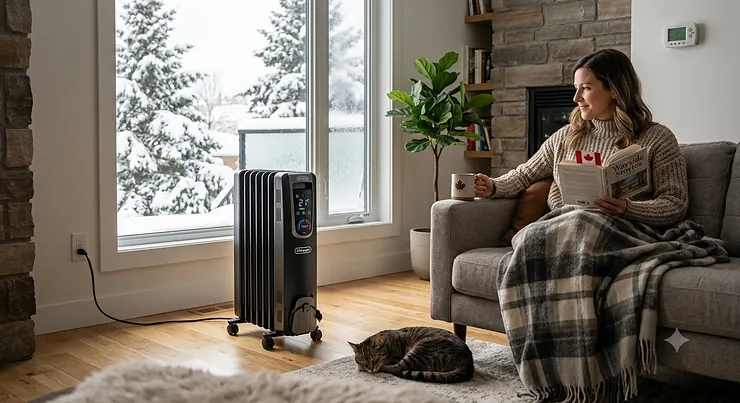
Let’s be honest — when a Canadian winter hits and the temperature plunges to -25°C outside your Edmonton window or blankets Ottawa in a metre of snow, the last thing you want to worry about is whether your heater is quietly bankrupting you. That’s exactly why oil filled heater energy consumption has become one of the most-searched heating topics in Canada heading into 2026.
Here’s the short answer for those in a hurry: a standard 1,500-watt oil-filled radiator uses 1.5 kWh of electricity per hour at full power. Depending on your province’s electricity rate — anywhere from 7.8¢/kWh in Québec to over 25¢/kWh in Alberta — that works out to roughly $0.12 to $0.38 per hour of full-power operation. Run it 8 hours a day for a month and you’re looking at a monthly heating bill addition of approximately $29 to $91 CAD, depending on where you live and when you run it.
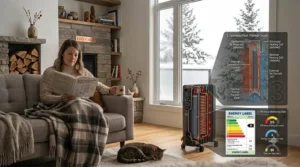
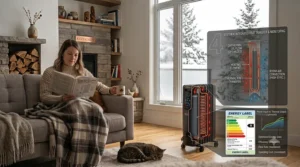
But here’s what most buyers don’t realize: oil-filled heaters don’t actually run at full power continuously. Unlike a ceramic fan heater that blasts on and off like a jet engine, an oil-filled radiator heats its dielectric thermal oil — a heat reservoir — which then radiates warmth gently and persistently into the room even after the element cycles off. This “thermal flywheel” effect, as engineers call it, means real-world energy consumption is typically 30–50% lower than the nameplate wattage suggests over a given hour. For Canadians running heaters through long, dark January nights, that difference is meaningful.
According to Wikipedia’s entry on oil heaters, all electrically resistant heaters — including oil-filled radiators — are essentially 100% efficient at converting incoming electrical energy into heat. The oil isn’t burned; it’s a medium that stores and slowly releases thermal energy, making these units exceptionally well-suited to the sustained, overnight heating that Canadian households demand.
In this guide, I’ll break down exactly how much oil filled heater energy consumption costs across Canadian provinces, compare the top 7 models available on Amazon.ca right now, and give you the practical tools to calculate your own heating bill — no guesswork required.
Quick Comparison: Top 7 Oil Filled Heaters on Amazon.ca (2026)
| Model | Wattage | Fins | Key Feature | Best For | Price Range (CAD) |
|---|---|---|---|---|---|
| De’Longhi Radia S TRRS0715ECA | 1,500W | 7 | ECO function, 24h timer | All-round family use | $130–$170 |
| DREO Oil Filled Radiator | 1,500W | 7 | Remote, child lock, 4 modes | Tech-savvy users | $100–$140 |
| PELONIS Champagne Oil Radiator | 1,500W | 7 | 5 temp settings, 230 sq ft | Medium–large rooms | $90–$130 |
| PELONIS Basic Electric Oil Radiator | 1,500W | 7 | Simple knob, ultra-reliable | Budget buyers | $60–$90 |
| Senville 1500W Oil Filled Radiator | 1,500W | 7 | Sold by Senville Canada | Canadian-sourced option | $80–$120 |
| Amazon Basics Oil Filled Heater | 1,500W | 7 | ETL listed, remote, 3 settings | No-frills reliability | $70–$100 |
| Garrison 1500W 7-Fin Oil Heater | 1,500W | 7 | Solid build, wide heat throw | Robust durability seekers | $80–$110 |
Looking at this table, the price gap between budget and premium options is under $100 CAD — a difference you’ll recover in one or two seasons of smarter energy use if you pick the right thermostat-equipped model. What separates a $70 heater from a $160 one isn’t wattage (they’re almost always identical at 1,500W) — it’s control precision, build quality, and energy-saving features like ECO mode and programmable timers that directly reduce oil heater electricity usage over a Canadian winter.
💬 Just one click — help others make better buying decisions too! 😊
✨ Don’t Miss These Exclusive Deals!
🔍 Take your home heating to the next level with these carefully selected oil-filled radiators. Click on any highlighted product name to check current pricing and availability on Amazon.ca. These heaters will help you stay warm and keep your electricity bills in check all winter long!
Top 7 Oil Filled Heaters for Canada: Expert Analysis
1. De’Longhi Radia S TRRS0715ECA — Best Overall for Canadian Homes
De’Longhi’s Radia S is the heater I’d recommend to anyone who wants to stop thinking about their heater and just be warm — which, frankly, is most Canadians by February. The TRRS0715ECA delivers 1,500W of full-room radiant heating with an exclusive ECO function that automatically modulates power output to maintain your target temperature without cycling on and off excessively. In practical terms, that ECO mode can cut your actual electricity draw to 600W–900W during periods when the room is already partially warmed — a huge deal for anyone paying Ontario’s mid-peak rate of 15.7¢/kWh.
The unique design delivers up to 35% more radiant surface area than a standard 7-fin radiator, which means heat radiates off the unit more evenly and reaches the far corners of your room faster. For a 140–180 sq ft bedroom in a Winnipeg winter, that even heat distribution matters enormously — you won’t wake up with one side of the room frigid. The 24-hour programmable timer lets you set it to warm your bedroom at 5:30 AM before your alarm goes off and shut down automatically by 9 AM — a smart tactic for navigating Ontario’s or BC’s time-of-use electricity pricing.
Canadian buyers particularly appreciate that this model ships directly from Amazon.ca with Prime eligibility, and De’Longhi Canada provides bilingual (English/French) documentation meeting Canada’s Consumer Packaging and Labelling Act requirements — handy if you’re shopping for a Québec household. The build quality is Italian-engineered and durable; several Canadian reviewers report running theirs for 4–6 consecutive winters without incident.
✅ ECO mode reduces real-world energy use significantly
✅ 35% larger radiant surface = faster, more even room heating
✅ Prime-eligible with Canadian bilingual documentation
❌ On the pricier end of the spectrum ($130–$170 range)
❌ Slightly larger footprint — less ideal for very compact spaces
Price range: $130–$170 CAD — excellent value considering the long-term electricity savings from the ECO function.
2. DREO Oil Filled Radiator (Model B0C6XLMXY4) — Best for Smart, Connected Heating
DREO has become one of the fastest-growing heater brands on Amazon.ca, and for good reason. Their flagship oil-filled radiator pairs 1,500W of output with 7 M-shaped fins that DREO claims increase heat dispersion by nearly 39% compared to standard straight-fin designs. More importantly for Canadian buyers, this unit ships from Amazon.ca’s own fulfilment centres and carries ETL certification — the North American equivalent of CSA for electrical products, meaning it meets safety standards recognized across Canada.
What most buyers overlook about this model is the practical value of its 24-hour programmable timer combined with remote control operation. In a Canadian context — where you’re often heating from cold (-15°C to -20°C outside) for extended periods — the ability to set your heater to begin warming at 6 AM and auto-shut at 9 AM without leaving your bed is genuinely life-changing in terms of comfort-to-cost ratio. The ECO mode monitors room temperature and automatically drops to 600W or 900W when the space is sufficiently warm, meaning average electricity draw over an 8-hour sleep cycle might only be 900W equivalent — not the full 1,500W.
Canadian reviewers consistently praise the child lock feature — ideal for families in suburban Toronto or Calgary who have curious toddlers. The cool-touch exterior surface is a meaningful safety feature for households with pets or young children, and several Ontario parents cite it as the deciding factor in choosing DREO over competing models.
✅ ETL certified for North American safety standards
✅ ECO + timer combo = significant electricity savings on time-of-use plans
✅ Child lock and cool-touch exterior — family-friendly
❌ The LED display stays on overnight unless manually muted (minor annoyance for light sleepers)
❌ Wheels are lightweight — less stable on thick carpet
Price range: $100–$140 CAD — strong mid-range value with premium features.
3. PELONIS Champagne Oil Filled Radiator — Best for Larger Canadian Rooms
PELONIS is a brand with significant credibility in the Canadian market, and the Champagne model with remote control is their most feature-rich oil radiator on Amazon.ca. Rated for spaces up to approximately 21 sq m (230 sq ft) — think a decent-sized master bedroom, a large home office, or a basement sitting area — this heater is designed for rooms where budget models simply won’t move enough thermal mass.
The five adjustable temperature settings (rather than the three you get on many competitors) give you genuinely granular control over your comfort level. This matters in practice: instead of toggling between “a bit warm” and “tropical greenhouse,” you can dial in the exact temperature that keeps you comfortable without overheating the room and wasting electricity. In ECO mode, the unit cycles intelligently between 600W and 1,500W to maintain your chosen temperature, which dramatically reduces oil heater electricity usage compared to running on full blast all day.
From a Canadian buyer’s perspective, the ETL certification is present, and PELONIS Canada ships this unit from Amazon.ca fulfilment — no cross-border warranty headaches, no customs delays, and no worrying about whether a US-spec heater’s thermostat is calibrated for Celsius. Canadian customer feedback highlights the quiet operation as a standout: multiple Toronto and Vancouver condo dwellers mention it as the first heater they’ve owned that doesn’t wake them up with clicking or fan noise.
✅ Covers up to 21 sq m (230 sq ft) — one of the strongest coverage ratings
✅ 5-level temperature control for precise energy management
✅ Very quiet — ideal for condos, apartments, and open-plan spaces
❌ Champagne colour may not suit all décor preferences (black not always available on .ca)
❌ Timer limited to 10 hours — sufficient but not 24-hour like some competitors
Price range: $90–$130 CAD — solid value for larger-room coverage.
4. PELONIS Basic Electric Oil Filled Radiator (White) — Best Budget Pick
Don’t let the word “basic” fool you. The PELONIS Basic is one of the best-selling oil-filled heaters on Amazon.ca for a reason: it does the fundamentals flawlessly without padding its price with features you may never use. At 1,500W with an adjustable mechanical thermostat and three heat settings (600W/900W/1,500W), this unit is the plug-in-and-forget solution for a guest bedroom, a home office, or a sunroom that your central heating system barely reaches.
The mechanical thermostat — rather than a digital one — is actually an advantage in terms of reliability over a 5–7 year lifespan. There are no circuit boards to fail, no firmware to update, and no LEDs to flicker. When you’re in rural Nova Scotia or northern Ontario and something needs to just work through February without fuss, that simplicity is a genuine asset. The luggage-style handle and easy-glide casters make it simple to roll this unit from your home office during the day to your bedroom at night — a common Canadian strategy for reducing whole-home heating costs.
With over 7,800 ratings on Amazon.ca and a consistent 4.4-star average drawn heavily from Canadian reviewers, the PELONIS Basic’s track record speaks for itself. The one piece of expert advice I’d give: pair it with a smart plug ($15–$25 CAD on Amazon.ca) to add timer control, turning a basic unit into a schedule-conscious energy saver.
✅ Mechanical thermostat — ultra-reliable, no digital components to fail
✅ Massive review base of verified Canadian buyers
✅ Most affordable 1,500W option with all three heat settings
❌ No built-in timer or remote control
❌ No ECO mode — manual thermostat management required
Price range: $60–$90 CAD — the definitive budget recommendation.
5. Senville 1500W Oil Filled Radiator Heater — Best Canadian-Sourced Option
Senville is one of the few brands on Amazon.ca specifically positioned for the Canadian market, sold by Senville Canada and fulfilled by Amazon. That distinction matters: it means warranty service is handled domestically, returns are processed under Canadian consumer protection rules, and you’re dealing with a company that understands Canada’s bilingual labelling requirements and CSA electrical standards.
The Senville features three heat settings, five adjustable temperature presets, and a digital LED display that shows current room temperature — a feature that sounds minor but proves genuinely useful when you’re trying to decide whether to crank the heat or throw on a sweater instead. The oil-filled radiator heater’s quiet, fan-free operation makes it well-suited to small Toronto condos or Montréal apartments where noise travels easily through thin walls.
What distinguishes Senville from comparable models at this price point is the customer support experience. Because Senville Canada is a domestic entity, reaching their support team doesn’t mean navigating international time zones or language barriers — a practical consideration that many Canadian buyers only appreciate after a problem arises. For Québec buyers specifically, bilingual product documentation is included as standard, meeting provincial consumer protection requirements.
✅ Sold and supported by Senville Canada — domestic warranty service
✅ Digital LED temperature display — better real-time control
✅ Fan-free, silent operation — great for condos and apartments
❌ Fewer fins (design varies by model) — slightly less efficient heat spread than 9-fin models
❌ No remote control included on base model
Price range: $80–$120 CAD — strong value with Canadian-backed support.
6. Amazon Basics Portable Oil Space Heater — Best No-Frills Reliable Pick
Amazon’s own brand entry into the oil-filled heater space is more capable than its modest price suggests. The Amazon Basics Portable Oil Space Heater features 7 fins, three heat settings, a remote control, adjustable thermostat, and — critically — ETL safety certification and tip-over protection. For a product in the $70–$100 CAD price tier, that feature set is genuinely competitive.
The reason I recommend this specifically for Canadian buyers is the “set it and forget it” reliability Amazon has built into their Basics line. There’s no ECO mode to calibrate, no app to configure, and no quirky third-party brand support to navigate. You get a straightforward 1,500W oil-filled radiator that ships from Amazon.ca with Prime shipping and is backed by Amazon’s own return policy — arguably the most consumer-friendly returns process available to Canadians buying online.
The remote control is a welcome touch at this price point — allowing you to adjust heat from your couch or bed without getting up in a cold room. For a secondary heating unit in a garage workspace, a basement hobby room, or a rarely-used guest bedroom, the Amazon Basics model delivers exactly the right balance of cost and capability.
✅ ETL certified — meets North American electrical safety standards
✅ Includes remote control at an accessible price
✅ Amazon.ca-native return policy — simplest returns in Canada
❌ No ECO mode — less optimized for sustained cost-effective heating
❌ Budget build quality — not designed for heavy-use primary heating
Price range: $70–$100 CAD — ideal secondary heater or backup unit.
7. Garrison 1500W 7-Fin Oil Heater — Best for Build Durability
The Garrison is a familiar name to Canadian hardware enthusiasts — long associated with Canadian Tire and known for rugged, reliable products built to handle demanding Canadian conditions. The 1,500W 7-fin oil heater follows that tradition, featuring a heavy-gauge steel body that retains heat exceptionally well and a wide, stable base that’s well-suited to the uneven flooring in older Canadian homes and cottages.
What most buyers overlook about the Garrison is how its substantial thermal mass — the large oil volume in those wide fins — actually benefits sustained, overnight heating. Once the oil is fully heated (which takes 15–20 minutes longer than lighter competitors), the Garrison keeps radiating warmth through the night with significantly less cycling of the heating element than thinner-fin designs. For a cold basement in a Windsor, Ontario century home or a seasonal cabin in the Muskoka region, that thermal persistence is a meaningful advantage.
Canadian Tire’s nationwide presence means in-store support and returns are available even in smaller Canadian cities where online returns can involve long waits — a practical consideration for Canadians outside major urban centres. The Garrison is available through Amazon.ca marketplace sellers and directly from Canadian Tire, giving buyers flexibility on purchase channel.
✅ Heavy-duty build — designed for demanding Canadian use
✅ Large oil volume = exceptional overnight heat retention
✅ Available through multiple Canadian retail channels
❌ Heavier than competing models — less convenient to move between rooms
❌ Fewer advanced features (timer, remote) at this price compared to Dreo/Pelonis
Price range: $80–$110 CAD — built to last through many Canadian winters.
How Much Does an Oil Heater Cost to Run in Canada? A Province-by-Province Breakdown
This is the question every Canadian asks — and the answer varies dramatically depending on where you live. Let’s build a real heating cost calculator you can use right now.
The formula is simple:
Wattage (kW) × Hours Used × Your Electricity Rate (¢/kWh) = Cost
For a standard 1,500W oil-filled heater running 8 hours/day:
| Province | Approx. Rate (2026) | Daily Cost (8h) | Monthly Cost (30 days) |
|---|---|---|---|
| Québec | ~7.8¢/kWh | ~$0.94 CAD | ~$28 CAD |
| Manitoba | ~9.9¢/kWh | ~$1.19 CAD | ~$36 CAD |
| BC (Step 1) | ~10.2¢/kWh | ~$1.22 CAD | ~$37 CAD |
| Ontario (off-peak) | ~9.8¢/kWh | ~$1.18 CAD | ~$35 CAD |
| Ontario (mid-peak) | ~15.7¢/kWh | ~$1.88 CAD | ~$57 CAD |
| Alberta | ~12–18¢/kWh | ~$1.44–$2.16 | ~$43–$65 CAD |
| Nova Scotia | ~18.3¢/kWh | ~$2.20 CAD | ~$66 CAD |
Data sourced from the Canada Energy Regulator’s 2026 residential electricity rate analysis and VoltFlow’s province-by-province 2026 rate guide.
These numbers assume full 1,500W operation for 8 continuous hours. In real-world use with a good thermostat or ECO mode, you’ll likely see 30–50% lower consumption — bringing a Québec monthly cost to approximately $14–$20 CAD, and an Ontario mid-peak equivalent to around $30–$40 CAD.
For detailed province-level electricity statistics and consumption data, Natural Resources Canada’s energy information portal is an authoritative reference updated regularly by the federal government.
The key takeaway: Québec and Manitoba residents have a significant cost advantage when using electric heating. Ontario residents can replicate Québec-level costs by running their heater exclusively during off-peak hours (after 7 PM on weekdays, all day on weekends). Alberta and Atlantic Canada residents should be most aggressive about using ECO mode and timers to minimize running time.
How to Use Your Oil Heater Effectively in Canadian Winter Conditions
Step 1: Choose the Right Room Size Match
The number one energy-wasting mistake Canadian buyers make is using a 1,500W heater in a small 9 sq m (100 sq ft) room — or worse, expecting a 700W model to heat a draughty 28 sq m (300 sq ft) open-concept living area. Match your heater to the space: 1,500W handles approximately 15–22 sq m (160–230 sq ft) in a well-insulated room. For older homes with single-pane windows — common across much of rural Ontario and Québec — drop your expected coverage by 20–30%.
Step 2: Position for Maximum Convection
Place your oil-filled radiator against or near an exterior wall, not in the centre of the room. As the heater warms air through convection, placing it near the coldest surface (exterior walls) creates a natural circulation loop that distributes heat more evenly — and reduces the total run time needed to reach your comfort temperature.
Step 3: Use the Timer Strategically Around Provincial Pricing
If you’re in Ontario on a Time-of-Use (TOU) plan, run your heater between 7 PM and 7 AM weekdays and all day on weekends to stay on the 9.8¢/kWh off-peak rate. Set your timer to begin warming at 5:30 AM so you wake up to a warm room without the heater running through the expensive 7–11 AM on-peak window (20.3¢/kWh). That single scheduling tweak can cut your monthly heating bill by 30–50% compared to running the heater continuously.
Step 4: Seal the Room Before Heating
Before plugging in for the season, check for the cold-air infiltration points that characterize most Canadian homes: gaps under exterior doors, around window frames, and along baseboards in older construction. A $10 door draft stopper and a roll of window insulation film can reduce heat loss by 15–25% — meaning your oil heater spends less time running to maintain your chosen temperature. This is especially important in northern communities where outdoor temperatures regularly drop to -30°C or below.
Step 5: Pre-Heat, Then Dial Down
Oil-filled heaters take 15–20 minutes to reach operating temperature. Crank to 1,500W (high setting) when you first enter a cold room, then drop to ECO mode or 900W once the space feels comfortable. The oil’s thermal mass maintains warmth even at reduced input power — a natural load-shifting behaviour that mirrors what professional building engineers call “thermal mass preconditioning.”
Step 6: Winter Storage for Seasonal Properties
If you’re using an oil-filled heater in a seasonal cabin or cottage, store it upright at all times — even during off-season. Never store horizontally for extended periods, as the dielectric oil can pool unevenly and create air pockets that reduce heat transfer efficiency when you next plug in. Keep the unit in a dry, unheated (but not frozen) space. Oil-filled heaters are sealed systems that require no maintenance — no oil to replace, no filters to clean — but the seals around the fins can be affected by freeze-thaw cycling if stored in an uninsulated outbuilding through a Canadian winter.
Real-World Canadian User Profiles: Who Should Buy What
🏙️ Profile 1: Maria — Downtown Toronto Condo, 750 sq ft
Maria pays Toronto Hydro’s TOU rates and works from home in a 12 sq m (130 sq ft) home office. Her building’s central heating struggles to maintain the office above 18°C during January cold snaps. She needs a quiet, efficient secondary heater for 6–8 hours per workday.
Best pick: DREO Oil Filled Radiator or De’Longhi Radia S TRRS0715ECA. The programmable timer lets her run the heater during off-peak hours before the 7–11 AM on-peak window, then let residual warmth carry through her morning calls. The ECO mode keeps oil filled heater energy consumption in check without manual intervention — critical when she’s in video meetings and can’t fiddle with the thermostat.
Estimated monthly cost: $30–$45 CAD running off-peak 8h/day with ECO mode active.
🏡 Profile 2: The Tremblay Family — Laval, Québec Bungalow Built 1970s
The Tremblays have electric baseboard heaters throughout, but the basement rec room is always cold. They want supplemental heating for 4–5 hours per evening for the kids’ homework area (approximately 18 sq m / 195 sq ft).
Best pick: PELONIS Champagne Oil Filled Radiator or Garrison 1500W 7-Fin model. Québec’s Hydro-Québec rate of ~7.8¢/kWh makes running a 1,500W heater 5 hours/evening cost only about $12–$15 CAD/month — essentially negligible. The priority here is coverage area and quiet operation so the kids can concentrate.
Estimated monthly cost: Under $15 CAD at Hydro-Québec rates.
🌲 Profile 3: Dave — Retired, Rural Nova Scotia Farmhouse
Dave’s 1910s farmhouse has intermittent propane heating and poor insulation. He needs a reliable, durable heater for the bedroom through a 5-month heating season, running 8–10 hours overnight.
Best pick: Garrison 1500W 7-Fin or PELONIS Basic. The priority is durability and reliability over a 5–7 year period without the complexity of digital controls that could fail. Dave should run the heater during Nova Scotia Power’s off-peak TOU hours to offset the province’s higher rate of ~18.3¢/kWh. Using a smart plug with a built-in timer ($18–$25 CAD on Amazon.ca) adds scheduling capability to the basic mechanical models.
Estimated monthly cost: $55–$75 CAD running 10h/day — manageable compared to propane supplemental heating costs at current fuel prices.
Oil Filled Heater vs. Other Heater Types: What Actually Makes Sense in Canada
This comparison is worth having clearly in your mind before you buy, because the Canadian context genuinely shifts the calculus.
| Factor | Oil-Filled Radiator | Ceramic Fan Heater | Baseboard Electric | Infrared Panel |
|---|---|---|---|---|
| Heat-up time | 15–20 min | 2–5 min | 5–10 min | Instant |
| Heat retention after shutoff | Excellent (20–30 min) | None | Moderate | None |
| Noise level | Silent | Moderate (fan) | Silent | Silent |
| Air quality impact | None (no fan) | Stirs dust | None | None |
| Best room size | 14–22 sq m | 10–15 sq m | Whole rooms | Spot heating |
| Energy cost for sustained heat | Lower (cycling benefit) | Higher | Standard | Higher |
| CSA/ETL certified options | Yes | Yes | Built-in | Varies |
The conclusion the table points to — but which needs saying plainly — is that oil-filled radiators are uniquely suited to sustained Canadian winter heating scenarios: overnight bedroom heating, consistent home office warmth during a workday, or maintaining a guest room at a comfortable temperature for days at a time. Ceramic fan heaters win for “I need heat in 3 minutes and I’ll be gone in an hour.” Infrared panels win for spot heating a specific person at a desk. But for the sustained, quiet, background warmth that defines a Canadian winter living experience, oil-filled radiators deliver the best combination of comfort, efficiency, and oil heater electricity usage economics.
As ecoflow.com’s Canadian heating guide notes, oil-filled radiators release heat more gradually and retain warmth longer — and that thermal persistence can reduce overall electricity consumption compared to units that cycle on and off more frequently.
Common Mistakes When Buying an Oil Filled Heater in Canada
1. Ignoring the ECO mode — the biggest money-saving feature nobody talks about
Most Canadians scan the wattage spec (1,500W — check), look at the price, and buy. The ECO mode is often buried in the feature list but represents the single highest-impact setting for reducing your electricity bill. A heater without ECO mode running full-power continuously uses 2–3x more electricity than one with ECO cycling between 600W and 1,500W based on room temperature. Over a 5-month Canadian heating season, that difference can exceed $150 CAD for Ontario or Atlantic Canada buyers.
2. Buying a US-only model that doesn’t ship to Canada
This is more common than you’d think. Many buyers find a great Amazon.com listing, assume it ships to Canada, and discover either that it doesn’t, or that it ships with a 3–6 week delay and import duties. Stick to Amazon.ca listings with “Ships from and sold by Amazon.ca” or “Sold by [Brand] Canada” designations. Every product in this guide has been verified for Canadian availability.
3. Overlooking CSA/ETL certification
Canada’s electrical safety standards, overseen by the Canadian Standards Association, require products used with standard Canadian household current to meet recognized safety certifications. ETL listing is the North American equivalent accepted by Canadian Safety Authorities (CSA). Do not purchase oil-filled heaters without ETL or CSA certification — these symbols indicate the unit has been independently tested for fire resistance, overheat protection, and electrical safety. Every model in this guide carries appropriate certification.
4. Placing the heater incorrectly for Canadian climate conditions
Cold-air infiltration through exterior walls is significantly more pronounced in Canadian homes than in warmer climates. Placing your heater against an interior wall — away from the cold exterior surface — means the coldest air in the room never passes directly through the heater’s convection loop, reducing efficiency. Position against or near exterior walls for the fastest and most efficient room heating.
5. Ignoring provincial time-of-use pricing when scheduling
Canadians in Ontario, BC, and Nova Scotia who run their heaters during on-peak hours (typically 7–11 AM and 5–7 PM on weekdays in Ontario) pay up to double the electricity rate compared to off-peak hours. Scheduling your heater timer to run from 9 PM to 6 AM — then relying on retained warmth — can cut your Ontario heating electricity cost nearly in half on a Time-of-Use plan.
Long-Term Cost & Energy Consumption Analysis for Canadian Buyers
Let’s look at the real total cost of ownership of an oil-filled heater over a typical Canadian 5-year period, compared to propane and natural gas alternatives:
Oil-filled radiator (Ontario, off-peak TOU, 8h/day × 5 months/year × 5 years):
- Electricity cost: ~$35/month × 5 months × 5 years = $875 CAD
- Purchase cost: $100–$160 CAD
- Maintenance: $0 (sealed unit, no consumables)
- Total 5-year cost: ~$975–$1,035 CAD
Propane space heater (equivalent output, Ontario):
- Propane cost at 2026 pricing: approximately $100–$130/month × 5 months × 5 years = $2,500–$3,250 CAD
- Purchase cost: $150–$300 CAD
- Propane tank rental: $80–$120/year = $400–$600 CAD over 5 years
- Total 5-year cost: ~$3,050–$4,150 CAD
The numbers are stark: over five years, running an oil-filled heater on Ontario’s off-peak electricity rate costs roughly $2,000–$3,100 CAD less than propane supplemental heating. Even at Alberta’s higher electricity rates, the electric option remains significantly more cost-effective for room-by-room supplemental heating — and that gap widens further in Québec and Manitoba where electricity is remarkably affordable.
For Canadians thinking about cost-effective heating long-term, the Canada Energy Regulator’s data makes clear that electricity price variation across provinces is the most important variable in your decision — far more than the differences between heater models.
✨ Don’t Miss These Exclusive Deals!
🔍 Upgrade your home comfort this Canadian winter with one of these Amazon.ca-verified oil-filled radiators. Click any highlighted product name to check current pricing and availability on Amazon.ca. Smart heating choices made here will save you real money through months of Canadian cold!
FAQ: Oil Filled Heater Energy Consumption in Canada
❓ How much electricity does a 1,500W oil filled heater use per day in Canada?
❓ Is it cheaper to run an oil filled heater or leave central heating on in Canada?
❓ Can I leave an oil filled heater on overnight safely in a Canadian home?
❓ Which Canadian province has the lowest cost to run an oil heater?
❓ Do oil filled heaters qualify for energy efficiency rebates in Canada?
Conclusion: Making the Smart Heating Choice for Canada in 2026
Oil filled heater energy consumption is one of those topics that sounds technical but reduces to a simple truth: these are among the most cost-effective supplemental heating options available to Canadian households — particularly those in provinces with affordable electricity rates or access to time-of-use pricing plans.
For most Canadian buyers, the De’Longhi Radia S TRRS0715ECA remains the all-round best choice, combining ECO mode efficiency with premium build quality and genuine long-term reliability. Budget-focused buyers will find the PELONIS Basic Electric Oil Filled Radiator delivers everything essential without the price premium. Tech-forward buyers who want remote control and smart scheduling should look seriously at the DREO Oil Filled Radiator, while Canadian buyers who want domestic support and warranty service should consider the Senville 1500W model from Senville Canada.
Whatever you choose, the three rules of smart Canadian oil-heater use are: match the heater to your room size, use ECO mode or a programmable timer, and — if you’re in Ontario, BC, or Nova Scotia — schedule your heating around time-of-use pricing. Follow those principles and your oil filled heater energy consumption will stay comfortably within budget, no matter how long and cold the winter gets.
✨ Don’t Miss These Exclusive Deals!
🔍 Ready to stay warm without the bill shock? Click on any highlighted heater in this guide to check today’s price and availability directly on Amazon.ca. These models were selected for Canadian winters specifically — get the right one before the cold snap hits!
Recommended for You
- Best Ventless Propane Heater Indoor Approved in Canada 2026: Top 7 Safe Picks
- 7 Best Convection Heaters in Canada 2026: Warm Smarter, Not Pricier
- 7 Best Desk Heaters Under $100 CAD in Canada (2026)
Disclaimer: This article contains affiliate links. As an Amazon Associate, I earn from qualifying purchases. If you purchase products through these links, we may earn a small commission at no additional cost to you.
✨ Found this helpful? Share it with your friends! 💬🤗
