
In This Article
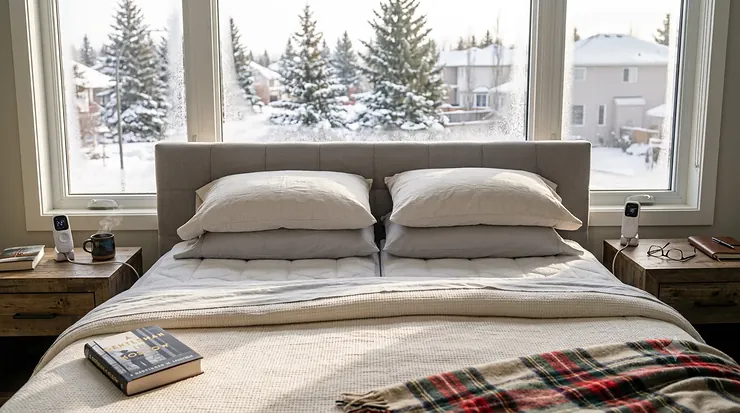
Somewhere around November, every bedroom in Canada turns into a tiny battlefield. One side wants the room like a sauna. The other side is perfectly happy under three blankets and a draft. If that sounds familiar, a king heated mattress pad dual zone system might be the one home upgrade that actually ends the argument instead of restarting it every night. Rather than fighting over the thermostat, each sleeper gets their own controller, their own heat curve, and their own definition of “comfortable.”
This guide walks through seven real, currently available options — from no-frills analog dials to cotton-topped models with twenty heat settings — and breaks down what actually matters when you’re shopping for one. It’s worth noting that heating a whole bedroom is one of the priciest habits in a Canadian home, and CBC has reported on practical ways Canadians cut winter energy bills — a dual-zone pad is essentially that same zone-heating logic applied directly to your bed instead of your whole house. We’ll get into wattage, wire layout, wash-care, and the safety details that Amazon listings tend to gloss over, plus honest, sourced commentary on where each pad shines and where it falls short. Prices below are shown in Canadian dollar ranges rather than exact figures, since retail pricing shifts constantly — always check the current listing before buying.
By the end, you should know not just which pad to click on, but why, and what to actually expect once it’s tucked under your fitted sheet.
What Is a King Heated Mattress Pad With Dual Zone?
A king heated mattress pad with dual zone control is an electric bedding layer that sits between your mattress and fitted sheet, using a grid of insulated heating wires to warm the sleeping surface. “Dual zone” means the king-size pad is split down the middle, so each sleeper gets an independent controller, heat level, and auto-off timer — no compromise required.
Quick Comparison Table
| Product | Zones | Heat Settings | Best For |
|---|---|---|---|
| Sunbeam Premium Cotton King | Dual | 20 | Hot-and-cold sleeping pairs |
| HOMTEC Dual Zone King | Dual | 12 | Timer-and-routine lovers |
| Serta Multi-Zone King | Dual (body + foot) | 10 | Cold-footed sleepers |
| Biddeford Blankets Analog King | Dual | 10 (analog dial) | Tight-budget shoppers |
Looking at this shortlist, the split comes down to how much control you actually want versus how much you want to just plug it in and forget it. The Sunbeam Premium Cotton King and HOMTEC Dual Zone King reward people who like fiddling with settings until the temperature is exactly right, while the Biddeford Blankets Analog King is built for the “just make it warm” crowd who has zero interest in a digital menu at 11 p.m. The Serta Multi-Zone King stands apart because its second zone runs foot-to-body instead of left-to-right, which solves a completely different problem than the others on this list.
💬 Just one click — help others make better buying decisions too!😊
Top 7 King Heated Mattress Pads With Dual Zone Control: Expert Analysis
1. Sunbeam Premium Cotton King — most heat settings for fine-tuned warmth
The standout here is the sheer granularity: twenty heat settings per side means you’re not stuck choosing between “too warm” and “not warm enough” the way cheaper three-or-five-setting pads force you to. The 100% cotton top is genuinely the differentiator against most competitors on this list, which lean on polyester or microfiber blends. Underneath, the pad uses Sunbeam’s fine-gauge wiring, and the auto shut-off caps continuous use at around ten hours — a detail worth noting since Sunbeam has previously issued a heated-blanket recall in Canada for an unrelated model, which is a good reminder to register any electric bedding you buy and to retire it once wiring shows wear.
Based on the spec comparison, this pad suits people who consider themselves “particular” about temperature — the kind of sleeper who wants level 11 out of 20, not just “medium.” Reviewers consistently report that the preheat function genuinely gets the bed toasty within about fifteen minutes, and several note the cotton surface feels noticeably less “plasticky” against skin than polyester alternatives, though a handful mention the quilting pattern shows wear after a couple of years of regular washing.
Pros:
- ✅ Twenty heat settings allow precise, side-by-side customization
- ✅ 100% cotton top feels softer than synthetic competitors
- ✅ Fast preheat gets the bed warm before you climb in
Cons:
- ❌ Premium cotton construction pushes it toward the top of the price range
- ❌ Some owners note quilting wear after extended machine washing
Expect this one to sit in the C$150-C$190 range at most Canadian retailers, and for the added heat-setting precision and cotton surface, it’s a reasonable value pick for anyone who’s tired of “close enough” warmth.
2. Sunbeam Restful Quilted King — best water-resistant build for spill-prone bedrooms
What most buyers overlook about this model is the water-resistant backing, which matters far more than it sounds once you factor in pets, kids’ sippy cups, or the occasional 2 a.m. glass of water knocked sideways. The quilted polyester top runs twelve heat settings with a selectable twelve-hour auto shut-off, so you can choose whether you want it cutting power after a shorter or longer stretch. On paper, this means slightly less granular control than the cotton model above, but in practice twelve settings is still more than enough range for most couples.
Aggregated review sentiment points to fast heat-up and a soft, non-crinkly feel once broken in, with a common complaint being that the fitted-style pocket runs slightly snug on very thick mattresses. It’s a strong option for a household with a dog that insists on sleeping on the bed, or for anyone who’s replaced a spill-ruined pad before and doesn’t want to repeat the experience.
Pros:
- ✅ Water-resistant layer protects against spills and pet accidents
- ✅ Twelve heat settings with selectable auto shut-off duration
- ✅ Quilted texture feels soft rather than plasticky over time
Cons:
- ❌ Deep-pocket fit can run tight on extra-thick mattresses
- ❌ Fewer fine-tuning increments than the 20-setting Sunbeam model
Priced in the C$100-C$140 range typically, this one earns its keep in households where “water-resistant” isn’t a nice-to-have, it’s a requirement.
3. HOMTEC Dual Zone King — best built-in timer for routine sleepers
The standout feature is right there in the name: a genuine 1-12 hour programmable timer paired with a memory function that recalls your last-used setting, so you’re not re-dialing your preferred heat level every single night. That memory feature is a small thing that reviewers keep bringing up unprompted, which tells you it solves a real annoyance rather than being a marketing checkbox. The preheat function lets you warm the bed 20-30 minutes before climbing in, then the timer quietly steps down or shuts off entirely once you’re asleep.
For anyone who goes to bed at roughly the same time every night — shift workers with a fixed schedule, retirees, parents syncing to a toddler’s bedtime — the timer-plus-memory combination genuinely reduces the “fiddling with a remote in the dark” problem that plagues simpler pads. Reviewers frequently mention the twelve heat settings feel evenly spaced rather than clustered at the low end, which isn’t universal among budget-adjacent pads.
Pros:
- ✅ Programmable 1-12 hour timer removes nightly guesswork
- ✅ Memory function saves your preferred heat setting automatically
- ✅ Preheat mode warms the bed before you get in
Cons:
- ❌ Brand has a smaller Canadian review base than legacy names
- ❌ Controller buttons run small for anyone adjusting settings without glasses
Expect a C$80-C$110 range for this one, which is competitive given the timer-and-memory feature set usually reserved for pricier pads.
4. Serta Multi-Zone King — only pad with separate body-and-foot heating zones
Here’s what the spec sheet won’t tell you outright: “multi-zone” on this model doesn’t mean left-side/right-side like the rest of this list — it means your feet get their own heating zone, independent from the rest of your body. That’s a genuinely different problem being solved. If you’re the person who wears socks to bed every single night regardless of house temperature, that’s a strong signal your feet run cold long before the rest of you does, and a foot-specific zone addresses that directly instead of just cranking overall bed heat until your feet catch up.
Because King, and Cal King sizes ship with two individual controllers, couples still get side-by-side independence on top of the body/foot split, though it’s worth noting there isn’t a true four-way zone map — it’s two controllers, each governing a body-plus-foot pairing on their half of the bed. Reviewers frequently describe the foot zone as “finally solving cold feet” without needing to crank the whole pad to an uncomfortable temperature, while a smaller number note the microfiber surface feels less premium than cotton-topped alternatives.
Pros:
- ✅ Dedicated foot zone helps chronically cold feet without overheating the rest of the body
- ✅ Two individual controllers still allow side-by-side independence
- ✅ Soft three-layer microfiber construction feels plush underfoot
Cons:
- ❌ Microfiber surface reads as less premium than cotton-topped models
- ❌ Foot-zone design is less useful if cold feet aren’t your specific issue
Sitting around the C$90-C$120 range, this is a smart pick specifically for cold-footed sleepers rather than a general-purpose recommendation for every couple.
5. Sealy Heated Mattress Pad King — plushest quilted top from a trusted mattress brand
The standout here is brand pedigree combined with genuine plushness — Sealy built its name on mattress comfort, and that shows up in the quilted surface texture, which reviewers consistently describe as feeling closer to a mattress topper than a thin heating layer. Ten heat settings per side with a selectable 1-12 hour auto shut-off keep the control scheme simple without feeling limited, and the ETL certification confirms it’s been independently tested against North American electrical safety standards.
What most buyers overlook is that this pad functions almost as a light mattress topper in its own right, thanks to the extra quilted fill — useful if your existing mattress runs a touch too firm and you’d welcome a slightly softer sleeping surface alongside the added warmth. Aggregated reviews note the deep-pocket fit accommodates thicker modern mattresses comfortably, with occasional mentions that the plush fill takes an extra wash cycle or two before it feels fully broken in.
Pros:
- ✅ Extra-plush quilted top doubles as light mattress-topper comfort
- ✅ Ten evenly spaced heat settings with flexible auto shut-off
- ✅ ETL certified for tested electrical safety
Cons:
- ❌ Premium plush fill nudges it toward the higher end of the price range
- ❌ New units may need a wash or two before the fill fully softens
Expect this one in the C$120-C$160 range — a reasonable ask for a heated pad that also softens the feel of a firmer mattress.
6. Degrees of Comfort Dual Control King — lowest-EMF design for radiation-conscious sleepers
The standout advantage is the brand’s specific engineering focus on minimizing electromagnetic field emissions during heating, paired with independent side-by-side controllers so one partner can run warm while the other stays essentially unheated. Reviewers consistently note the “heat one side, stay cool the other” design genuinely works as advertised, rather than bleeding warmth across the centre seam the way some cheaper zoned pads do.
Here’s what to weigh: EMF exposure from consumer electric bedding is generally considered low by mainstream safety bodies, but for sleepers who are specifically concerned about it — or simply prefer to minimize any additional electromagnetic exposure near their body for eight hours a night — this is one of the few pads on the market built explicitly around that concern, on top of standard UL safety certification. It’s not a substitute for unplugging the unit once you’re warm and asleep, which remains the most reliable way to eliminate any electrical exposure entirely.
Pros:
- ✅ Engineered specifically to reduce EMF emissions during operation
- ✅ Independent dual controllers keep zones genuinely separate
- ✅ UL safety certified with auto shut-off protection
Cons:
- ❌ EMF-focused engineering commands a modest price premium over basic pads
- ❌ Brand’s review volume is smaller than legacy names like Sunbeam or Sealy
Typically found in the C$100-C$140 range, this is a niche-but-legitimate pick for anyone specifically shopping with EMF minimization in mind.
7. Biddeford Blankets Analog King — simplest analog dial for tech-wary budget shoppers
The standout feature is refreshing simplicity: an analog rotary dial instead of a digital touch controller, which means no menus, no memory settings to configure, and nothing that can glitch or need a factory reset. For anyone who’s ever fumbled with a finicky digital remote in a dark bedroom at midnight, a simple twist-to-warm dial has genuine appeal, and it typically comes in as the most affordable entry point on this list.
Based on the spec comparison, you’re trading fine-grained precision for reliability and low cost — analog dials generally offer fewer discrete heat levels than their digital counterparts, and there’s no programmable timer or preheat memory to speak of. Reviewers consistently describe this as “does exactly what it says, nothing fancy,” which is precisely the appeal for a guest room, a cottage, or anyone buying their first heated pad and not ready to commit to a premium model.
Pros:
- ✅ Simple analog dial with no digital menus to navigate
- ✅ Lowest typical price point among dual-control king pads
- ✅ Straightforward operation suits guest rooms and first-time buyers
Cons:
- ❌ Fewer precise heat increments than digital-controller competitors
- ❌ No programmable timer or preheat memory function
Usually available under C$70, this is the pragmatic choice for anyone who wants dual-zone warmth without paying for features they’ll never touch.
How to Choose a King Heated Mattress Pad With Dual Zone Control
- Start with heat-setting range, not just the number. A pad advertising twenty settings only matters if the increments are evenly spaced — a cluster of settings all near “barely warm” is less useful than ten well-distributed levels.
- Match zone type to your actual complaint. Left-right zones like most models here solve couples’ temperature mismatches; a body-and-foot split like the Serta Multi-Zone King solves cold feet specifically. Buying the wrong zone type for your problem wastes the feature.
- Check the auto shut-off window. Ranges span roughly ten to twelve hours across this list — shorter if you fall asleep fast, longer if you’re a slow drifter who needs sustained warmth through the night.
- Confirm deep-pocket depth against your mattress. Several reviewers across multiple brands mention a snug fit on extra-thick mattresses, so measure your mattress depth before assuming a “fits most” claim applies to yours.
- Weigh cotton against synthetic tops. Cotton generally breathes better and feels less plasticky; polyester and microfiber blends tend to be more water- and stain-resistant.
- Look for independent certification, not just brand reputation. ETL or UL marks confirm third-party testing against recognized electrical safety standards — a meaningful signal regardless of how established the brand name is.
- Decide whether preheat and memory functions matter to your routine. If your bedtime shifts nightly, these are nice-to-haves; if it’s fixed, a timer-and-memory pad like HOMTEC Dual Zone King removes real friction.
Common Mistakes When Buying a King Heated Mattress Pad With Dual Zone Control
The single most common misstep is assuming “dual control” automatically means “dual zone.” Some listings use the terms loosely, describing two separate on/off switches that still heat the entire surface uniformly, rather than genuinely independent left-right zones. Read the product description carefully — true dual zone means each sleeper’s half heats independently, while dual control can sometimes just mean two remotes attached to one shared heating grid.
Another frequent error is ignoring wattage and heat distribution in favour of chasing the highest heat-setting count. A pad with fewer settings but more consistent wire spacing across the surface will often feel more evenly warm than one boasting a bigger number on the box but concentrating heat unevenly near the centre. Buyers also commonly skip checking the auto shut-off duration until after purchase, only to discover the pad cuts power mid-sleep on a setting too short for their schedule — always confirm the shut-off window before you buy, not after.
Heated Mattress Pad Dual Control vs Traditional Electric Blanket
| Feature | Dual-Zone Heated Mattress Pad | Traditional Electric Blanket |
|---|---|---|
| Placement | Under the fitted sheet, on the mattress | On top, between top sheet and comforter |
| Zone independence | Yes, typically left-right split | Sometimes, model-dependent |
| Mattress interaction | Sits against mattress surface | No direct mattress contact |
| Warranty risk | May affect foam mattress warranties | Generally warranty-neutral |
A heated mattress pad and an electric blanket solve the same underlying problem — a cold bed — but from opposite directions. The pad warms from beneath, rising gently through your sheets the way underfloor heating warms a room, while a blanket sits directly on top of you and moves with you if you shift positions overnight. What most buyers overlook is the mattress warranty angle: some manufacturers note that sustained heat against memory foam or latex can affect the foam structure over time, so it’s worth checking your mattress warranty terms before placing a heated pad directly against a foam-core mattress night after night. Reviewers consistently note that blankets feel warmer faster because they sit closer to your body, while pads distribute more evenly across the whole sleeping surface, which matters more for couples splitting a king bed than for a single sleeper.
Zoned Heating Wire Layout: How Dual-Zone Warmth Actually Works
Inside a dual-zone king pad, you’ll typically find two entirely separate networks of insulated heating wire, mirror-imaged down the centre seam of the mattress, each wired back to its own controller. This isn’t a single heating grid with a divider valve — it’s genuinely two independent circuits sharing one quilted shell, which is what allows one side to run at setting eighteen while the other sits at setting three without either side “bleeding” warmth across the middle.
The wire itself is generally a fine-gauge, flexible element woven through the quilting in a serpentine or zigzag pattern designed to distribute heat evenly rather than in hot spots. What the spec sheet won’t tell you, but reviewers note, is that pads with tighter wire spacing near the shoulders and hips (the areas that touch the mattress most directly) tend to feel more consistently warm than models that space wiring evenly across the whole surface regardless of body contact points. This is also precisely why you should never fold or tuck a heated pad tightly under the mattress corners — bending the wire repeatedly at a sharp angle is the most common cause of premature wire fatigue and localized hot spots.
Practical Usage Guide: Setup, First 30 Days, and Common Early Mistakes
Getting a new dual-zone pad right starts before you ever plug it in. Lay the pad flat on your bare mattress with the quilted side up and the controller cords hanging off the side you’ll actually use — it sounds obvious, but plenty of buyers install it backward and only notice once they’re reaching across the bed for their partner’s remote. Fit the elastic pocket corners snugly but without stretching them taut; over-stretching thins the fabric near the corners faster than normal wear would.
For the first week, resist the urge to run either side on its highest setting overnight. Start on a mid-range setting for the first few uses, both to let you calibrate what “comfortable” actually means on this specific model and to give the wiring a gentle break-in period. A smart routine for the first month: switch it on about twenty to thirty minutes before bed on a medium-high setting, then dial down to low or medium once you’re actually under the covers, rather than running high heat all night. Common early mistakes include piling extra blankets directly on top of the heated zone (which traps heat and can trigger premature auto shut-off), forgetting to detach both controllers before a wash cycle, and folding the pad in quarters for storage instead of rolling it, which is gentler on the internal wiring over the pad’s lifespan.
Real-World Scenarios: Who Actually Benefits From a Dual-Zone Pad
Consider a retired couple in a century-old farmhouse outside Guelph, where the upstairs bedroom never quite catches up to the furnace no matter the thermostat setting. One partner runs cold year-round; the other overheats within minutes under a comforter. A pad like the Sunbeam Premium Cotton King, with its wide twenty-setting range, lets each side dial in independently without either person compromising — and the cotton surface avoids the clammy feeling synthetic tops sometimes produce for hot sleepers.
Now picture a shift worker in Halifax whose bedtime shifts by six hours depending on the week’s rotation. For that household, a timer-and-memory pad like the HOMTEC Dual Zone King does real work: it recalls the preferred setting regardless of what time it gets switched on, removing the friction of re-programming a controller at 3 a.m. after a night shift. And for a university student in a drafty Ottawa apartment on a tight budget who just wants reliable warmth without extra features, the Biddeford Blankets Analog King delivers the core benefit — independent dual-zone control, in case a roommate ever shares the bed — without paying for a timer or preheat memory they’d rarely use.
Solving Temperature Preference Mismatch: When Couples Disagree on Heat
Temperature preference mismatch is arguably the single biggest reason dual-zone pads exist in the first place, and it’s rarely about one partner being “wrong.” Core body temperature, circulation, and even hormone fluctuations all genuinely shift how warm a person feels at rest, which means the classic “just meet in the middle” thermostat compromise leaves at least one person uncomfortable every single night. A true dual-zone pad sidesteps the debate entirely by letting each side run its own independent setting.
Here’s what to weigh if you’re troubleshooting mismatch specifically: confirm the pad you’re considering is genuinely zoned left-right (not just dual-controlled with shared heating, per the common mistake above), and consider starting both partners on a lower setting than either would choose solo, then adjusting up gradually over the first week. Reviewers frequently mention that partners initially over-correct — cranking their side unnecessarily high out of habit from years of using extra blankets — before settling into a lower, more sustainable setting once they trust the pad to actually hold consistent warmth.
Heated Mattress Pad Safety: Nighttime Auto-Off, Timers, and Certification
Every pad on this list includes an automatic shut-off feature, and that’s not a minor convenience — it’s the single most important safety feature to check before buying. Health Canada guidance generally recommends that children under five not use electric blankets or heated bedding unsupervised, since younger kids may not reliably recognize overheating or notice a tangled cord. For adults, look specifically for products carrying a CSA or ETL certification mark, which confirms independent testing against recognized Canadian and North American electrical safety standards rather than relying on brand reputation alone.
Nighttime auto-off matters because it protects you from the two realistic failure modes: falling asleep with the pad still running at a high setting, and a wiring fault going unnoticed for hours. Practically, that means never running a pad without checking the shut-off window matches your sleep schedule, never stacking heavy blankets or pillows directly on the heated zone while it’s active, and inspecting the cord and controller for fraying or discoloration before every heating season. It’s also worth periodically checking Canada’s consumer product recall database for your specific model — recalls on electric bedding do happen, and registering your product with the manufacturer is the fastest way to get notified if one affects you.
✨ Don’t Miss These Exclusive Deals!
🔍 Take your bedroom comfort to the next level with a certified, properly zoned heated mattress pad. Click on any highlighted pick above to check current pricing and availability — a warmer, more peaceful night’s sleep is one click away.
Long-Term Cost & Maintenance
| Cost Factor | Typical Range |
|---|---|
| Purchase price | Under C$70 to C$190 range |
| Nightly electricity cost | Roughly 2-4 cents per hour of use |
| Expected lifespan | Several winter seasons with proper care |
| Wash frequency | Every 4-6 weeks, controllers detached |
Running one of these pads costs pennies per night compared to cranking a whole-house thermostat, which lines up with broader Canadian energy-saving guidance: dialing the house thermostat down to around 17°C while you sleep, rather than heating the whole home to daytime temperatures, is one of the simplest ways to cut energy costs through winter. A dual-zone pad essentially lets you apply that same zone-heating logic at the bed level — warm exactly where you’re sleeping, rather than the whole room, and the electricity cost of running a pad all night remains far lower than raising the thermostat a couple of degrees across an entire house. Over several seasons, that adds up to real savings even before you factor in the comfort upside, and detaching controllers before every wash extends the wiring’s usable life considerably.
Features That Actually Matter (And Those That Don’t)
Genuinely useful: independent left-right zone control, a shut-off window that matches your actual sleep schedule, third-party electrical certification, and a fabric top that suits your temperature profile (cotton for hot sleepers, water-resistant polyester for spill-prone households). These are the features that change your actual nightly experience.
Less consequential than marketing suggests: an extremely high heat-setting count offers diminishing returns once you pass roughly ten to twelve well-spaced levels — most people settle into two or three preferred settings and rarely touch the rest. Preheat timers are convenient but not essential if you’re comfortable turning the pad on manually a half hour before bed. And while a five-year warranty sounds reassuring, most heated bedding failures happen from physical wear (folding, over-stretching corners) rather than manufacturing defects the warranty would actually cover.
FAQ
❓ Does a dual zone heated mattress pad work if I have a split king with two separate mattresses?
❓ How much does it cost to run a heated mattress pad overnight?
❓ Can I machine wash a king heated mattress pad with dual zone control?
❓ Is it safe to leave a heated mattress pad on all night?
❓ What's the real difference between 'dual control' and 'dual zone' on a heated mattress pad?
Conclusion
A king heated mattress pad dual zone system solves a problem that a shared thermostat simply can’t: two people with two different definitions of “warm enough,” sharing one bed. Whether you land on the granular twenty-setting control of the Sunbeam Premium Cotton King, the timer-and-memory convenience of the HOMTEC Dual Zone King, the foot-specific relief of the Serta Multi-Zone King, or the no-fuss simplicity of the Biddeford Blankets Analog King, the underlying value is the same — independent comfort, without either partner losing the nightly negotiation.
Before you buy, run through the checklist above: confirm it’s genuinely zoned rather than just dual-controlled, check the auto shut-off window against your actual sleep schedule, and look for real certification marks rather than relying on brand name alone. Get those details right, and a heated pad stops being a seasonal gadget and starts being the thing that quietly ends your household’s thermostat wars for good.
Recommended for You
- King Heated Mattress Pad: 7 Best Picks for Canadian Winters (2026)
- Heated Mattress Pad vs Electric Blanket: 7 Picks for Cozy Winters (2026)
- Queen Heated Mattress Pad: 7 Cozy Picks for Canadian Winters (2026)
Disclaimer: This article contains affiliate links. As an Amazon Associate, I earn from qualifying purchases. If you purchase products through these links, we may earn a small commission at no additional cost to you.
✨ Found this helpful? Share it with your friends! 💬🤗
