
In This Article
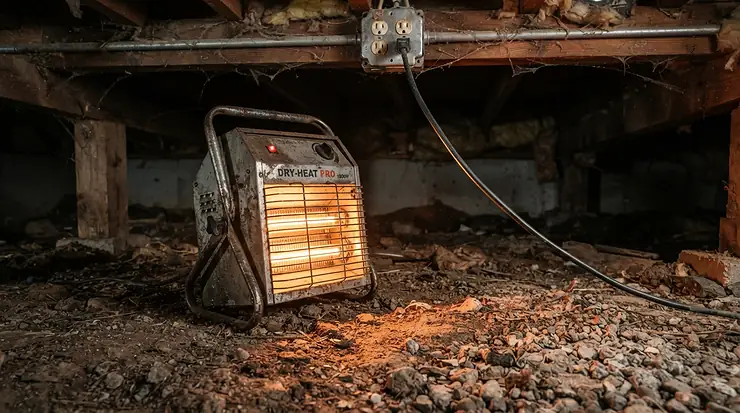
Somewhere beneath your feet right now sits a dark, cold, faintly spider-flavoured room you’ve visited maybe twice since you moved in. It holds your water lines, possibly your ductwork, and a startling share of your home’s winter heat loss. When a Canadian January parks itself at −25 °C for a week, that forgotten gap decides whether your pipes make it to spring. Picking a crawl space heater for cold climate conditions isn’t about comfort down there. It’s about not paying a plumber time-and-a-half to chase a burst line at 2 a.m.
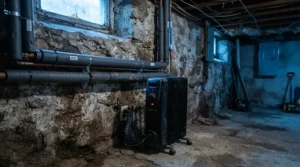
A crawl space is an unoccupied, unfinished, narrow space between the ground and your first floor. The term covers everything from a tidy 1.2 m service void to a damp 50 cm squeeze. That variety is exactly why generic space-heater advice falls flat here. Whatever you buy has to fit in tight clearances, tolerate moisture, and run without a babysitter.
What Is a Crawl Space Heater for Cold Climate Use?
A crawl space heater for cold climate use is a compact, thermostat-controlled electric heater, either plug-in or hardwired, that holds an unfinished crawl space just above freezing. Most people aim for roughly 3 to 5 °C. That protects plumbing, ducts and floor framing during deep-freeze stretches. It maintains a temperature; it doesn’t make the space cozy.
I’ve compared seven real options below, from a Canadian-made workhorse to a pipe-level heat kit. I’ve also made room for the unglamorous truth that insulation and moisture barriers often matter more than the heater itself.
Quick Comparison: Crawl Space Heater for Cold Climate Options at a Glance
Here’s the 30-second version. Price ranges are approximate CAD figures drawn from retailer listings at the time of research, and some are estimates, so check current pricing before you buy.
| Product | Type | Power | Thermostat | Price Range (CAD) | Best For |
|---|---|---|---|---|---|
| Caframo True North 9206 | Plug-in, fan-forced | 600/900/1500 W | Yes, plus anti-freeze setting | C$130–C$170 | Set-it-and-forget-it freeze protection in a dry space |
| Cadet Com-Pak Twin | Hardwired, in-wall | 3000/4000 W at 240 V | Yes (thermostat models) | C$300–C$450 (plus electrician) | Conditioned or semi-conditioned crawl spaces |
| BEYOND HEAT Milkhouse | Plug-in | 1300/1500 W | Yes, anti-freeze | C$70–C$120 (est.) | Cold utility spaces needing portable flexibility |
| Lasko 5919 Pro-Ceramic Utility | Plug-in, ceramic | 1500 W | Yes, adjustable | C$80–C$150 | Shallow crawl spaces and budget buyers |
| Mr. Heater Electric Buddy | Plug-in, ceramic | 1500 W | None listed | C$60–C$110 (est.) | Short cold snaps and repair jobs |
| Dreo 1500W PTC Space Heater | Plug-in, PTC ceramic | 1500 W | Yes, about 0.5 °C precision | C$70–C$130 (est.) | Tight temperature control |
| Frost King HC6A | Pipe heat kit | Low wattage | Automatic | C$40–C$90 (est.) | Short plumbing runs |
Looking at the table, the Caframo True North 9206 is the only option that pairs a true anti-freeze setting with stepped wattage, which makes it the most crawl-space-minded of the plug-ins. The Lasko 5919 Pro-Ceramic Utility wins on sheer compactness, while the Cadet Com-Pak Twin is the outlier: it’s a permanent install, so it costs more and needs an electrician. Budget buyers should note that the Mr. Heater Electric Buddy lacks a listed thermostat, which changes how you’d have to use it.
💬 Just one click — help others make better buying decisions too!😊
Top 7 Crawl Space Heater for Cold Climate Picks: Expert Analysis
I haven’t handled these units, so what follows is honest analysis grounded in published specs, manufacturer FAQs and the review material I could verify. Where I couldn’t find a meaningful review pool, I say so instead of inventing one.
1. Caframo True North 9206 — Canadian-made anti-freeze specialist
The headline feature is the snowflake setting, which wakes the heater only when temperatures sag to about 3 °C (38 °F). It works on any fan speed. Beyond that, you get three heat steps (600, 900 and 1500 W), a built-in thermostat, a steel body, a 6-foot cord, a five-year warranty, and dual overheat protection. One protector resets; the other is a thermal fuse that permanently retires the unit if it trips. A Canadian retailer lists it as CSA certified. The stepped wattage matters because 600 W draws only about 5 A, so you can run a gentle trickle instead of hammering a 15 A circuit.
Here’s the catch, straight from the manufacturer’s own FAQ: the thermostat reads the heater’s internal temperature, not the room’s, and the company advises against using it in damp or humid greenhouses. That puts the Caframo True North 9206 squarely in dry, sealed or semi-sealed crawl spaces with moisture barriers already down. Reviews are thin: a Canadian marine retailer shows two five-star ratings, one owner running two units to keep a boat warm all winter. That’s a durability hint, not crawl space proof.
Pros:
- ✅ Anti-freeze setting that works on any fan speed
- ✅ Stepped 600/900/1500 W output
- ✅ Dual overheat protection, five-year warranty
Cons:
- ❌ Not recommended for damp or humid spaces
- ❌ Thermostat senses heater temperature, not space temperature
Expect roughly C$130–C$170. Good value if your space is dry.
2. Cadet Com-Pak Twin — hardwired muscle for finished crawl spaces
Two fan-forced elements sit behind one grille, which spreads warm air and helps break up cold pockets. The numbers: 3,000 or 4,000 W at 240 V (about 10,236 or 13,648 BTU/h), a recess-mount can roughly 41 cm wide, 30 cm tall and 13 cm deep, a high-temperature shutoff, and a two-year warranty. It’s rated for around 46 m² (500 sq ft) of living space. In a crawl space that’s wild overkill, but it’s overkill that lives in a wall, off the floor, with no cord to trip over.
Who’s it for? Homeowners with a conditioned or semi-conditioned crawl space, a framed stub wall, and an electrician on speed dial. A 4,000 W unit pulls about 16.7 A, so plan a dedicated circuit. One more flag for Canadian buyers: one retailer listing shows it as UL/ETL listed and another marks “CSA Listed: No.” Confirm the certification mark on the exact model you receive. Reviews I could verify were light, though a US installer praised the quiet operation and mounted the heater about 30 cm (12 in) off the floor to cut dust intake.
Pros:
- ✅ Permanent, cord-free, floor-space-free install
- ✅ Two elements reduce cold spots
- ✅ Built-in thermostat on the complete models
Cons:
- ❌ Requires an electrician and a dedicated circuit
- ❌ Certification marks need checking for Canada
Plan on C$300–C$450 for the unit, plus labour. Worth it only for properly conditioned spaces.
3. BEYOND HEAT Milkhouse — barn-bred toughness with an anti-freeze thermostat
The name nods to farm milkhouses, which are cold, damp, utilitarian rooms, and that’s a reasonable hint about the design target. Retailer summaries list 1300 W and 1500 W output, three heat settings including fan-only, and an anti-freeze thermostat function. On paper, a fan-only mode is handy for pushing air around after a cold snap without adding heat.
The portable format is both the appeal and the risk. You can set the BEYOND HEAT Milkhouse on a concrete block to keep it off damp ground and move it when pipes are the priority. But plug-in heaters in crawl spaces demand discipline about clearance, as one comparison site puts it: elevate or secure the unit and verify clearance and moisture exposure first. Fan-driven units can also stir dust in unfinished crawl spaces, so expect to vacuum afterwards. I couldn’t verify a meaningful review pool for this unit, so check current Amazon.ca ratings before you commit.
Pros:
- ✅ Anti-freeze thermostat function listed
- ✅ Fan-only mode for air circulation
- ✅ Portable, so placement stays flexible
Cons:
- ❌ Verified review data was scarce
- ❌ Fan can kick up dust in unfinished spaces
Expect around C$70–C$120 (estimate). Decent value if reviews check out.
4. Lasko 5919 Pro-Ceramic Utility — compact, low and refreshingly honest
Its low, boxy shape is the whole pitch. At about 26 × 29 × 26 cm (10.1 × 11.4 × 10.4 in) and 8.5 lb, it slides under joists that would reject a tower heater. Specs: 1500 W at 12.5 A, about 5,115 BTU/h, a pivoting head, an adjustable thermostat, high/low/fan-only settings, a self-regulating ceramic element, overheat protection, a six-foot cord and a three-year warranty. The ceramic element self-limits its temperature, so there’s no glowing coil near dusty framing.
My take: this is the sensible first stop for shallow, 50–70 cm crawl spaces and for anyone who wants a low clearance space heater without a hardwired install. The listing shows ETL certification, which is acceptable in Canada when the product carries the Canadian mark, so confirm that on the carton. The manufacturer rates it for about 14 m² (150 sq ft) of room heating. Treat that as a ceiling for crawl spaces, which leak heat through foundation walls. I found only a single retailer review, so I can’t summarize reviewer sentiment responsibly.
Pros:
- ✅ Very low profile fits tight clearances
- ✅ Adjustable thermostat and pivoting head
- ✅ Self-regulating ceramic element
Cons:
- ❌ Only two heat steps, no dedicated anti-freeze mode
- ❌ Limited verified review data
Roughly C$80–C$150. Strong value for shallow spaces.
5. Mr. Heater Electric Buddy — featherweight ceramic for short stints
Not to be confused with the propane “Buddy” heaters, which have no business in an enclosed crawl space, this is the electric model (F236300). It’s a 1500 W ceramic heater (about 5,118 BTU/h) weighing just 4 lb, measuring roughly 27 × 16 × 26 cm (10.8 × 6.14 × 10.35 in). Listed features include high and low settings, overheat protection, a tip-over switch and a six-foot cord that wraps up for storage.
Notice what’s missing: no thermostat in the published specs. That means on its own it’s a manual heater, and manual heaters are for monitored jobs: thawing a frozen section, a weekend repair, a cold snap you’re actively watching. You could pair it with a plug-in thermostat controller rated for the load, but now you’re building a rig, and rigs deserve an electrician’s opinion. The Mr. Heater Electric Buddy shines on weight and compactness. I couldn’t verify a robust review pool, so check recent buyer reports.
Pros:
- ✅ Very light and compact at 4 lb
- ✅ Tip-over and overheat protection listed
- ✅ Easy to store between winters
Cons:
- ❌ No thermostat listed
- ❌ Only two manual heat settings
Plan on C$60–C$110 (estimate). Good value as a temporary tool, poor as unattended protection.
6. Dreo 1500W PTC Space Heater — tight temperature control
Retailer summaries describe a 1500 W PTC ceramic heater with a thermostat precise to about 1 °F (roughly 0.5 °C) and smart controls. Why care about precision? A cheap dial thermostat can swing several degrees, which means colder lows and wasteful highs. A tight thermostat holding 4–5 °C is what you want when your goal is “just above freezing” and not “mildly toasty.”
Two cautions. First, Dreo sells several body styles, and tower models won’t fit a low crawl space, so measure your joist clearance against the exact model’s dimensions. Second, Wi-Fi features may struggle to reach a concrete-walled crawl space, so treat smart control as a bonus, not a plan. For the right clearance, the Dreo 1500W PTC Space Heater is a precise, modern option. I couldn’t verify review depth, so scan current Amazon.ca feedback for thermostat accuracy complaints.
Pros:
- ✅ Precise thermostat for steady temperatures
- ✅ PTC ceramic element self-limits heat
- ✅ Smart control available on some models
Cons:
- ❌ Body styles vary; many won’t fit low spaces
- ❌ Wi-Fi may not reach underground
Likely C$70–C$130 (estimate). Strong value if the dimensions work.
7. Frost King HC6A — pipe-level insurance, not room heat
I’m including this deliberately, even though it isn’t a space heater. In many Canadian crawl spaces the only thing really worth protecting is the water line, and heating the whole cavity to save one pipe is like heating your house to save a houseplant. This is an automatic electric heat kit built for short pipe runs, and it wraps the pipe directly.
It doesn’t warm joists, ducts or air. Heat cable also loses much of its value if the pipe isn’t insulated over top, and one comparison source flags that it may need insulation in extreme cold. That’s exactly the Canadian scenario. Treat the Frost King HC6A as a complement to a heater, or as the lean alternative when you have a single exposed supply line and a very low ceiling. Verified review data was limited, so read current buyer feedback on installation difficulty.
Pros:
- ✅ Targets pipes directly instead of heating air
- ✅ Automatic operation in a compact kit
- ✅ Often the cheapest freeze protection
Cons:
- ❌ Short-run kit only
- ❌ Needs insulation over the pipe in deep cold
Roughly C$40–C$90 (estimate). Excellent value for a single exposed line.
How to Choose a Crawl Space Heater for Cold Climate Conditions
Most buyers shop by wattage and stop there. Here’s the order I’d work in:
- Measure clearance first. Height under joists eliminates half the market before you read a single spec. A heater that fits only on paper is a fire-safety problem.
- Size by heat loss, not floor area. A 1500 W heater is rated for roughly 14–16 m² (150–170 sq ft) in a room. Crawl spaces bleed heat through uninsulated foundation walls, so treat that rating as an upper limit.
- Demand a real thermostat. An anti-freeze setting that holds a few degrees above 0 °C beats a manual dial every time.
- Check the certification mark. Look for CSA, cUL or cETL on the unit and carton.
- Match the heater to the moisture level. Damp spaces need the moisture fixed first; some manufacturers explicitly rule out humid locations.
- Choose plug-in or hardwired deliberately. Unattended winter-long use points to a hardwired unit installed by a licensed electrician.
- Check the circuit. A 1500 W heater draws 12.5 A, which can trip a shared 15 A circuit.
| Heater Power | Approx. BTU/h | Approx. Draw | Best For |
|---|---|---|---|
| 600 W (120 V) | ~2,050 | ~5 A | Gentle anti-freeze trickle, as on the Caframo True North 9206 |
| 900 W (120 V) | ~3,070 | ~7.5 A | Mid-level maintenance in a small, insulated space |
| 1500 W (120 V) | ~5,120 | ~12.5 A | Cold snaps, as with the Lasko 5919 Pro-Ceramic Utility |
| 3000 W (240 V) | ~10,240 | ~12.5 A | Large conditioned spaces, as with the Cadet Com-Pak Twin |
| 4000 W (240 V) | ~13,650 | ~16.7 A | Heavy-duty hardwired installs, again the Cadet Com-Pak Twin |
Note how 3,000 W at 240 V draws about the same current as a 1500 W plug-in at 120 V. That’s why hardwired units can deliver double the heat without stressing a circuit more. The takeaway: pick the lowest wattage that holds your target temperature, because anything bigger just cycles on and off and wastes money.
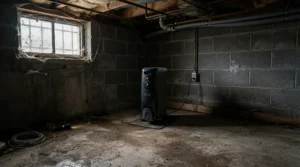
Practical Usage Guide: Low-Ceiling Heater Placement and Setup
Low-ceiling heater placement is where good products go to fail. Here’s how to get it right.
Placement. Set a plug-in heater on a flat, level, non-combustible base such as a concrete paver, raised a few centimetres off the ground so it stays out of condensation. Aim airflow along the length of the space, toward the coldest wall, rather than at a joist. Keep the heater away from insulation, stored boxes and dust piles.
First-use test. Run the heater for an hour while you stay nearby. Smell for hot dust, watch the thermostat cycle, and confirm that the cord and plug stay cool.
Set the target. Aim for roughly 4–5 °C. That’s enough margin for pipes without wasting money keeping a dirt-floor cavity warm.
Maintenance schedule. Every autumn, vacuum dust off vents and elements, check the cord for nicks, and test the thermostat by lowering the set point. Check again after any major cold snap.
Common first-30-day mistakes. Running an extension cord (don’t), leaving the heater directly on dirt, and forgetting to check the space for new moisture after the first heavy melt.
✨ Don’t Miss These Exclusive Deals!
🔍 Take your crawl space heating plan to the next level with carefully selected products. Click on any highlighted product to check current pricing and availability. These picks will help you create a warmer, safer, drier foundation your family will count on!
Real-World Scenarios: Three Crawl Spaces, Three Setups
These are illustrative profiles, not personal case studies. Use them to find your own match.
Scenario 1: The 1970s bungalow in Winnipeg. One uninsulated crawl space, roughly 90 cm high, with a single copper supply line. Budget: under C$200. A Frost King HC6A on the pipe, plus a few strips of foam board around the rim joist, solves 90 per cent of the problem. A Lasko 5919 Pro-Ceramic Utility on hand covers emergencies.
Scenario 2: The Ontario cottage left empty for weeks. Unattended use is the issue. A plug-in heater running unsupervised isn’t the safest approach, and here I’d lean toward a hardwired solution or fully draining the system. If a plug-in stays, the Caframo True North 9206 on its snowflake setting is the right behaviour, with an electrician confirming the circuit.
Scenario 3: The Halifax addition with ductwork. Ducts run through a crawl space that’s already framed and semi-conditioned. This is the Cadet Com-Pak Twin use case: a recessed, hardwired unit installed by a licensed electrician, with moisture barriers on the floor first.
The pattern across all three: spend money in this order, which is moisture, insulation, targeted heat, then air heating. Matching the heater to the space beats buying the most powerful unit.
Crawl Space Insulation and Moisture Barriers: The Heater’s Silent Partner
Here’s the uncomfortable truth I’d want someone to tell me: a heater in a leaky, wet crawl space is a bucket with a hole in it. Natural Resources Canada’s “Keeping the Heat In” guide includes a dedicated section on crawl space insulation within its basement and foundation chapter, and it’s a useful free starting point.
Crawl space insulation reduces how much heat you need to supply. Moisture barriers, typically heavy polyethylene sheeting over the ground, keep soil vapour from raising humidity, which drives condensation, mould and rot. A CMHC-funded study of crawl spaces in British Columbia found that moisture problems traced back to the absence of an effective moisture barrier, even where a thin concrete slab was present. In other words, a slab alone isn’t enough.
If you want unfinished crawl space warmth, the logic runs backward from what most people expect. Seal and insulate first, then add the smallest heater that works. One Canadian cost guide estimates closed-cell spray foam at roughly C$1.50–C$4.00 per square foot and notes that clearances under 90 cm can raise labour costs by about 20 per cent. Full encapsulation with barrier, insulation, dehumidifier and drainage is estimated at C$7,000–C$15,000 or more. Treat these as ballpark figures and get local quotes.
Safety, Regulations and Certification for Heating a Crawl Space in Canada
Never use fuel-burning heaters, such as propane or kerosene units, in an enclosed crawl space. Combustion gases and oxygen depletion are a genuine hazard. Stick to electric.
Health Canada’s electrical product safety guidance tells consumers to look for CSA, cUL or cETL marks, keep portable heaters at least 1 metre from combustibles, never plug them into extension cords or power bars, and unplug them when leaving home or going to sleep.
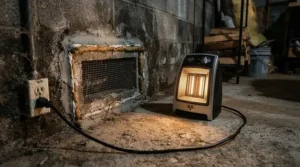
Now apply that to a crawl space, because this is where common sense collides with reality. The 1 m rule is nearly impossible in a space where wood joists sit 60 cm overhead. That’s why plug-in heaters suit only crawl spaces with the clearance the manufacturer’s manual allows, and why unattended winter-long operation points toward hardwired, electrician-installed equipment. CSA guidance also warns against hard-wiring a plug-in portable heater yourself. Don’t.
Ventilation rules for unheated crawl spaces appear in the National Building Code of Canada and vary by province and municipality. Check your local requirements before sealing vents, and check whether your province requires a permit for electrical work. Add a carbon monoxide detector upstairs if any fuel-burning appliance shares the building.
Crawl Space Heating vs Alternatives: What Actually Works
Before buying anything, compare approaches honestly.
| Approach | Upfront Cost | Running Cost | Protects | Best For |
|---|---|---|---|---|
| Electric crawl space heater | Low to moderate | Moderate | Air, pipes, framing | Uninsulated but dry spaces needing quick fixes |
| Pipe heat cable, such as Frost King HC6A | Low | Low | Pipes only | Short plumbing runs |
| Insulation plus moisture barriers | Moderate to high | Very low | Everything, long term | Owners planning to stay |
| Propane or kerosene heaters | Low | Moderate | Not recommended | Never in enclosed crawl spaces |
| Ducting furnace air downward | Moderate | Varies | Air and framing | Homes with spare furnace capacity |
The honest reading: heaters win on speed, insulation wins on lifetime cost, and heat cable wins on cheap targeted protection. If you’re short on cash, a Frost King HC6A on the pipe plus foam board on the rim joist is usually the best money you can spend. If you’re staying put for a decade, put the budget into crawl space insulation and moisture barriers, then use a small heater like the Lasko 5919 Pro-Ceramic Utility as backup.
Long-Term Cost and Maintenance of Crawl Space Heating
A 1500 W heater uses 1.5 kWh per hour at full output. Provincial electricity rates range widely, roughly C$0.08 to C$0.20 per kWh depending on where you live, so these are illustrative.
| Scenario | kWh per Day | Cost at C$0.10/kWh | Cost at C$0.20/kWh | Best For |
|---|---|---|---|---|
| 1500 W running 100% of the time | 36 | C$3.60 | C$7.20 | Worst-case cold snap |
| 1500 W cycling 30% of the time | 10.8 | C$1.08 | C$2.16 | Typical thermostat-held operation |
| 600 W cycling 30% of the time | 4.3 | C$0.43 | C$0.86 | Insulated space, low-wattage anti-freeze mode |
The numbers show why thermostat control and insulation matter. A Caframo True North 9206 on its 600 W step in a well-sealed space might cost under a dollar a day, while a manual 1500 W heater left running in a leaky space can cost eight times that. Peer-reviewed research has examined this link directly: a study on moisture conditions and energy consumption in heated crawl spaces in cold climates appeared in the journal Energy and Buildings, treating humidity and heating bills as two sides of the same problem.
For maintenance, budget ten minutes each autumn for vacuuming and inspection, and replace any heater showing cord damage immediately.
Common Mistakes When Buying a Crawl Space Heater for Cold Climate Use
- Buying by wattage alone. A 1500 W heater that doesn’t fit under your joists is a paperweight.
- Ignoring moisture. Heating a damp, uninsulated space can drive condensation and wastes energy.
- Skipping the thermostat. Manual heaters are fine for monitored jobs, such as the Mr. Heater Electric Buddy, but unattended protection needs automatic control.
- Using extension cords. Health Canada says never. The cord’s thin wire is your weakest link.
- Trusting smart features in a dead zone. Wi-Fi control, such as on the Dreo 1500W PTC Space Heater, is great upstairs and unreliable underground.
- Skipping certification checks. A missing CSA, cUL or cETL mark is a deal-breaker.
- Forgetting the building envelope. The cheapest heat is the heat you don’t lose.
FAQ
❓ Can I use a regular space heater in a crawl space?
❓ How many watts do I need to heat a crawl space?
❓ Is it cheaper to insulate a crawl space or heat it?
❓ Is it safe to leave a crawl space heater on all winter?
❓ Do I need a dehumidifier with a crawl space heater?
Conclusion
Here’s the short version. A good crawl space heater for cold climate winters is small, certified, thermostat-controlled and matched to the space’s actual clearance and moisture level. Of the seven options, the Caframo True North 9206 is the best all-round plug-in for dry spaces, the Lasko 5919 Pro-Ceramic Utility is the budget-friendly low-profile pick, and the Cadet Com-Pak Twin is the right call for conditioned spaces with an electrician involved. The BEYOND HEAT Milkhouse and Dreo 1500W PTC Space Heater are worth a close look if their dimensions and reviews check out. The Mr. Heater Electric Buddy suits short, supervised jobs, and the Frost King HC6A is the smart, cheap fix for a lone exposed pipe.
The bigger lesson is order of operations. Seal and insulate, add moisture barriers, then heat as little as you can get away with. Do that, and even a modest heater gives you unfinished crawl space warmth that lasts through the worst the Canadian winter delivers.
Recommended for You
- Basement Heater For Canadian Winter: 7 Best Warm-Up Picks 2026
- Basement Heaters Under $150 CAD: 7 Smart Picks For 2026
- Electric Fireplace Insert Vs Freestanding Electric Fireplace 2026
Disclaimer: This article contains affiliate links. As an Amazon Associate, I earn from qualifying purchases. If you purchase products through these links, we may earn a small commission at no additional cost to you.
✨ Found this helpful? Share it with your friends! 💬🤗
