
In This Article
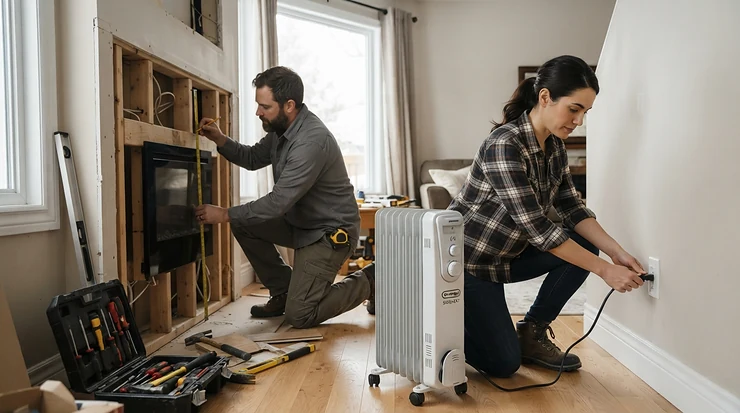
In the electric fireplace insert vs freestanding electric fireplace debate, the difference is the housing, not the heater. An insert is a firebox that drops into an existing opening or a framed wall cavity. A freestanding unit is a finished stove, mantel or TV console that plugs in wherever you park it. Both give you flames and supplemental heat from electricity.
That sounds simple. It isn’t, because the choice quietly decides your installation headaches, your furniture layout, what a buyer sees at your open house and whether the thing leaves with you when you move. Wikipedia’s overview of the electric fireplace traces the category back to Dimplex’s Optiflame flame effect in 1988, and it has been quietly eating the wood-burning fireplace ever since. No chimney, no ash, no cord of wood stacked beside the garage.
Here’s a twist most shoppers miss. Look inside a lot of “freestanding” mantel packages and you’ll find an insert. The Napoleon Charlotte and Ameriwood Home Farmington both wrap a firebox in furniture. So the real question is whether you want that firebox built into your walls or sitting in a cabinet.
This guide gives you that answer without the sales fog. I compared seven real products across budget, mid-range and premium tiers, pulled specs from manufacturer and retailer listings, and checked heating claims against Natural Resources Canada guidance. Prices are ranges in CAD at the time of research, so check current prices before you buy. By the end, you’ll know which format suits your room, your wiring and your wallet.
Quick Comparison: Electric Fireplace Insert vs Freestanding Electric Fireplace
| Feature | Electric Fireplace Insert | Freestanding Electric Fireplace |
|---|---|---|
| Typical heat output | About 5,000 BTU (1,500 W) | About 4,700-5,200 BTU (1,500 W) |
| Installation | Needs an opening, surround or framing; some hardwire | Assemble and plug in |
| Footprint | Almost none; recessed | Floor space, 30-170 cm wide |
| Portability | Fixed once built in | Moves with you |
| Look | Custom, architectural | Furniture-style |
| Best For | Existing hearths, new builds: Modern Ember Uptown 33″, Napoleon Cineview 26 | Renters, quick upgrades: Duraflame 3D Infrared Stove, Ameriwood Home Farmington |
Look at the heat row first. Nearly every unit here lands near 5,000 BTU because they all run on a standard 120 V household circuit. So heat is not the tiebreaker. The Duraflame 3D Infrared Stove claims the most coverage on paper, but its heater isn’t a different species from the one in the PuraFlame Western. What differs is the effort and the permanence. Inserts reward a one-time build with a cleaner, built-in look, while freestanding units win on speed and flexibility.
💬 Just one click — help others make better buying decisions too!😊
Top 7 Electric Fireplaces Compared: Expert Analysis
1. PuraFlame Western Electric Fireplace Insert — most convincing crackle-and-log effect for the money
The PuraFlame Western Electric Fireplace Insert earns its reputation on realism, with resin logs, a brick-pattern interior and an optional crackling sound that make it look less like a gadget. It runs on 750/1,500 W settings with a thermostat, and roundup sites list roughly 4,600-5,100 BTU depending on the source. That’s enough supplemental heat for a bedroom or den up to about 37 m² (400 sq ft).
Here’s what the spec sheet won’t tell you. At roughly 84 cm (33 inches) wide, it suits older masonry openings and framed cabinets better than tiny hearths. If your opening is smaller, measure twice.
On review sentiment, I couldn’t verify a large pool of individual customer ratings. Several editorial roundups, however, consistently pick it as their value choice and praise the log-and-crackle realism. Treat that as editorial consensus, not a customer average.
Pros:
- ✅ Realistic logs, brick backdrop and crackling sound
- ✅ Thermostat plus 750/1,500 W settings
- ✅ Plug-in design suits most existing openings
Cons:
- ❌ Heat claims vary slightly between sources
- ❌ Needs 5 cm (2 in) clearance behind for airflow
Price range: expect roughly C$300-C$550 depending on seller and finish. For a first insert in a bedroom or den, the value verdict is strong.
2. PuraFlame 27″ Free Standing Electric Fireplace Log Set — insert realism without a hole in the wall
The PuraFlame 27″ Free Standing Electric Fireplace Log Set is the bridge product in this debate. It’s insert-style realism with no opening required. It has a 750 W/1,500 W heater, six flame colours, five brightness levels and a crackle option. You set it on a hearth, inside a fireplace opening or within a cabinet.
Spec translation: the 1,500 W setting is the same class as the bigger boxes, so you’re trading size, not warmth. Reviewers who’ve covered it flag the limit too. It is rated for roughly 37 m² (400 sq ft), and a larger open-concept space will outrun it.
My take is that this is the cleverest first purchase if you’re unsure which camp you belong to. Place it on a hearth now and decide on a permanent build later. If you outgrow it, it still works as a spare-room or cabin unit. Reviewer sentiment I could find calls it easy to set up, but I couldn’t verify a large review pool, so judge on the editorial praise.
Pros:
- ✅ Almost no installation effort
- ✅ Six flame colours and five brightness levels
- ✅ Works in a hearth, cabinet or opening
Cons:
- ❌ Limited to roughly 37 m² of supplemental heat
- ❌ Compact size looks small in big openings
Price range: roughly C$250-C$450. That makes it a low-risk entry point.
3. Modern Ember Uptown 33″ Smart Electric Fireplace Insert — app and voice control in a mid-range firebox
The Modern Ember Uptown 33″ Smart Electric Fireplace Insert is the techy one, with TuyaSmart app control and Alexa and Google Home compatibility. It also has a touch panel and a handheld remote. Specs include an infrared heater adjustable from 18°C to 28°C (64-82°F) in 2-degree steps, and a 1-9 hour auto-shutoff timer. Listings cite 5,118 BTU at 1,500 W.
What that means in practice is that you can run flames without heat in July. You can also pre-warm the room from your phone before you walk in. Installation is flexible, either plug into a 120 V outlet or hardwire for a cord-free finish. Never use an extension cord. A magnetic trim kit is required for new framed installations, so check whether your listing includes it. Some bundles do and some sell it separately.
Retail reviews I found sit around 4.5 out of 5. Positive reviewers call it striking and realistic. Critical reviewers report a rhythmic mechanical noise, light showing through gaps between logs, and, in a few cases, wishing for more heat.
Pros:
- ✅ Smart app, voice and remote controls
- ✅ Plug-in or hardwire installation
- ✅ Infrared heater with adjustable thermostat range
Cons:
- ❌ Some reviewers report mechanical noise
- ❌ Trim kit may be a separate cost
Price range: roughly C$600-C$900 with a trim kit. Good value if you want modern controls.
4. Napoleon Cineview 26-Inch Electric Fireplace Insert — Ontario-founded brand with a lifetime-warranty reputation
The Napoleon Cineview 26-Inch Electric Fireplace Insert is the premium insert here. It’s an all-in-one unit with logs, crystal media, remote and a 5-inch surround. The Cineview line offers two-stage heating, an eco mode that halves heater power, and a boost mode with higher blower speed. Heat tops out around 5,000 BTU (1,465 W).
Why pay more? Retailer listings describe the President’s Limited Lifetime Warranty, which is unusual in this category. Warranty terms vary, so confirm them with the seller. Longevity is the real premium. A firebox you’ll recess into a wall is a unit you don’t want to cut out in three years.
My read is that this is the “build it once” choice. If you’re framing a wall or finishing a basement, the incremental cost over a budget insert is small compared to the carpentry. Customer-review sentiment wasn’t something I could verify at scale, so I’m basing this on specs, brand claims and warranty documentation. One retailer showed it on backorder, so check availability.
Pros:
- ✅ Eco and boost heat modes
- ✅ Lifetime limited warranty per retailer listings
- ✅ Logs and crystal media both included
Cons:
- ❌ Costs several times a budget insert
- ❌ Availability can be patchy
Price range: roughly C$1,200-C$1,700 depending on retailer. Worth it for permanent builds.
5. Duraflame 3D Infrared Electric Fireplace Stove (DFI-5010) — the freestanding crowd-favourite
The Duraflame 3D Infrared Electric Fireplace Stove is a wood-stove lookalike with a 5,200 BTU infrared heater and 1,500 W draw. The spec sheet lists a 24″ wide, 23.4″ tall, 12.9″ deep body that weighs about 34 lb (15 kg). The manufacturer says it warms up to 1,000 sq ft (93 m²). That figure is ambitious. Other 5,000 BTU units are rated for 400 sq ft, so expect 1,000 sq ft to apply only to a well-insulated, open space.
Translated into daily life: it’s small enough to slide into a corner and heavy enough to feel solid. You plug it in and it works.
Review sentiment is the strongest verifiable data of the seven. The listing I checked shows about 4.3-4.4 out of 5 across roughly 14,000 ratings. Reviewers praise looks and durability, and one reports seven winters of use. Common complaints include a mechanical hum when the flame effect runs and fiddly onboard controls.
Pros:
- ✅ Strong ratings across thousands of reviews
- ✅ Truly plug-and-play with remote control
- ✅ Compact and moveable
Cons:
- ❌ Audible hum with flame effect on
- ❌ One-year warranty only
Price range: roughly C$350-C$600. A top pick for renters.
6. Ameriwood Home Farmington Electric Fireplace TV Console — the budget media centre with built-in flames
The Ameriwood Home Farmington Electric Fireplace TV Console pairs a 23-inch insert with a 150 cm (59.6 in) wide cabinet. It supports TVs up to 60 inches and 95 lb. Listings give 1,500 W and 4,700 BTU for roughly 37 m² (400 sq ft), with 11 heat levels and 4 brightness levels and an LED life rated at 50,000 hours.
The real-world translation is that it replaces a TV stand, fireplace and storage in one footprint. It ships flat, weighs more than 100 lb (about 48-68 kg depending on size), and the maker recommends two adults for assembly. Budget a weekend afternoon.
I couldn’t verify a large pool of individual review scores, so I’m relying on specs. One point deserves honesty: engineered-wood furniture doesn’t age like solid wood, so expect a five- to ten-year piece rather than an heirloom.
Pros:
- ✅ TV stand, storage and fireplace in one
- ✅ Replacement inserts are available
- ✅ LED life rated at 50,000 hours
Cons:
- ❌ Heavy, two-person assembly
- ❌ Engineered-wood construction
Price range: roughly C$450-C$800 depending on size and finish. Good value for apartments.
7. Napoleon Charlotte Electric Fireplace Media Console (NEFP30-3820AW) — premium furniture-grade freestanding option
The Napoleon Charlotte Electric Fireplace Media Console pairs a distressed white cabinet with a cherry-finish top and the Cineview 30 firebox. It’s 68″ wide, 35″ tall and 19.2″ deep, and it plugs in or hardwires. Heat is 5,000 BTU (about 1,465 W) with two-stage heating, an eco mode, a boost mode and concealed wire management.
Translation: this is the one that proves “freestanding” and “insert” aren’t opposites. It’s an insert in a very nice cabinet. The front-facing heat vents allow built-in placement near combustibles per the retailer description.
Review data on this exact model was too thin to summarize fairly, so I’m judging on specs and manufacturer positioning. The Canadian price begins at the high end of this group, and the value case is furniture quality plus the Cineview firebox.
Pros:
- ✅ Furniture-grade cabinet with media wiring
- ✅ Plug-in or direct-wire flexibility
- ✅ Eco and boost heating modes
Cons:
- ❌ Largest footprint of the seven
- ❌ Highest price of the freestanding group
Price range: starting around C$1,900 on the manufacturer’s Canadian site. Check current prices before you buy.
Top 7 at a Glance: Specs, Price Ranges and Best For
| Product | Type | Heat output | Coverage | Price range (CAD) | Best For |
|---|---|---|---|---|---|
| PuraFlame Western | Insert | ~4,600-5,100 BTU | ~37 m² | C$300-C$550 | First insert, bedrooms |
| PuraFlame 27″ Log Set | Hybrid log set | ~5,000 BTU at 1,500 W | ~37 m² | C$250-C$450 | Testing the idea |
| Modern Ember Uptown 33″ | Insert | 5,118 BTU | ~37 m² | C$600-C$900 | Smart-home fans |
| Napoleon Cineview 26 | Insert | ~5,000 BTU | ~37 m² | C$1,200-C$1,700 | Permanent builds |
| Duraflame 3D Infrared Stove | Stove | 5,200 BTU | Up to 93 m² (claimed) | C$350-C$600 | Renters |
| Ameriwood Home Farmington | TV console | 4,700 BTU | ~37 m² | C$450-C$800 | Media rooms on a budget |
| Napoleon Charlotte | Mantel package | ~5,000 BTU | ~37 m² | From ~C$1,900 | Premium living rooms |
Price ranges are estimates from retailer listings at the time of research and may vary. Check current prices on amazon.ca.
The pattern is hard to miss. Heat barely moves, from about 4,700 to 5,200 BTU, while price swings by a factor of six or more. You’re paying for housing, finish, controls and warranty rather than warmth. Budget buyers should note that the PuraFlame Western and Duraflame 3D Infrared Stove deliver comparable warmth to the premium Napoleon Charlotte at a fraction of the cost.
✨ Ready to Compare Current Options?
🔍 Take your fireplace plans to the next level with these carefully selected products. Click any highlighted item to check current pricing and availability. Whether you pick a built-in insert or a plug-and-play stove, these options will help you create the cozy room your family will love!
Fireplace Type Comparison: How Inserts, Mantel Packages, Stoves and TV Stands Differ
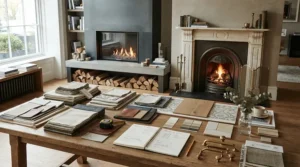
A fireplace type comparison starts with a quick taxonomy, because “freestanding” covers more than one form. Retailers like Best Buy Canada group electric fireplaces into wall-mounted, recessed, insert, freestanding and TV stand formats, and each makes a different trade.
Inserts disappear into a wall or hearth. They’re ideal if you want the flames to feel built-in. Mantel packages like the Napoleon Charlotte wrap that same firebox in furniture. Stoves like the Duraflame 3D Infrared Stove borrow the look of a wood stove and need only floor space. TV stands like the Ameriwood Home Farmington merge a media console and fireplace.
Here’s the quick rule. Ask whether you need a place to put a TV. If yes, the TV console form saves you buying two pieces of furniture. If you want a focal wall with the TV above, an insert in a framed surround usually looks cleaner.
Your room’s layout matters more than any spec. A narrow condo living room rarely has space for a 170 cm (68 in) console, but it can host a compact stove. A basement rec room with a bare feature wall is a natural insert candidate.
Insert vs Standalone Fireplace: The Head-to-Head Verdict
Insert vs standalone fireplace comes down to three trade-offs.
Permanence. An insert is a renovation decision. A standalone unit is a furniture decision. If you rent, can’t cut walls or might move within three years, standalone wins. If you own and plan to stay, inserts reward you with a cleaner finish.
Look. Inserts can look custom because you control the surround, tile, stone or paint. Standalone units arrive finished, which means less choice but zero design risk. A well-made mantel package can look just as polished as a built-in.
Heat distribution. Neither format has an edge. A front-venting insert in a recess and a front-venting stove in the room both push roughly 1,500 W into the air. If the insert is recessed in an outside wall, check manufacturer clearance guidance.
My verdict is blunt. If you’re asking which format is “better,” you haven’t yet defined your constraint. Renters and people unsure about the room should buy standalone. Owners with an existing opening or planned feature wall should buy an insert. Everyone else can go hybrid with the PuraFlame 27″ Log Set and learn how they use it.
Heating Output Comparison: What 5,000 BTU Really Means
Heating output comparison is where marketing gets slippery. Almost every unit here converts a 1,500 W draw into roughly 5,000 BTU. Natural Resources Canada explains that electric space heaters produce one unit of heat per unit of electricity, so they’re 100 percent efficient at the point of use. NRCan also notes that geothermal heat pumps can deliver around three units of heat per unit of electricity. It further states that electric space heaters aren’t currently covered by Canada’s Energy Efficiency Regulations or available as ENERGY STAR qualified models.
Translation: no electric fireplace is more efficient than another at turning electricity into heat. Differences come from how heat moves. Infrared elements like the one in the Duraflame 3D Infrared Stove warm objects and people directly, which can feel warmer at lower air temperatures. Fan-forced elements like those in the Napoleon Cineview 26 circulate air and warm a room faster.
Treat fireplaces as zone heaters, not furnaces. Roughly 37 m² (400 sq ft) is a realistic target for most units. In practice, that means a living room, bedroom or den. Using the Duraflame 3D Infrared Stove‘s 93 m² claim as a plan for heating a whole open-concept floor would be optimistic. A well-insulated space may get closer than a drafty one.
Choosing Electric Fireplace Style: Matching Flame, Finish and Footprint
Choosing electric fireplace style is easier when you separate three decisions: flame effect, finish and footprint.
Flame effect. Cheap units show flat, repeating flickers. Better ones use layered LED lighting, rotating elements or reflective surfaces to add depth. The Modern Ember Uptown 33″ offers five colours, ten speeds and ten brightness levels. The PuraFlame Western adds a crackle sound for realism.
Finish. Traditional homes suit logs and brick-pattern interiors. Modern homes suit crystal media or linear fireboxes. The Napoleon Cineview 26 includes both logs and crystal media, so you can flip the look.
Footprint. Measure your opening, wall or room before shopping. For a stove, leave clearance on every side. For a console, check TV weight and width.
Here’s the style trap. Many shoppers fall for flame photos in bright showrooms. Always imagine the unit in a dim evening living room. Flames that look dazzling at noon can look cartoonish at 8 p.m., and subtle ones can look best.
Installation Complexity: Plug-In, Hardwire or Build-Out?
Installation complexity is the biggest gap between the two formats. Here’s the real-world ladder, easiest to hardest.
- Plug-in stove. The Duraflame 3D Infrared Stove needs a level floor and a wall outlet.
- Assembled console. The Ameriwood Home Farmington ships flat, and the maker recommends two adults for assembly.
- Drop-in insert. The PuraFlame Western slides into an existing opening, with 5 cm (2 in) behind it for airflow.
- Framed-in insert. The Modern Ember Uptown 33″ needs a framed opening, a trim kit and either a plug or a hardwire connection.
- Hardwired build. Any unit hardwired through a wall should be handled by a licensed electrician per your province’s rules.
First 30 days checklist:
- Plug the unit into its own circuit if you can. A 1,500 W heater draws about 12.5 A, most of a typical 15 A circuit.
- Never use an extension cord or power strip.
- If you install an insert in a wood-burning hearth, close the damper and seal gaps. An open chimney is a draft machine.
- Run the heater for 30 minutes on day one and check for odours. A faint new-heater smell is common and fades.
- Re-check clearances after you move furniture.
Common mistake: buying an insert first and measuring the opening second. Measure first, shop second.
Resale Value Considerations: What Buyers Notice
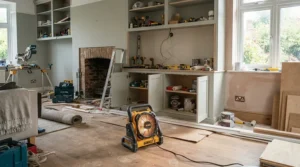
Resale value considerations are tricky because I couldn’t find reliable Canadian data quantifying how much an electric fireplace adds to sale price. Anyone quoting a precise percentage is guessing. What I can offer is reasoning.
A built-in insert in a finished surround generally reads as a fixture. In Canadian real estate, fixtures typically convey with the home unless excluded in the contract, while chattels such as furniture usually don’t unless listed. A freestanding stove or console is typically treated as a chattel. Confirm specifics with your real estate agent or lawyer.
What buyers notice is atmosphere. A well-executed feature wall with a clean insert photographs nicely for listings. A bulky console can look dated or personal. A neutral stove can be removed for staging.
My take: resale benefits come from the overall room, not the appliance. A cheap insert in a sloppy surround can hurt more than help. A premium Napoleon Cineview 26 in a crisp built-in can strengthen a listing, while a freestanding Ameriwood Home Farmington is a lifestyle piece you’ll likely take with you. If resale matters, favour insert-based builds with neutral finishes.
Long-Term Cost and Maintenance
Running costs are simple arithmetic. A 1,500 W heater uses 1.5 kWh per hour. At an illustrative 12 cents per kWh, that’s roughly 18 cents per hour. Your provincial rate will differ, so use your own bill. NRCan’s Heating with Electricity guide walks through comparing annual heating costs, which is useful if you’re thinking about supplemental heat.
Maintenance is minimal. Dust the vents, wipe the glass, check the cord and replace remote batteries. LED life on the Ameriwood Home Farmington is rated at 50,000 hours, according to the maker.
| Feature | Electric Fireplace | Wood-Burning | Gas |
|---|---|---|---|
| Chimney or vent | No | Yes | Yes |
| Fuel | Electricity | Firewood | Natural gas or propane |
| Installation | Plug in or light carpentry | Masonry or certified install | Gas line and vent |
| Upkeep | Dusting | Cleaning, sweeping | Annual service |
| Best For | Renters and quick upgrades: Duraflame 3D Infrared Stove | Primary heat enthusiasts | Homes with gas hookups |
Electric units win on convenience and installation simplicity. Wood and gas can deliver far more heat, so treat the Napoleon Cineview 26 and its peers as ambience plus supplemental warmth. Consider the PuraFlame Western if you want the lowest upkeep and a modest budget.
Safety, Certification and Electrical Rules in Canada
Safety is non-negotiable. Technical Safety BC advises that space heaters carry a certification mark from an agency recognized by the Standards Council of Canada, with CSA, UL and ULC given as examples. It also recommends tip-over and overheat protection and warns against extension cords and leaving heaters running in an empty room.
Practical rules:
- Check the unit’s label for a recognized mark before you buy.
- Keep combustibles at least 1 metre (3 ft) away unless the manufacturer states otherwise. The Napoleon Charlotte‘s front-facing vents are designed for built-in placement near combustibles per the retailer description, but follow the manual.
- Don’t plug anything else heavy into the same circuit.
- Hardwiring is electrician work in most provinces.
- If a breaker trips repeatedly, stop using the unit and call a licensed electrician.
Some listings mention ETL certification. Confirm the label on the product itself.
How to Choose Between an Electric Fireplace Insert and a Freestanding Unit
Here’s a quick decision path in six steps.
- Decide rent or own. Renters should lean toward standalone, such as the Duraflame 3D Infrared Stove.
- Measure the space. For inserts, measure the opening or wall cavity. For stoves and consoles, measure floor area and clearances.
- Match heat to room size. About 37 m² (400 sq ft) fits most units.
- Pick your style. Traditional logs, crystal media or linear glass.
- Set a budget. Remember the cabinet, trim kit or carpentry.
- Check certification and warranty. Compare one-year and lifetime terms.
If you want a TV centre, choose a console like the Ameriwood Home Farmington. If you want a permanent focal wall, choose an insert such as the Modern Ember Uptown 33″.
Real-World Scenarios: Which Pick Matches Your Home?
These are hypothetical profiles to show the reasoning.
The condo renter. A downtown renter has 30 m² of living space, a landlord who dislikes holes in walls, and a C$500 budget. The Duraflame 3D Infrared Stove fits the corner and moves with her. Check building rules before you buy.
The century-home owner. A homeowner has a dormant masonry fireplace and wants flames without wood. The PuraFlame Western or Modern Ember Uptown 33″ slides into the opening. Close the damper, seal gaps and measure the opening first.
The new-build family. A family building a basement rec room has a feature wall and a C$2,000 budget. A Napoleon Cineview 26 in a framed surround gives a clean look. If they’d rather skip carpentry, the Napoleon Charlotte offers the same firebox in furniture.
The media-room starter. A couple needs a TV stand more than a fireplace. The Ameriwood Home Farmington covers both on a modest budget.

FAQ
❓ Can I put an electric fireplace insert in a wood-burning fireplace?
❓ Does an electric fireplace insert need to be hardwired?
❓ Is it safe to leave a freestanding electric fireplace on overnight?
❓ How much does an electric fireplace cost to run in Canada?
❓ Can an electric fireplace heat a whole house?
Conclusion
So, where does the electric fireplace insert vs freestanding electric fireplace choice land? Heat is a wash, since everything here sits near 5,000 BTU on a 120 V circuit. The real differences are permanence, installation effort, style and what happens when you move.
If you rent or want something that works tonight, go freestanding with the Duraflame 3D Infrared Stove or the Ameriwood Home Farmington. If you own and want a built-in focal point, pick an insert, with the PuraFlame Western for value, the Modern Ember Uptown 33″ for smart controls or the Napoleon Cineview 26 for a long-term build. If you can’t decide, the PuraFlame 27″ Log Set lets you test the idea cheaply, and the Napoleon Charlotte gives you insert quality in furniture form.
Whichever route you take, measure first, check certification, respect the circuit and treat the unit as a cozy zone heater rather than a furnace. Check current prices before buying, since ranges shift.
Recommended for You
- Mantel Electric Fireplace For Canadian Home: 7 Proven Picks 2026
- Corner Electric Fireplace For Small Space: 7 Best Picks 2026
- Freestanding Electric Fireplace For Apartment: 7 Best Picks 2026
Disclaimer: This article contains affiliate links. As an Amazon Associate, I earn from qualifying purchases. If you purchase products through these links, we may earn a small commission at no additional cost to you.
✨ Found this helpful? Share it with your friends! 💬🤗
