
In This Article
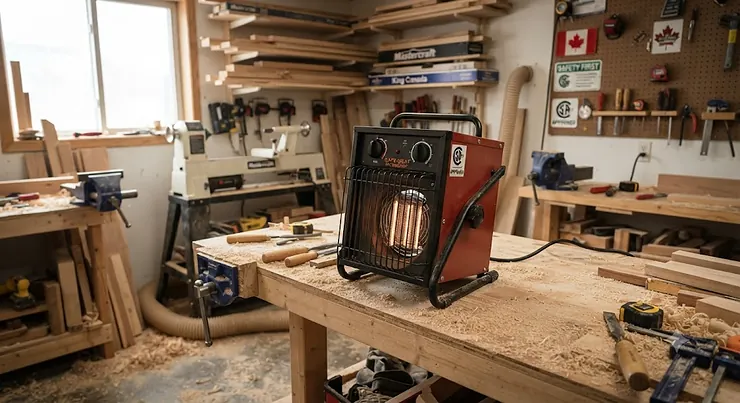
There’s a particular kind of cold that lives in an unheated garage workshop — the kind that turns your fingers into clumsy sausages right when you need them steadiest, guiding a chisel or setting a router bit. So you go shopping for a heater, and that’s when the second problem shows up: your shop floor is dusted in fine sawdust, and every space heater warning label seems to be shouting directly at you. Finding the safest heater for small workshop with dust conditions isn’t about buying “any old heater” — it’s about picking a design that can’t turn floating wood particles into an ignition event. Sealed, enclosed-element electric heaters (oil-filled radiators, cool-touch quartz cabinets, and hardwired fan-forced units with guarded stainless coils) are the category that consistently checks that box, while open-flame propane and glowing-coil bar heaters do not belong anywhere near a dust-laden bench. Below, we’ve dug into seven real, currently sold Canadian options — from a C$60 radiator to a hardwired 5,600-watt industrial unit — and broken down exactly which one fits your shop, your budget, and your risk tolerance.
Quick Comparison
Before the deep dive, here’s the shortlist so you can jump straight to the section that matters to you.
| Heater | Type | Best For |
|---|---|---|
| De’Longhi TRH0715CA | Oil-filled radiator | Tightest budgets, zero fan |
| Comfort Zone CZQTV5M | 240V dual quartz infrared | Best all-around dust safety |
| Dr. Infrared Heater DR-968 | Quartz + PTC cabinet | Small shops, quick warm-up |
| Dimplex DGWH4031G | Hardwired fan-forced | Permanent installs, mid-size shops |
| Dr. Infrared Heater DR-988 | 240V industrial fan-forced | Larger detached shops |
| Comfort Zone CZ220BK | Hardwired ceiling mount | Two-car garage shops |
| Amazon Basics Oil Radiator | Oil-filled radiator | Backup unit, apartments/condos with a shop corner |
Looking at this lineup, the two radiant, fan-free options — the De’Longhi TRH0715CA and the Comfort Zone CZQTV5M — sit at the safest end of the spectrum because neither one moves air across a dusty floor to reach its heating surface. The hardwired units trade a small amount of that inherent safety for serious square-footage coverage, which matters once your shop passes about 250 square feet (23 m²). Your final pick really comes down to one question: are you heating a one-car detached shed, or a proper two-car garage shop that never quite gets above 10°C in January?
💬 Just one click — help others make better buying decisions too!😊
Top 7 Safest Heaters for a Dusty Workshop: Expert Analysis
1. De’Longhi TRH0715CA — zero fan, zero dust circulation
The De’Longhi TRH0715CA is the heater equivalent of a good cast-iron pan: unglamorous, slow, and almost impossible to mess up. It’s a 1,500-watt oil-filled radiator, meaning the heating element lives permanently sealed inside a jacket of thermal oil — there’s no exposed coil, no glowing bar, and critically, no fan pulling sawdust across hot metal. The oil retains heat and releases it slowly through the radiator fins, which is why the surface stays warm rather than scorching, even after hours of runtime. That slow-release design is exactly why woodworkers on forums like Sawmill Creek and Woodworking Talk repeatedly land on oil radiators as their go-to for dusty shops — the consensus among people who’ve actually run heaters in shavings-covered garages is that a sealed radiator simply gives fine dust nowhere to ignite. Reviewers consistently note the unit runs near-silently and doesn’t produce the faint “burning dust” smell that fan-forced heaters get on their first use each season. On the downside, oil radiators are slow: expect 20-30 minutes before you feel a real difference in a one-car shop, and they struggle once a space exceeds roughly 150 square feet (14 m²) or has a garage door that isn’t well-sealed.
Pros:
- ✅ No fan means dust never contacts the hot surface
- ✅ Silent operation, ideal for focus-heavy tasks like finishing
- ✅ Built-in tip-over and thermal cut-off protection
Cons:
- ❌ Slow to warm larger or drafty spaces
- ❌ Limited effective coverage past 150 sq ft
Priced around C$130-C$160 at the time of research, this is a strong value pick for anyone whose “workshop” is really a corner of an insulated single garage — check current price before buying, since oil radiator pricing shifts with seasonal demand.
2. Comfort Zone CZQTV5M — pure radiant heat, no moving parts
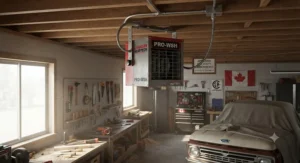
If the De’Longhi TRH0715CA is the cast-iron pan, the Comfort Zone CZQTV5M is the induction burner — faster, more powerful, and built for people who actually work in their shop rather than just standing near it. This is a 240-volt, dual quartz-element heater with a switchable 3,000W/6,000W output and five individually adjustable louvers, mounted permanently on a wall or ceiling. What most buyers overlook about quartz infrared is that it heats objects and bodies directly through radiant energy rather than warming the air first — so there’s no convective airflow stirring up whatever’s settled on your bench. Based on the spec comparison against fan-forced units of similar wattage, the trade-off is coverage pattern: quartz throws heat in a directional cone rather than filling a whole room evenly, so placement matters more than with a blower-style heater. On the 6,000W setting it draws about 25 amps on a 240V circuit, so you’ll need to confirm your panel and wiring can handle that load — this isn’t a plug-and-go unit. Real-world owner reports describe mounting it roughly 2.4 m up, angled toward the main workbench, which concentrates warmth exactly where hands are working rather than heating the whole shop equally.
Pros:
- ✅ Zero fan, zero forced-air dust disturbance
- ✅ Dual wattage settings for shoulder-season vs deep winter
- ✅ Compact 14.5-inch cabinet profile
Cons:
- ❌ Requires 240V wiring and a qualified electrician
- ❌ Heats a cone, not the whole room evenly
Expect to pay in the C$200-C$300 range before installation costs, making the Comfort Zone CZQTV5M the single best-balanced pick for anyone serious about the “safest heater for small workshop with dust” question specifically.
3. Dr. Infrared Heater DR-968 — dual quartz-and-PTC cabinet with a cool-touch shell
The Dr. Infrared Heater DR-968 solves a different problem: what if you want radiant, low-dust-risk heat but don’t want to hire an electrician or commit to a permanent 240V install? This 1,500-watt, 120-volt cabinet heater combines a quartz infrared tube with a PTC ceramic element inside a solid wood housing, and the manufacturer claims the combo produces roughly 60% more effective heat output than a standard single-element 1,500W heater. Here’s what the spec sheet won’t tell you, but long-term users on woodworking gear review sites note: the wood cabinet genuinely stays cool to the touch even after hours of continuous use, which matters in a shop where you’re moving around a lot and might brush against it. The dual-element design means it warms a mid-size garage noticeably faster than a pure quartz or pure oil unit — some owners report feeling warmth within 30 seconds on the high setting. Reviewers do flag that, because it includes a small internal fan to help distribute the PTC-side heat, it isn’t quite as “zero circulation” as the pure radiant options above, so the intake grille needs a quick vacuum-out every few weeks in a sawdust-heavy shop.
Pros:
- ✅ Fast warm-up thanks to dual quartz + PTC design
- ✅ Cool-touch wood cabinet reduces contact-burn risk
- ✅ Plugs into a standard 120V outlet, no wiring needed
Cons:
- ❌ Small internal fan still pulls some air through the grille
- ❌ Heavier and bulkier than a slim tower heater
At around C$150-C$220, this sits comfortably as a mid-range pick for shops that want more punch than an oil radiator without going the hardwired route.
4. Dimplex DGWH4031G — sealed stainless element built for permanent mounting
Once your shop crosses into “actual detached building” territory, the Dimplex DGWH4031G starts making a lot of sense. This is a 4,000-watt, 240V hardwired garage and workshop heater built around a stainless steel tubular element enclosed inside a heavy-gauge steel housing, with a wall or ceiling mounting bracket and an on-unit thermostat. Based on the spec comparison with portable units, the real advantage here isn’t raw wattage — it’s the fully enclosed element itself: the heating coil never sits exposed the way it does on bargain-bin bar heaters, which is precisely the design detail that separates a genuine fire-safe workshop heater from one that merely claims to be. A built-in fan delay keeps the blower running briefly after the element shuts off, using up residual heat rather than wasting it, and automatic overheat protection cuts power if internal temperatures climb too high. Owner discussions on Canadian renovation forums consistently mention that this unit handles a two-car garage-sized shop (400-600 sq ft, insulated) without breaking a sweat, provided the space has reasonable insulation to begin with.
Pros:
- ✅ Fully enclosed stainless steel element
- ✅ Automatic overheat protection plus fan delay
- ✅ Swivels and tilts to direct heat where you work
Cons:
- ❌ Requires a dedicated 240V circuit and professional install
- ❌ Overkill for shops under 200 sq ft
Pricing typically lands in the C$180-C$250 range for the unit alone (installation is extra) — a genuinely solid mid-range investment for anyone planning to keep the same workshop for years.
5. Dr. Infrared Heater DR-988 — industrial output for larger detached shops
For a full detached garage, a barn conversion, or a shop that just never seems to hold heat, the Dr. Infrared Heater DR-988 brings serious capacity: 5,600 watts on a 240V circuit, wall- or ceiling-mountable, with a thermostat range of roughly 3°C to 45°C (37-113°F). What most buyers overlook about stepping up to this wattage tier is that it’s not really about speed — it’s about maintaining temperature in a space with more air volume and more heat loss through an uninsulated garage door. The stainless steel element is fully enclosed within a guarded housing, and the fan-forced design, while it does move air, is built with an industrial-grade motor rated to handle the dusty, gritty environments of garages and construction sites — a meaningfully different engineering standard than a bedroom space heater that happens to be marketed for garages. Reviewers who’ve run it through a full winter in a dusty shop report the sealed motor holds up well, though they consistently recommend a quarterly vacuum of the intake grille as basic maintenance rather than an optional nicety.
Pros:
- ✅ Industrial-rated motor built for dusty environments
- ✅ Wide thermostat range for shoulder seasons and deep cold
- ✅ Fully enclosed heating element
Cons:
- ❌ Needs a dedicated 240V circuit, likely a licensed electrician
- ❌ Fan-forced design still moves some air across the shop
Expect a price range around C$220-C$320, positioning the Dr. Infrared Heater DR-988 as the premium pick for anyone heating a genuinely large or leaky space.
6. Comfort Zone CZ220BK — ceiling-mount hardwired workhorse
The Comfort Zone CZ220BK occupies similar territory to the Dimplex above but leans harder into permanent ceiling installation for a standard two-car garage shop. It’s a 5,000-watt, 240V hardwired unit with fan-forced distribution, a thermal cut-out switch, and overheat protection built into a heavy-gauge steel housing that’s ETL-compliant. On paper this means you get comparable output to the Dr. Infrared Heater DR-988 at a slightly lower wattage, but the ceiling-only mounting frees up 100% of your wall space and floor space — a detail that actually matters in a workshop where every square foot of wall is already claimed by pegboard and clamp racks. Reviewers who’ve compared it against wall-mounted alternatives note that ceiling placement also keeps the heat source further from benches, lumber racks, and finishing stations, which is a meaningful passive safety benefit in a shop where flammable materials tend to pile up at working height rather than near the rafters.
Pros:
- ✅ Ceiling-only mount frees up all wall space
- ✅ ETL-compliant thermal cut-out and overheat protection
- ✅ Heavy-gauge steel housing resists workshop knocks
Cons:
- ❌ Ceiling mounting height must be confirmed before purchase
- ❌ Requires dedicated 240V wiring like other hardwired options
Pricing tends to sit around C$200-C$280, making this a strong alternative to the Dimplex for shops with limited usable wall real estate.
7. Amazon Basics Oil Radiator — budget-friendly backup radiator
Rounding out the list is a genuinely humble option: the Amazon Basics Oil Radiator, a 1,500-watt, seven-fin oil-filled unit with three heat settings, tip-over protection, and ETL safety certification. This isn’t a heater that’s going to win any awards for speed or square footage, but that’s not really the point — it’s the heater you keep in the trunk, or the one you set up for a weekend project in an unheated shed corner where running new wiring simply isn’t worth it. Based on the spec comparison with the pricier De’Longhi TRH0715CA, the fundamentals are the same (sealed oil, enclosed element, no fan), and the practical difference mostly comes down to build finish and thermostat precision rather than the underlying dust-safety profile. Aggregated review sentiment across major retailers points to reliable long-term performance for the price, with the most common complaint being a slightly less precise thermostat than name-brand competitors — a fair trade-off for the lower price point.
Pros:
- ✅ Sealed oil design with no exposed element
- ✅ ETL-certified tip-over and overheat protection
- ✅ Lowest price point on this list
Cons:
- ❌ Less precise thermostat than name-brand radiators
- ❌ Slow heat-up in larger or drafty spaces
At roughly C$60-C$90, this is the entry point for anyone who wants a genuinely safe heater without spending much at all.
Setting It Up Right: A Practical First-30-Days Guide
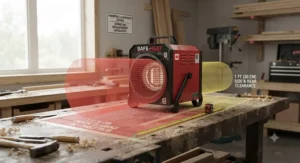
Buying the right unit is half the job — placement and habits do the rest. Start by clearing a minimum 1-metre radius around any heater, oil radiator or hardwired unit alike, from lumber stacks, finishing rags, and anything with sawdust piled against it; that clearance number comes straight from Canadian fire-safety guidance and isn’t a suggestion to shave down when space is tight. For portable units like the De’Longhi TRH0715CA or Amazon Basics Oil Radiator, plug directly into a wall outlet — never an extension cord, since undersized cords are a genuine ignition risk on their own, independent of dust. For hardwired options like the Dimplex DGWH4031G, Dr. Infrared Heater DR-988, or Comfort Zone CZ220BK, schedule the electrician visit before the first cold snap, not during it; a rushed install under pressure is how corners get cut. In the first month, get into the habit of a weekly five-minute intake vacuum on any unit with a fan or grille — this single habit does more for long-term dust safety than almost any spec on the box. Finally, never run a heater unattended overnight in a workshop, even a sealed radiator; workshops accumulate more loose combustible material than living rooms, and that changes the math.
Buyer’s Decision Framework
If you’re still torn between two or three options, work through this quick priority checklist:
- If your shop is under 150 sq ft and you have zero interest in an electrician, choose the De’Longhi TRH0715CA or Amazon Basics Oil Radiator because sealed oil radiators need nothing beyond a wall outlet.
- If dust safety is your single top priority and your shop is mid-size, choose the Comfort Zone CZQTV5M because pure quartz radiant heat never circulates air across your bench.
- If you want strong output without new wiring, choose the Dr. Infrared Heater DR-968 because its dual quartz-PTC design plugs into a standard outlet.
- If your shop is a full two-car garage and you’re heating it long-term, choose either the Dimplex DGWH4031G or Comfort Zone CZ220BK because hardwired units maintain temperature far better across large, leaky spaces.
- If your shop is a detached building or unusually large, choose the Dr. Infrared Heater DR-988 because its 5,600W output is built for exactly that scenario.
How to Choose the Safest Heater for a Dusty Workshop
Picking correctly comes down to five criteria, roughly in order of importance:
- Element enclosure. Look specifically for “sealed,” “enclosed element,” or “fully guarded” in the spec sheet — this is the single biggest factor separating a genuinely fire-safe workshop heater from a fire hazard wearing a heater’s clothing.
- Heating method. Oil-filled radiators and quartz infrared units heat without moving air; ceramic PTC and standard fan-forced units do, which means periodic dust cleaning becomes mandatory rather than optional.
- Certification marks. Confirm CSA, ULC, or ETL certification, since these are the marks recognized by the Standards Council of Canada for space heater safety.
- Coverage vs shop size. Match wattage to square footage honestly; an undersized heater run at max output constantly is harder on components and less safe long-term than a properly sized one running comfortably.
- Installation type. Decide upfront whether you’re open to a 240V hardwired install, since that decision alone eliminates or unlocks half the products on this list.
Fire-Safe Workshop Heaters vs Open-Element Models
This is the comparison that actually matters most for dusty shops, and it deserves plain language rather than marketing terms. A fire-safe workshop heater — oil radiators, quartz infrared, and enclosed-coil fan-forced units like the ones featured above — physically prevents dust from ever touching a hot surface, either by sealing the element inside oil or a guarded housing, or by using radiant heat that doesn’t rely on airflow at all. An open-element model — the classic glowing orange coil bar heater, or any propane/kerosene unit with an exposed flame — creates exactly the ignition scenario that turns a dusty shop into a fire report. According to woodworking equipment guides, propane heaters burn with a flame or element hot enough to ignite sawdust directly, which is why manufacturers themselves discourage indoor use in enclosed workshops. What most buyers overlook is that “electric” alone doesn’t guarantee safety — a cheap electric heater with an exposed, visibly glowing coil carries much of the same risk profile as an open flame, just without the combustion byproducts. The seven products above were all chosen specifically because they avoid exposed elements entirely.
Common Mistakes When Heating a Dust-Filled Garage
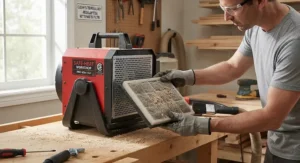
Even good hardware gets undermined by bad habits. The most common mistake is skipping dust cleaning on fan-equipped units simply because “it’s electric, so it’s fine” — fine dust, described by longtime shop owners as “like flour,” can work its way into internal switches and cause failures, occasionally dangerous ones. Second is undersizing the heater for the space and then running it at maximum output around the clock, which stresses components that were designed for intermittent use. Third is using an extension cord for a 1,500W unit, which overloads circuits not rated for the draw. Fourth is placing any heater directly beneath a dust collection port or downwind of a sander, guaranteeing the highest local dust concentration lands exactly where the heat source is. Fifth, and most overlooked, is treating a sealed radiator’s slow warm-up as a defect and cranking the thermostat past what the room needs — patience is part of the safety design, not a flaw in it.
Enclosed Element Heaters Explained
The phrase “enclosed element heaters” covers a specific engineering category worth understanding on its own terms. In an enclosed-element design, the actual heating coil or quartz tube sits inside a sealed chamber — oil, in the case of radiators, or a mesh-guarded tube for quartz infrared — so nothing external, including airborne wood particles, can physically contact the part that gets hot enough to ignite them. This differs meaningfully from “covered” or “guarded” heaters that simply have a wire cage over an otherwise exposed coil; a cage stops fingers, not fine dust. Reviewers and safety guides alike treat enclosed-element as the gold standard specification to search for on any Amazon listing, ahead of wattage, brand, or price. Every product featured in this guide meets that bar, which is exactly why they made the cut.
Workshop Ventilation and Heater Placement
Good workshop ventilation does double duty: it clears airborne dust that could otherwise settle on hot surfaces, and it supplies the fresh combustion air that fuel-burning equipment (welders, finishing sprayers) needs to operate safely alongside your heater. WorkSafeBC’s guidance on combustible dust hazards notes that dust accumulation on horizontal surfaces can become airborne again when disturbed, forming a cloud that poses risk if it reaches an ignition source — which is precisely why a dust collector running at the source of your tools matters as much as the heater you choose. Position any wall- or ceiling-mounted unit away from your primary dust-collection ductwork and away from the direct path of a shop vac’s exhaust. If your shop shares space with a spray-finishing station, never run a heater — even a sealed one — while solvent-based finishes are curing, since vapour ignition is an entirely separate hazard from dust.
Woodworking Shop Heater Safety: Rules, Codes, and Sawdust Fire Hazards
Wood dust isn’t just a housekeeping annoyance — it’s classified as a genuine combustible material capable of explosive ignition under the right conditions of concentration and confinement. The Canadian Centre for Occupational Health and Safety outlines that combustible dust incidents require five factors together: fuel, an ignition source, oxygen, dispersion into the air, and confinement — remove any single one and the risk collapses. For a home workshop, that translates into practical rules: keep sawdust swept rather than piled, choose enclosed-element heaters specifically to eliminate the “ignition source” factor, and ensure your space has enough natural or mechanical ventilation that dust doesn’t concentrate in pockets near the ceiling or rafters. On the regulatory side, Canadian provinces generally require space heaters carry CSA, ULC, or an equivalent Standards Council of Canada-recognized certification mark, and Transport Canada / provincial fire codes govern clearance distances and hardwiring requirements for permanent units like the Dimplex DGWH4031G and Comfort Zone CZ220BK. Homeowners’ insurance policies in Canada frequently ask about supplemental heating sources during claims, so keeping your certification labels and installation receipts on file is cheap insurance against a coverage dispute down the line.
🔥 Ready to stop shivering through your shop time? Compare the picks above, pick your size, and check current pricing before the cold snap hits.
Long-Term Cost & Maintenance
Total cost of ownership on a workshop heater isn’t just the sticker price — it’s the electricity draw, the maintenance routine, and how long the unit realistically lasts under dusty conditions. A 1,500W radiator like the De’Longhi TRH0715CA running four hours a session, three sessions a week, costs only a few dollars a month in most Canadian electricity markets, while a 5,600W unit like the Dr. Infrared Heater DR-988 running the same schedule will cost roughly three to four times as much — worth factoring in if your shop time is mostly weekend hobby work rather than daily use. Maintenance-wise, sealed radiators and quartz units need almost nothing beyond an occasional wipe-down, while fan-forced hardwired units benefit from an annual professional inspection of the 240V connection alongside the seasonal intake-grille vacuum. Battery-powered CO and smoke detectors near the shop should be tested monthly regardless of which heater you choose — a five-minute habit that costs nothing and catches the failures a thermal cut-off can’t.
What to Expect: Real-World Performance
Specs on a box rarely match the lived experience of standing in your own shop at 6°C. In practice, a sealed radiator like the De’Longhi TRH0715CA takes the edge off a small, insulated garage in about 20-30 minutes and holds a steady temperature quietly enough that you’ll forget it’s running. A dual-element cabinet unit like the Dr. Infrared Heater DR-968 feels warmth on exposed skin within half a minute on high, which matters on the coldest mornings when patience is in short supply. Hardwired 4,000-5,600W units transform a genuinely cold two-car garage into a workable space within 30-45 minutes even in sub-zero outdoor temperatures, according to owner reports, though the trade-off is the upfront electrical work. Across every category, the common thread reviewers mention is that radiant and sealed-oil designs simply feel less “aggressive” in a dusty environment — no burning-dust smell, no visible haze kicked up near the vents — which lines up exactly with how these designs are engineered.
Frequently Asked Questions
❓ Is it safe to use a space heater in a woodworking shop?
❓ What type of heater is safest for dust?
❓ Can sawdust catch fire from a heater?
❓ Do I need an electrician for a garage workshop heater?
❓ How far should a heater be from flammable materials in a workshop?
Conclusion
If there’s one takeaway from all seven of these products, it’s that “safest heater for small workshop with dust” isn’t a marketing phrase — it’s a specific, checkable design feature. Enclosed elements, whether oil-sealed or quartz-guarded, are what actually stand between a comfortable winter shop session and a genuinely dangerous one. For most small shops, the De’Longhi TRH0715CA or Comfort Zone CZQTV5M will cover the bulk of Canadian workshop scenarios beautifully, while the hardwired Dimplex DGWH4031G, Dr. Infrared Heater DR-988, and Comfort Zone CZ220BK exist for the moment your shop outgrows portable heat entirely. Whichever you choose, pair it with basic housekeeping — regular sweeping, working dust collection, and a metre of clearance — and you’ll get a warm, genuinely safe shop all winter long.
Recommended for You
- Radiant Shop Heater For Workshop: 7 Best Picks That Actually Warm You (2026)
- Title Natural Gas Shop Heater for Large Garage: 7 Picks That Deliver (2026)
- Propane Garage Heater Vs Electric Garage Heater: 7 Best Picks 2026
Disclaimer: This article contains affiliate links. As an Amazon Associate, I earn from qualifying purchases. If you purchase products through these links, we may earn a small commission at no additional cost to you.
✨ Found this helpful? Share it with a fellow woodworker before the next cold snap hits! 💬🔥
