
In This Article
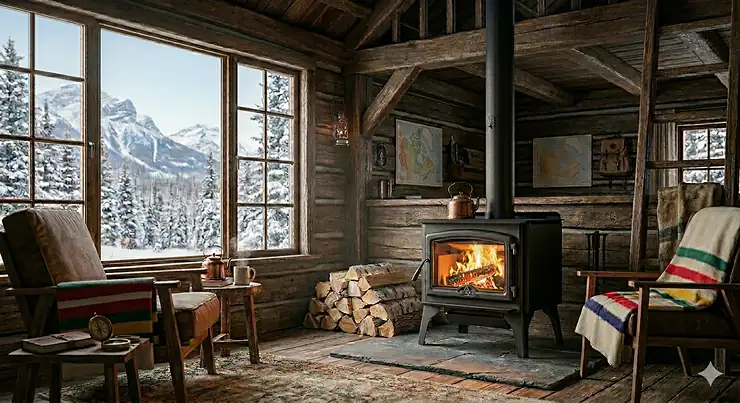
Picture this: it’s February in northern Ontario. Outside, it’s -28°C (-18°F), the kind of cold that turns your breath into a small cloud before it even leaves your mouth. Your solar panels are buried under 40 cm of snow, and the wind has been howling since Tuesday. In that moment, the only thing standing between you and a truly miserable night is the quietly crackling wood stove in the corner of your cabin. No electricity required. No propane tank to run dry. Just you, a stack of dry birch, and a well-chosen stove that doesn’t flinch at a Canadian winter.
Choosing the right wood stove for off-grid cabin living in Canada is not as simple as picking the prettiest cast-iron box on Amazon.ca. The stakes are real. A stove that’s too small leaves you shivering at 2 a.m. A stove that’s too large turns your 600 sq ft retreat into a sauna. A poorly installed chimney is not just inefficient — it’s a fire hazard. And in remote areas of Quebec, Manitoba, or BC, you don’t want to discover any of these problems when the nearest hardware store is a 90-minute drive over logging roads.
In this guide, I’ve pulled together the seven best wood stoves currently available to Canadian buyers — options ranging from portable hot-tent stoves for seasonal-use cabins to serious, CSA-certified cast iron units capable of keeping an 800 sq ft structure warm through the longest prairie winter. I’ve also covered cabin wood stove installation basics, heat distribution strategies, firewood storage solutions, and exactly what CSA certification means and why it matters for your insurance policy.
Whether you’re building a new off-grid homestead in the Cariboo or upgrading a tired old box stove in your Muskoka camp, this guide gives you everything you need to make a confident, Canada-smart purchase in 2026.
Quick Comparison: Top Wood Stoves for Off-Grid Cabins in Canada
| Model | Type | Heating Area | Weight | Price Range (CAD) | Best For |
|---|---|---|---|---|---|
| Drolet Escape 1200 | Cast Iron, EPA/CSA | up to 111 m² (1,200 ft²) | ~90 kg | $$$–$$$$ | Full-time cabin living, 600–1,000 ft² |
| Winnerwell Nomad Large | Stainless, Portable | Medium tents/small cabins | ~15 kg (34 lbs) | $$ | Seasonal cabin, portability needed |
| US Stove Company 900 | Cast Iron, EPA | up to 84 m² (900 ft²) | ~45 kg | $–$$ | Budget buyers, rustic small cabins |
| Osburn 1700 Insert | Steel, EPA/CSA | up to 185 m² (2,000 ft²) | ~90 kg | $$$–$$$$ | Upgrading existing fireplace |
| POMOLY Dwarf 5T | Titanium, Portable | Hot tent / 150–250 ft² | ~3.5 kg (7.7 lbs) | $$–$$$ | Ultralight, bikepacking/canoe cabins |
| Drolet Spark II | Steel, EPA/CSA | up to 186 m² (2,000 ft²) | ~75 kg | $$$ | Mid-size cabins, budget-conscious |
| United States Stove Co. 2469E | Cast Iron, EPA | up to 111 m² (1,200 ft²) | ~50 kg | $–$$ | Entry-level, tight budget |
All prices in CAD. Check current pricing on Amazon.ca as prices fluctuate.
These seven stoves span four very different buyer profiles — from the weekend paddler who needs something they can carry in a canoe to the family that lives off-grid in BC year-round and needs a stove that runs 16 hours a day from October to April. The Drolet models stand out as the strongest choices for year-round Canadian cabin use, given that they’re manufactured in Quebec and are engineered specifically for Canadian conditions. That said, the budget and portable categories have some genuinely impressive options that shouldn’t be dismissed.
💬 Just one click — help others make better buying decisions too! 😊
Top 7 Wood Stoves for Off-Grid Cabins: Expert Analysis
1. Drolet Escape 1200 — Best Overall for Year-Round Canadian Cabins
The Drolet Escape 1200 is, in my view, the gold standard for Canadians buying a wood stove for off-grid cabin use in the 600–1,200 sq ft range. What makes it stand out isn’t just the specs — it’s the philosophy behind the design.
Manufactured in Québec City by a company that has been building wood-burning appliances since 1967, the Drolet Escape 1200 produces up to 45,000 BTU/h and is EPA certified at just 1.8 g/h of particulate emissions. It handles logs up to 43 cm (17 inches) long and has a maximum burn time of approximately 10 hours on a single load — which, practically speaking, means you load it up at 10 p.m. in January and still wake up to a warm cabin. That’s not a marketing claim; it’s the reality of a properly sized, airtight cast-iron firebox working the way it was designed to. The heating area is rated up to 111 m² (roughly 1,200 ft²), which covers the vast majority of off-grid cabin builds.
What most Canadian buyers overlook about this model is that its CSA B415.1 certification isn’t just an environmental credential — it’s a practical financial one. Many Canadian home insurance providers require that any wood-burning appliance be CSA or EPA certified before they’ll issue a policy on a property. Without that sticker, you might find yourself uninsurable. The Escape 1200 ticks that box cleanly.
The airwash system keeps the ceramic glass window clear during burns, which sounds cosmetic but is genuinely useful — you can monitor combustion quality without opening the door and losing heat. Canadian buyers particularly appreciate the pedestal model option, which improves clearance to combustibles on rustic cabin floors and gives a slightly more traditional look.
Customer feedback from Canadian buyers consistently highlights the stove’s ease of re-firing in the morning even from cold ash, which speaks well of its firebox design and air control.
✅ Pros:
- Made in Canada, CSA and EPA certified — insurance-friendly
- Excellent 10-hour burn time for cold Canadian nights
- Air wash system keeps glass clear for fire monitoring
❌ Cons:
- Heavy (~90 kg) — installation requires help and planning
- Higher price range; not ideal for occasional-use camp stoves
Price range: $$$–$$$$ CAD. Check current availability on Amazon.ca.
2. Winnerwell Nomad Large — Best Portable Option for Seasonal Cabins
The Winnerwell Nomad Large is the stove I’d recommend to anyone who needs a heating solution for a seasonal cabin, a canvas tent hunting camp, or an off-grid structure that’s used a few months a year rather than year-round. It’s a 304 stainless steel portable wood stove that weighs about 15 kg (34 lbs) — light enough that one person can carry it from the truck to the cabin without breaking their back.
The firebox holds approximately 1,500 cubic inches of fuel, which is substantial for a portable unit. The four collapsible legs fold flat and tuck inside the stove body for transport, and all five chimney pipe sections (89 mm / 3.5-inch diameter) store internally as well. Assembly on-site takes under 10 minutes. The flat cooktop is thick enough for a cast-iron pan, which matters if your off-grid cabin doesn’t have a propane setup.
Now, here’s the caveat that the product listing glosses over: the Winnerwell Nomad is classified as a recreational wood stove, not a certified residential appliance. It is not CSA certified for permanent residential installation. That means it is not appropriate as the sole heat source in a year-round, permanently occupied off-grid home — and using it as such could create insurance issues. For a seasonal hunting cabin, a canvas-walled glamping setup, or a three-season ice fishing shack, however, it is absolutely excellent.
Canadian reviewers on Amazon.ca note that the stainless steel handles cold-weather condensation well and that the stove heats small spaces (under 20 m² / 215 ft²) remarkably quickly. One reviewer in northern Manitoba noted it kept their 14×16 canvas tent at 18°C when the outside temperature was -22°C — impressive performance for a portable unit.
✅ Pros:
- Extremely portable; full kit self-contained in the stove body
- Fast assembly; no tools required
- Flat cooktop functional for off-grid meal prep
❌ Cons:
- Not CSA certified for permanent residential installation
- Not suitable as primary heat for year-round occupied cabins
Price range: $$ CAD. Available on Amazon.ca; Prime-eligible in most provinces.
3. US Stove Company 900 — Best Budget Pick for Rustic Small Cabins
The US Stove Company 900 is a no-frills, cast-iron box stove that has earned its reputation the hard way: decades of use in hunting camps, fishing shacks, and rustic cabins across North America where the priority is “does it work?” and not “does it look pretty?”
Its EPA certification confirms emissions below the 2020 standard, and its rated heating capacity of up to 84 m² (900 ft²) is genuinely achievable in a well-insulated small cabin. The cast-iron construction means it radiates heat long after the fire has died down — which is actually a significant advantage over thinner steel stoves that cool off quickly. If you’re at the cabin and let the fire die while you’re out snowshoeing, you’ll come back to residual warmth rather than a cold box.
Where it falls short compared to the Drolet models is in burn-time efficiency. The firebox is smaller, the air control is less precise, and you’ll be feeding it more frequently than you would a larger Canadian-made unit. That said, at roughly half the price of premium options, it’s a legitimate choice for a cabin that’s used intermittently and doesn’t require the set-it-and-sleep comfort of an overnight burn.
Availability on Amazon.ca is good, though Canadian buyers should confirm the specific model ships to their province, as remote northern addresses occasionally incur additional freight costs.
✅ Pros:
- Cast iron construction retains radiant heat well
- EPA certified; budget-friendly entry into cabin heating
- Compact enough for tight cabin layouts
❌ Cons:
- Shorter burn times than premium models — needs more frequent tending
- Less precise air control
Price range: $–$$ CAD. Check current pricing on Amazon.ca.
4. Osburn 1700 Stove Insert — Best for Upgrading an Existing Cabin Fireplace
If your off-grid cabin already has a masonry fireplace that’s been losing more heat up the chimney than it’s been producing, the Osburn 1700 is the upgrade that transforms it into an actual heating appliance. Osburn has been manufacturing in Saint-Georges, Québec since 1979 — another proudly Canadian brand — and the 1700 insert represents their entry-level offering that still manages up to 185 m² (approximately 2,000 ft²) of heating capacity at 65,000 BTU/h.
The insert slides into an existing fireplace opening and connects to the existing masonry chimney via a flexible liner — a much less disruptive installation than a freestanding stove if the structure is already built. For buyers who purchased a cabin with an inefficient open fireplace, this is often the most cost-effective upgrade path, since it preserves the existing hearth aesthetic while radically improving efficiency.
CSA and EPA certified, the Osburn 1700 features a large ceramic glass viewing window and a blower system that actively pushes warm air into the room rather than relying solely on radiant heat — important in cabins with an open floor plan or high ceilings. What the spec sheet won’t tell you is that the blower makes a meaningful difference in how quickly the warmth reaches the far corners of a room; passive radiant heat from an insert without a blower can leave you warm near the hearth but chilly across the cabin.
Canadian buyers note that Osburn’s dealer network in Canada is strong, making parts and service accessible even in mid-sized towns.
✅ Pros:
- Insert design; ideal for existing fireplace conversions
- Integrated blower improves whole-room heat distribution
- Made in Canada, CSA/EPA certified
❌ Cons:
- Requires existing masonry fireplace opening
- Installation complexity warrants a certified WETT technician
Price range: $$$–$$$$ CAD. Check Amazon.ca for current availability.
5. POMOLY Dwarf 5T Titanium Stove — Best Ultra-Light Option for Remote Backwoods Cabins
The POMOLY Dwarf 5T occupies a niche that not many Canadian buyers think about but absolutely should: the off-grid cabin that is accessed by canoe, floatplane, or long portage trail. When your cabin requires a 14 km paddle followed by a 2 km carry-in to reach, every gram of gear matters. The Dwarf 5T weighs approximately 3.5 kg (7.7 lbs) complete — less than a large bag of flour — and collapses into a flat package that slides into a pack.
Titanium construction gives it a better strength-to-weight ratio than stainless steel, and it’s remarkably resistant to warping at sustained high temperatures. The secondary combustion system produces a cleaner, more efficient burn than comparable steel camping stoves, reducing creosote buildup in the pipe sections — something worth paying attention to if your chimney isn’t easily accessible for annual cleaning.
Be clear-eyed about its limitations: this is a hot-tent and micro-cabin stove, not a solution for an 800 sq ft off-grid home. In a well-insulated 12 m² (130 ft²) cabin space, it performs excellently. In a larger structure, you’ll be feeding it constantly and still feeling drafts. The price point is higher than its size suggests — titanium is expensive — but for the paddler or trail-access cabin owner, the weight savings are genuinely transformative.
Available on Amazon.ca; buyers in northern regions should confirm shipping lead times, as delivery to remote postal codes can take 7–14 business days.
✅ Pros:
- Exceptionally lightweight — ideal for portage/canoe-access cabins
- Titanium resists warping and corrosion
- Secondary combustion produces cleaner burns
❌ Cons:
- Only suitable for very small spaces (under ~130 ft²)
- Higher price for its size category
Price range: $$–$$$ CAD. Check current pricing on Amazon.ca.
6. Drolet Spark II — Best Mid-Range Pick for 800 sq ft Cabins
The Drolet Spark II hits the sweet spot that most Canadian off-grid cabin owners are actually looking for: a genuinely high-efficiency stove at a price that doesn’t require remortgaging the property. Also made in Québec and certified to both EPA and CSA B415.1-10 standards, it offers a heating area of up to 186 m² (2,000 ft²) with 75,000 BTU/h output — more than enough for a standard wood stove for 800 sq ft cabin applications.
What distinguishes the Spark II from older-generation models is its non-catalytic advanced combustion system. Rather than relying on a catalytic combustor (which needs periodic replacement and careful maintenance), it uses a baffle and secondary air system to achieve a clean, high-temperature secondary burn above the fuel bed. In plain terms: it burns the smoke itself, squeezing more heat out of your firewood and sending far less creosote up the chimney. For a cabin that’s occupied regularly through a Canadian winter, that translates to less frequent chimney cleaning — a meaningful advantage.
The firebox accepts logs up to 51 cm (20 inches), which means you can load standard split firewood without extra cutting. Burn time on a full load is approximately 8 hours, suitable for overnight use. The steel construction heats up faster than cast iron, which is ideal for weekend cabin use where you want warmth quickly after arriving on a Friday night.
✅ Pros:
- CSA and EPA certified; satisfies most Canadian insurance requirements
- Advanced combustion reduces creosote and extends chimney cleaning intervals
- Fast heat-up time for weekend cabin use
❌ Cons:
- Steel body cools faster than cast iron after fire dies
- Requires proper chimney installation for optimal draft
Price range: $$$ CAD. Check current pricing and availability on Amazon.ca.
7. United States Stove Co. 2469E — Best Entry-Level Cast Iron Pick
The United States Stove Co. 2469E rounds out the list as the most accessible entry point into cast-iron cabin heating. It’s a compact, EPA-certified cast-iron stove with a flat cooktop surface, rated for areas up to 111 m² (1,200 ft²). The cast-iron body gives it better heat retention than comparable steel stoves at this price point — once it’s hot, it stays warm significantly longer after the fire burns down.
The 2469E is honest about what it is: a utilitarian heating appliance for a small cabin, not a premium long-burn showcase model. The air control is simple but functional. The glass door lets you monitor combustion. There are no electronic components — nothing to fail in a remote off-grid setting. For a three-season or light four-season cabin where you want reliable heat without complexity or high cost, it delivers exactly that.
Canadian buyers should note that while the product is available on Amazon.ca, shipping heavy cast-iron items to remote addresses can incur additional freight costs. Prime eligibility may not apply to all postal codes. Confirm your address at checkout before ordering.
✅ Pros:
- Affordable entry-level cast iron option
- Flat cooktop surface for basic off-grid cooking
- No electronic components — nothing to break in remote use
❌ Cons:
- Simpler air controls limit overnight burn efficiency
- Shipping to remote Canadian addresses may incur surcharges
Price range: $–$$ CAD. Check current pricing on Amazon.ca.
✨ Don’t Miss These Exclusive Deals!
🔍 Take your off-grid cabin comfort to the next level with these carefully selected wood stoves and heating accessories. Click on any highlighted item to check current pricing and availability on Amazon.ca. These products will help you stay warm through even the most brutal Canadian winters!
Cabin Wood Stove Installation: What You Must Know Before You Buy
Installing a wood stove for off-grid cabin use is not a weekend DIY project to figure out on the fly. In Canada, wood stove installation is governed by specific codes and standards — and getting it wrong isn’t just dangerous, it can void your home insurance and make your cabin legally uninhabitable.
Understanding WETT Certification in Canada
In most Canadian provinces, wood stove installations must be inspected and certified by a WETT (Wood Energy Technology Transfer) certified technician. WETT is the national standard program for wood energy systems in Canada. Many insurance companies require a WETT inspection certificate as a condition of coverage for any property with a solid-fuel appliance. If you’re buying a cabin that already has a wood stove, request the WETT certificate from the seller — if they can’t produce one, budget for an inspection before moving forward.
You can find a certified WETT inspector through WETT Inc.’s official directory, Canada’s national wood energy training program.
The 3-2-10 Rule for Chimney Height
Proper chimney height isn’t optional — it directly affects draft performance and creosote accumulation. The standard rule followed across Canada is the 3-2-10 rule: the chimney must extend at least 0.9 m (3 feet) above the point where it exits the roof, and it must be at least 0.6 m (2 feet) taller than any part of the roof or adjacent structure within 3 m (10 feet) horizontally. In off-grid cabin settings — especially with low-pitched roofs or nearby tree canopy — this rule is critical for preventing backdraft.
Stovepipe Length and Elbow Rules
The stovepipe (the connector between the stove and the chimney) should be as short and direct as possible. Canadian installation guidelines recommend a maximum straight pipe length of 3 m (10 feet). Where bends are necessary, two 45-degree elbows create less turbulence than a single 90-degree elbow and should be preferred wherever the geometry allows. Every section of pipe must slope upward toward the chimney at a minimum of 20 mm per metre (¼ inch per foot). Flue pipe must never pass through a combustible floor, ceiling, attic space, or concealed cavity — only factory-built, listed chimney sections may penetrate these building elements.
Hearth Protection and Clearances
Your stove must sit on a non-combustible hearth pad that extends at least 45 cm (18 inches) in front of the loading door and 20 cm (8 inches) to each side. For an off-grid cabin with wood or laminate flooring, this typically means a tile, stone, or steel hearth pad. Clearances to combustible walls vary by model — always check the manufacturer’s installation manual, as reduced clearances are possible with approved heat shields. Do not estimate clearances; measure them.
Real-World Buyer Scenarios: Which Stove Fits Your Situation?
Every Canadian off-grid cabin buyer is different. Here are three realistic profiles to help you figure out which stove on this list actually fits your life.
Profile 1: The Weekend Warrior — Muskoka Lakefront Camp, ~500 sq ft
You own a modest camp on a lake north of Barrie, Ontario. You use it most weekends from September through April, arriving Friday evening and leaving Sunday afternoon. You want to walk in on a cold night and have the place warm within an hour. You’re not worried about overnight burns because you’re there to tend the fire.
Best match: Drolet Spark II — The steel construction heats up noticeably faster than cast iron, meaning you’ll feel warmth within 20–30 minutes of lighting a fire rather than the 45–60 minutes a thick cast-iron unit requires to reach full radiant output. At under 186 m² capacity, it’s more than ample for a 500 sq ft space, and the CSA certification keeps your cottage insurance policy intact.
Profile 2: The Remote Homesteader — Northern BC Off-Grid Property, ~900 sq ft
You live off-grid year-round on a 10-hectare property outside of Houston, BC. The wood stove is your primary heat source from October through April. You need overnight burns, 10+ hour run times, and something that doesn’t demand constant attention.
Best match: Drolet Escape 1200 — The 10-hour burn time is the critical spec here. When it’s -20°C and you have livestock to tend at 6 a.m., you need to wake up to a cabin that hasn’t dropped below 12°C. The Escape 1200’s large firebox, airtight cast-iron construction, and precise air controls deliver that reliability. The CSA certification also matters for any BC home insurance policy.
Profile 3: The Canoe-Country Camp Builder — Remote Lake Access, ~120 sq ft
You’ve built a small seasonal cabin on a Crown land lease accessible only by canoe across two lakes and a 3 km portage. Weight is everything. The structure is small — maybe 10 m² (110 sq ft) — and you use it three to four weeks a year in shoulder seasons.
Best match: POMOLY Dwarf 5T — Nothing else on this list makes sense for this scenario. The 3.5 kg total weight means you can carry the entire stove in a single portage load. In a space this small, it more than provides adequate heat. The titanium construction handles the wet conditions of a northern boreal lake environment without corrosion concerns.
How to Choose a Wood Stove for Off-Grid Cabin in Canada: 6 Key Criteria
Shopping for the right stove is a decision that will shape your comfort for decades. Here’s a clear framework to work through before clicking “buy.”
1. Calculate your actual heating area first. Don’t trust the manufacturer’s maximum rating as a planning number. A well-insulated new-build cabin in central BC is very different from a draughty older structure in northern Quebec. The Natural Resources Canada wood heating guide offers useful guidance on calculating heat loss. As a rough rule, assume the stove’s rated area is your maximum usable area under ideal insulation conditions — subtract 20–30% for a real-world Canadian cabin.
2. Prioritize CSA or EPA certification. This is not optional if you carry home insurance. Across Canada (except Nunavut, which has specific provisions), wood-burning appliances must be either EPA or CSA certified to comply with building codes and insurance requirements. The CSA B415.1-10 standard is the Canadian-specific certification — stoves certified under it have been tested under Canadian conditions and standards.
3. Match burn time to your usage pattern. If you’re at the cabin for extended stays, a 10-hour burn time (Drolet Escape 1200, Spark II) lets you sleep without tending the fire. If you’re a weekend visitor who’s active and alert, a shorter-burning but faster-heating stove (US Stove 900, Winnerwell Nomad) may suit you better.
4. Consider portability vs. permanence. Permanent freestanding or insert stoves require proper chimney installation and WETT inspection but deliver superior heat output and efficiency. Portable recreational stoves like the Winnerwell Nomad offer flexibility but are not certified for permanent residential use.
5. Factor in chimney system costs. The stove is rarely the most expensive part of the installation. A proper Class A insulated chimney system for a Canadian off-grid cabin typically runs $800–$2,500 CAD depending on height and complexity. Budget for this from the start.
6. Think about firewood logistics. A 75,000 BTU stove used 10 hours a day through a six-month northern Canadian winter will consume roughly 5–7 cords of hardwood annually. If you’re harvesting your own wood on Crown land in Ontario or BC, that’s manageable. If you’re buying delivered firewood, it’s a significant annual operating cost. Choose your stove size accordingly — bigger is not always better.
Wood Stove Heat Distribution: Getting Warmth to Every Corner
One of the most common complaints from off-grid cabin owners — even those with well-sized, properly installed stoves — is uneven heat distribution. The stove roasts you if you’re within 3 metres of it, but the far wall is 10 degrees cooler. Here’s how to address that practically.
Strategic Stove Placement
The single biggest lever you have for even heat distribution is stove placement. Centrally positioned stoves radiate in all directions and create more uniform temperatures than corner installations. For a typical rectangular cabin, positioning the stove along the interior wall that is closest to the geometric centre of the living space — rather than against an exterior wall — dramatically improves distribution. The trade-off is that central placement makes chimney routing more complex, but it’s worth the planning effort.
Stove Fans: Low-Tech, High Impact
A non-electric stove fan (also called a Peltier or thermoelectric fan) sits directly on top of the stove and converts the temperature differential between the hot stove surface and the cooler air above it into electricity to drive its own blades. No batteries, no wiring — it just works when the stove is hot and stops when it cools down. In a 600 sq ft open-plan cabin, a quality stove fan can extend the effective warm zone by 3–5 metres, pushing heated air toward sleeping areas and kitchen corners. These are widely available on Amazon.ca and are one of the best value accessories for cabin heating.
Passive Airflow and Thermal Mass
In a multi-room cabin, use transom openings above internal doors to allow warm air to circulate without requiring fans. Thermal mass — stone tile floors, brick hearth surrounds, soapstone cladding — absorbs radiant heat during peak burn and releases it slowly over several hours, smoothing out the temperature swings between a roaring fire and cold ash.
Firewood Storage Solutions for Off-Grid Cabins
Your stove is only as good as the fuel you feed it. Green or wet wood creates excessive smoke, accelerates creosote buildup, and produces a fraction of the heat of properly seasoned firewood — a difference that’s especially painful at -30°C in northern Alberta.
Seasoning Requirements
Hardwoods like birch, maple, oak, and ash — the preferred cabin firewood across most of Canada — require a minimum of 12 months of air-drying after splitting to reach the 20% or lower moisture content that produces optimal combustion. Softwoods like pine and spruce dry faster (6–8 months) but burn hotter and faster, creating more creosote if not managed carefully. A simple wood moisture metre (available on Amazon.ca for under $30 CAD) is one of the best investments any cabin owner can make — you’ll immediately know whether a load of delivered wood is actually ready to burn.
Outdoor Storage Design
For a Canadian off-grid cabin, your firewood storage should hold a minimum of one cord (approximately 3.6 m × 1.2 m × 1.2 m / 128 cubic feet) accessible near the cabin entry without you wading through deep snow. An open-sided lean-to with a metal or rubber roof over a gravel base keeps wood dry, allows airflow for continued seasoning, and prevents ground contact that causes rot. Position the structure so the open side faces south and away from prevailing winter winds — this maximizes solar drying and minimizes wind-driven precipitation into the stack.
Indoor Storage
Keep a 24–48 hour supply of firewood inside the cabin at all times. Not because you might run out, but because bringing frozen logs in from -25°C outdoor storage dramatically reduces your initial fire temperature and forces the stove to burn less efficiently for the first 30–45 minutes. Indoor wood also has lower surface moisture from cabin humidity, which helps with ignition. A simple metal firewood rack near the stove — widely available on Amazon.ca — keeps a day’s worth of wood organized and at room temperature.
Common Mistakes When Buying a Wood Stove for an Off-Grid Cabin in Canada
Even experienced off-grid buyers fall into these traps. Avoid them.
Buying for the coldest day, not the average day. A stove sized for the absolute worst-case scenario will be so oversized for 90% of your time that you’ll be running it at smouldering low temperatures just to avoid overheating — which is exactly the low-temperature burn condition that creates the most creosote. Size for your average-cold conditions and insulate your cabin properly.
Ignoring chimney quality. A $600 budget stove with a properly insulated, correctly installed Class A chimney will outperform a $2,500 premium stove connected to an undersized, DIY stovepipe running through an uninsulated wall. The chimney is half the heating system — treat it that way.
Skipping the WETT inspection. “I’ll just install it myself and not tell the insurance company” is a genuinely dangerous approach that has cost Canadian cabin owners everything when a chimney fire occurred and the insurance claim was denied. WETT inspections typically run $200–$400 CAD — a trivial cost relative to the risk.
Buying a stove not available in Canada or without Canadian service. Some premium European and American stove brands sold on Amazon.com are technically available to ship to Canada but carry no Canadian dealer network, no warranty service in Canada, and replacement parts that take 6–8 weeks to arrive internationally. Stick with brands that have established Canadian distribution — Drolet, Osburn, Pacific Energy, Napoleon/Timberwolf — or well-supported international brands with Canadian stockists.
Storing wet firewood and assuming it will dry fast enough. It won’t. Freshly split wood delivered in October will not be ready to burn efficiently by November. Plan your firewood supply 12–18 months ahead.
CSA Certified Cabin Wood Stove: Why Certification Actually Matters
The CSA (Canadian Standards Association) mark on a wood stove isn’t just a logo — it’s a legally and financially meaningful certification that affects everything from building permits to insurance coverage to environmental compliance.
Under the CSA B415.1-10 standard — the primary test method for solid-fuel heating appliances in Canada — stoves are tested for both emissions (particulate output measured in grams per hour) and thermal efficiency. A stove certified under this standard has been independently tested and verified to meet Canadian safety and performance requirements. The Government of Canada’s official wood heating resources provide detailed guidance on compliant appliances and installation requirements.
Practically, this means:
- Insurance compliance: Most Canadian home insurance providers require CSA or EPA certification as a condition of policy issuance for any solid-fuel appliance. An uncertified stove can result in denied claims or policy cancellation.
- Building permits: Many municipalities and rural jurisdictions in Canada require proof of certification before issuing a building permit for a wood stove installation.
- Environmental regulations: Provinces including BC, Ontario, and Quebec have air quality regulations that reference EPA and CSA emission standards. In areas with burn bans or wood stove exchange programs, uncertified stoves may be prohibited outright.
The EPA certification widely referenced on US-made stoves is generally accepted across Canada as equivalent to CSA for insurance and regulatory purposes — but the CSA B415.1-10 mark from a stove manufactured in Canada carries additional weight in Canadian regulatory contexts.
✨ Don’t Miss These Exclusive Deals!
🔍 Ready to upgrade your off-grid cabin heating? Click on any highlighted product to check current pricing and availability on Amazon.ca. Canadian Prime members get free shipping on eligible items — and many of these stoves qualify!
FAQ: Wood Stoves for Off-Grid Cabins in Canada
❓ What size wood stove do I need for an 800 sq ft cabin in Canada?
❓ Is CSA certification required for a wood stove in Canada?
❓ Can I install a wood stove in an off-grid cabin myself in Canada?
❓ What is the best firewood for Canadian cabin winters?
❓ Do wood stoves available on Amazon.ca ship to northern or remote Canadian addresses?
Conclusion: Staying Warm Off the Grid, the Canadian Way
The right wood stove for off-grid cabin life in Canada isn’t just a heating appliance — it’s a long-term relationship. Buy well, install correctly, and maintain it consistently, and it will keep you and your family warm through thirty Canadian winters without complaint. Buy poorly, skip the WETT inspection, or burn wet wood, and you’ll be cold, expensive, and potentially uninsured.
My top recommendation for most Canadian cabin owners remains the Drolet Escape 1200 for year-round or primary-use scenarios, and the Drolet Spark II for weekend and mid-season users wanting excellent efficiency at a slightly lower price point. Both are made in Canada, both are CSA certified, and both reflect decades of engineering experience aimed squarely at the Canadian winter.
For seasonal or portable applications, the Winnerwell Nomad Large is a genuinely impressive piece of equipment — just be clear-eyed about its recreational (non-residential) classification.
Whatever stove you choose, pair it with a properly installed Class A chimney, properly seasoned hardwood, and a WETT inspection certificate, and you’ll have everything you need to stay warm no matter what a Canadian winter throws at you.
✨ Don’t Miss These Exclusive Deals!
🔍 Check current pricing on all recommended wood stoves and heating accessories on Amazon.ca. Many items are Prime-eligible for free shipping — perfect for stocking up before winter hits!
Recommended for You
- 7 Best Small Wood Stove for Tiny House Canada 2026
- Best Wall Panel Heater Electric in Canada 2026: Top 7 Picks
- 7 Best Electric Baseboard Heaters Canada 2026
Disclaimer: This article contains affiliate links. As an Amazon Associate, I earn from qualifying purchases. If you purchase products through these links, we may earn a small commission at no additional cost to you.
✨ Found this helpful? Share it with your friends! 💬🤗
