
In This Article
A convection heater warms a room by heating the air around an internal element and letting that warm air circulate naturally or with a small fan, rather than blasting direct radiant heat at a person or object. For Canadians, the best convection heaters in 2026 balance three things most U.S.-focused guides ignore: performance in genuinely cold rooms (not just “chilly” rooms), compatibility with 240V wiring common in Canadian homes for permanent baseboards, and safety certification recognized here — specifically CSA, not just UL.
If you’ve ever stood in the heating aisle of a Canadian Tire or scrolled Amazon.ca at 11 p.m. wondering whether you need a $40 plug-in unit or a $300 hardwired baseboard, you’re not alone. Winter in this country isn’t really a season — it’s a four-to-six-month negotiation with your hydro bill. Convection heaters get pitched as the budget-friendly answer to a chilly basement or a bedroom your furnace can’t quite reach, but “convection heater” actually covers a surprisingly wide range of products: ceramic-element baseboards, oil-filled radiators, panel convectors, and smart wall units.
This guide walks through seven real models available on Amazon.ca right now, what their specs actually mean once winter hits, and where convection heating makes sense versus where it quietly drains your wallet. We’ll also get into Canadian-specific stuff most reviews skip entirely — provincial electricity rates, CSA certification, and what a licensed electrician will actually charge you to wire one in.
As an Amazon Associate, this site earns from qualifying purchases. All prices are in CAD and shown as ranges, since Amazon.ca pricing shifts frequently — always check current pricing on Amazon.ca before buying.
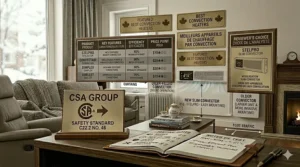
Quick Comparison: Convection Heaters at a Glance
| Heater | Type | Power | Best For | Price Range (CAD) |
|---|---|---|---|---|
| Stelpro Prima Series (SPR Series) | Hardwired baseboard | 500W–1500W | Permanent room heating, condos | $60–$160 |
| Dimplex Linear Convector | Hardwired baseboard | 750W–1500W | Renovations, Canadian-made preference | $75–$180 |
| Uniwatt by Stelpro Convector | Surface-mounted convector | 1000W–1500W | Quiet supplemental heat, bathrooms | $90–$190 |
| De’Longhi Convector Panel (HCX9115ECA) | Plug-in panel convector | 1500W | Renters, apartments | $90–$140 |
| De’Longhi Radia S (TRRS0715ECA) | Oil-filled radiator | 1500W | Bedrooms, overnight use | $100–$160 |
| DREO Smart Wall Heater (WH719S) | Smart wall-mount | 1500W | Tech-forward households | $90–$150 |
| PELONIS Oil-Filled Radiator | Portable oil radiator | 1500W | Budget-conscious buyers | $60–$110 |
A few things jump out of this table immediately. The two cheapest entry points — Stelpro’s smallest baseboard and the PELONIS radiator — sit at opposite ends of the use-case spectrum: one is a permanent fixture you wire into a wall, the other is something you can box up and move to a cottage. The wattage spread (500W to 1500W) also matters more than it looks: a 500W Stelpro unit suits a small bathroom or hallway, while anything heating a full bedroom or living room realistically needs the 1500W tier, full stop. Worth noting too — none of these qualify for ENERGY STAR certification, because Natural Resources Canada classifies all electric resistance heaters as already 100% efficient at the point of use — the savings come from how you use the unit, not the unit itself.
💬 Just one click — help others make better buying decisions too!😊
✨ Don’t Miss These Exclusive Deals!
🔍 Take your winter heating setup to the next level with these carefully selected products. Click on any highlighted item to check current pricing and availability on Amazon.ca. A little planning now saves you from a 2 a.m. emergency Canadian Tire run in January.
The 7 Best Convection Heaters Available on Amazon.ca
1. Stelpro Prima Series Baseboard Heater (SPR Series)
The Stelpro Prima Series is a hardwired electric baseboard convector designed and manufactured in Quebec, and it’s the closest thing to a default recommendation for anyone replacing an old baseboard in a Canadian home. It comes in several wattages — the SPR0501W (500W, 22¼”) suits a small room up to roughly 50 sq. ft., while the SPR1502W (1500W, just under 50″) covers up to about 150 sq. ft.
What the spec sheet doesn’t tell you: Stelpro’s enclosed element design runs noticeably quieter over years of use than the open-coil baseboards still found in a lot of older Canadian rentals, and the compact housing means it doesn’t eat as much wall space below a window — a real consideration in older homes where furniture placement is already a puzzle. This is the unit for someone doing a proper renovation and wants a “set it and mostly forget it” heat source, not someone needing portable supplemental warmth.
Pros: Compact housing saves wall space; quiet enclosed element; widely stocked at Canadian retailers (Home Depot, Home Hardware) for easy warranty service. Cons: Requires a licensed electrician for installation; no portability.
Price: Roughly $60–$160 CAD depending on wattage. Best value if you’re already paying for an electrician’s time on other work.
2. Dimplex Linear Convector Baseboard Heater
Dimplex baseboards (look for model codes like LC3010W31 or the LCM series) use a “shark-fin” element design that Dimplex claims moves heat into the room up to 40% faster than older baseboard styles, through top-vented airflow. In practice, that translates to a baseboard that’s roughly 40% shorter than a conventional unit of the same wattage — useful if you’re trying to fit a heater under a narrow window.
Dimplex is also manufactured in Canada, and the company sells an optional wireless multi-zone control system, letting several Dimplex units across a home respond independently to temperature changes on a shared circuit. That’s a meaningful upgrade path if you’re heating more than one or two rooms and don’t want to install a separate smart thermostat on every wall.
Pros: Compact “shark-fin” design; optional whole-home wireless zone control; widely available at Canadian big-box retailers.
Cons: Wireless zone controllers are sold separately and add cost; still requires hardwiring.
Price: Roughly $75–$180 CAD per unit before installation.
3. Uniwatt by Stelpro Convector Heater
The Uniwatt by Stelpro line is a surface-mounted convector (not a recessed baseboard) with a built-in electronic thermostat, available in 1000W and 1500W versions. Because it mounts directly to the wall surface rather than requiring a recessed cavity, it’s a reasonable option for basement renovations or additions where cutting into the wall isn’t practical.
The built-in thermostat is the detail worth flagging: many baseboard heaters require a separate wall thermostat purchased and wired independently, which adds $140–$350 to your installation cost according to Canadian renovation cost guides. Having the thermostat integrated removes that extra line item — useful if you’re budgeting tightly for a single-room reno.
Pros: Built-in electronic thermostat (no separate purchase needed); surface-mount simplifies installation in finished basements.
Cons: Still requires 240V wiring and an electrician; bulkier profile than recessed baseboards.
Price: Roughly $90–$190 CAD.
4. De’Longhi Convector Panel Heater (HCX9115ECA)
This is where convection heating gets accessible to renters. The De’Longhi Convector Panel is a freestanding or wall-mountable plug-in unit rated at 1500W, with a digital display, adjustable thermostat, timer, and an Eco energy-saving mode. No electrician, no permit, no landlord conversation required — you plug it in.
The trade-off versus a hardwired baseboard is what you’d expect: it’s not as “invisible” in a room, and a 1500W plug-in unit pushes close to the safe limit of a standard household outlet, so don’t pair it with other high-draw appliances on the same circuit. For a condo or apartment where you can’t touch the wiring, though, this is a sensible middle ground between a cheap ceramic fan heater and a real baseboard.
Pros: No installation or electrician needed; Eco mode and timer help manage hydro costs; slim freestanding/wall-mount design.
Cons: Draws close to a standard outlet’s safe capacity; not as discreet as a recessed baseboard.
Price: Roughly $90–$140 CAD.
5. De’Longhi Radia S Oil-Filled Radiator (TRRS0715ECA)
Oil-filled radiators work differently than the ceramic or panel convectors above: an internal heating element warms a sealed reservoir of diathermic oil, and that oil retains heat and keeps radiating warmth even after the unit cycles off. The De’Longhi Radia S is a 1500W version with adjustable thermostat, three heat settings, a digital timer, and Eco mode.
The practical upshot for Canadians: this is genuinely the better choice for an overnight bedroom heater than a fan-driven ceramic unit, because it’s silent and the thermal mass means the room doesn’t cool as sharply the moment the element shuts off — relevant when you’re trying to sleep through a -20°C night without the heater cycling loudly every twenty minutes.
Pros: Completely silent operation (no fan); retains heat after shutoff; Eco mode for overnight savings.
Cons: Slower to heat a room initially than fan-forced models; heavier and less portable.
Price: Roughly $100–$160 CAD.
6. DREO Smart Wall Heater (WH719S)
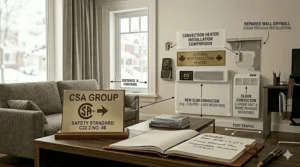
The DREO Smart Wall Heater is a 1500W wall-mounted unit with vertical oscillation, remote control, a 24-hour timer, and Alexa compatibility. It mounts to the wall (not recessed) using included hardware, splitting the difference between a permanent baseboard and a portable plug-in unit.
Smart scheduling is the actual value here, not the Alexa novelty. Natural Resources Canada notes that smart, line-voltage-compatible thermostats can cut electric heating costs by 20–25% through scheduling and occupancy-based adjustments — a meaningful number if you’re running a heater for several hours a day all winter. One caution worth repeating from electricians: standard low-voltage smart thermostats like Nest or Ecobee are not compatible with line-voltage baseboard circuits, so check that any smart heater or controller you buy is specifically rated for the wiring you have.
Pros: App and voice control; built-in scheduling can meaningfully cut hydro use; oscillation distributes heat more evenly than a static panel.
Cons: Wall-mount install still needed; smart features are wasted if you never set a schedule.
Price: Roughly $90–$150 CAD.
7. PELONIS Basic Oil-Filled Radiator
For the tightest budgets, the PELONIS Oil-Filled Radiator is a 1500W portable unit with an adjustable thermostat and the same retained-heat advantage as the De’Longhi radiator above, at a noticeably lower price point. It’s a fully portable, full-room radiant/convection hybrid — move it between rooms as your heating needs shift through the day.
The honest trade-off: budget oil radiators in this category generally lack the digital displays, Eco modes, and multi-stage timers of the De’Longhi and DREO units above. You’re paying less and getting fewer ways to fine-tune energy use, which matters more in provinces with higher electricity rates (Nova Scotia, PEI, the territories) than in Quebec or Manitoba, where rates are among the lowest in the country.
Pros: Lowest price point in this list; fully portable; silent oil-filled operation.
Cons: No Eco mode or smart scheduling; basic mechanical dial thermostat is less precise than digital controls.
Price: Roughly $60–$110 CAD.
Looking at the lineup as a whole, the dividing line isn’t really price — it’s whether you’re solving a renovation problem or a rental problem. The Stelpro, Dimplex, and Uniwatt units assume you can touch the wiring and want something permanent and close to invisible. The De’Longhi panel, DREO, and PELONIS units assume you can’t (or don’t want to) touch the wiring, and they trade a bit of discretion for the ability to plug in and walk away. If you’re choosing based on long-term hydro costs rather than upfront price, the oil-filled radiators (De’Longhi Radia S, PELONIS) generally hold heat longer per watt-hour used than fan-forced or panel designs, which can matter more than the sticker price over a five-month heating season.
How to Choose a Convection Heater in Canada
- Match wattage to room size, not marketing copy. Save on Energy’s buying guide recommends roughly 10 watts per square foot for primary heat — a 150 sq. ft. room needs about 1500W. Undersizing means the heater runs constantly without reaching comfort; oversizing wastes money and can overload a standard outlet.
- Decide hardwired versus plug-in before you fall in love with a model. A hardwired baseboard is quieter, more permanent, and usually cheaper to run long-term, but it needs a licensed electrician. A plug-in unit is renter-friendly but limited by what a standard outlet can safely supply.
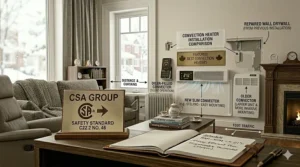
- Check for CSA certification, not just a UL sticker. Both are recognized in Canada, but CSA is the domestic standard — look for the mark on the box or product page before buying anything from a third-party Amazon seller you don’t recognize.
- Factor in your province’s electricity rate. Quebec and Manitoba sit near the bottom of Canada’s rate table; Nova Scotia, PEI, and the territories sit near the top. The same 1500W heater run for a winter costs dramatically different amounts depending on where you live.
- Decide if you actually need a smart thermostat add-on. It’s a real saving (20–25%, per NRCan) if you’ll actually use the scheduling — it’s wasted money if the heater just gets left on “high” all winter regardless.
- Look at heat retention, not just heat-up speed. Oil-filled radiators are slower to warm a cold room but hold that warmth longer once the element shuts off, which often nets out cheaper over a full night’s use than a fast ceramic fan heater that cycles constantly.
- Budget for installation, not just the unit. A $120 baseboard heater isn’t a $120 project if it needs new wiring — get a clear quote first.
Practical Usage Guide: Getting the Most From Your Convection Heater
Setup and first-use habits matter more with convection heaters than most people assume, especially through a Canadian winter:
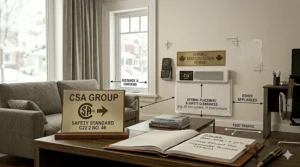
- Clearance matters for safety and performance. Keep at least 30 cm of clear space in front of any baseboard or panel heater — furniture or curtains blocking airflow both reduce heating efficiency and create a fire risk, which is exactly the kind of thing CSA certification testing checks for.
- Don’t run plug-in units on extension cords. A 1500W heater draws close to the safe limit of a standard 15-amp circuit; an extension cord rated for lighter loads can overheat.
- Dust the element seasonally. Baseboards and panel convectors pull air across the heating element constantly; built-up dust both reduces efficiency and can produce a burning smell on first use each fall — normal, but worth knowing in advance so it doesn’t alarm you.
- Use the lowest wattage setting that holds your target temperature, not the highest setting with the thermostat dialed down — running a heater hot-then-off-then-hot wastes more energy than holding a steady lower output.
- For oil-filled radiators, give them time. They’re genuinely slower to heat a cold room than a fan-forced ceramic unit — don’t assume a unit is broken if it takes 20–30 minutes to bring a bedroom up to temperature on a -20°C night.
- Store portable units somewhere dry in off-season. Basements and garages with humidity can corrode the casing on oil-filled units over a few off-seasons.
Real-World Scenarios: Matching a Heater to Your Situation
A Toronto condo dweller in a 1-bedroom unit: Condo bylaws often restrict any wiring changes, ruling out hardwired baseboards entirely. The De’Longhi Convector Panel or DREO Smart Wall Heater make more sense — both plug into a standard outlet and can be removed entirely at move-out with no trace.
A family in a 1970s bungalow in Winnipeg replacing failing original baseboards: With Manitoba’s electricity among the cheapest in the country, the long-term running cost is less of a concern than reliability and fit. The Stelpro Prima or Dimplex Linear Convector, sized to each room (500W for a small bedroom, 1500W for the living room), is a straightforward swap an electrician can usually complete in an afternoon per room.
A renter in a Halifax basement apartment with one consistently cold room: Nova Scotia’s electricity rates sit well above the national average, making running costs a real factor. A De’Longhi Radia S oil-filled radiator on Eco mode overnight, rather than running it on high constantly, balances comfort against a meaningfully higher per-kWh rate than, say, Quebec or Manitoba.
Common Mistakes When Buying a Convection Heater
- Buying based on wattage alone, ignoring room size. A 1500W heater in a 80 sq. ft. bathroom is overkill and a fire-clearance headache; the same unit in a 200 sq. ft. living room will struggle.
- Assuming “convection” and “radiant” perform identically. Convection heaters warm the air in a whole room over time; radiant heaters warm objects and people directly and faster, but only in their direct line of sight. Picking the wrong category for your actual need (e.g., quick spot heat for someone sitting at a desk versus whole-room comfort) leads to disappointment either way.
- Skipping the CSA/UL check on cheap third-party Amazon listings. Off-brand heaters without proper certification are a real fire risk — this is one place where saving $20 isn’t worth the trade-off.
- Forgetting installation costs when budgeting for a hardwired unit. Canadian electrician labour typically runs $50–$170/hour, and a basic baseboard install runs roughly $200–$450 per unit on top of the heater itself.
- Ignoring your province’s electricity rate entirely. The exact same heater can cost noticeably more to run per season in Nova Scotia or the territories than in Quebec or Manitoba — worth factoring into which model’s efficiency features (Eco mode, smart scheduling) actually matter for your wallet.
Long-Term Cost & Maintenance in Canada
Electric resistance heaters of any kind — convection, baseboard, or otherwise — are already at their maximum theoretical efficiency, since NRCan confirms they convert essentially 100% of electricity into heat. That means the real long-term cost lever isn’t the heater model — it’s how many hours it runs and your local electricity rate. According to Canada’s Energy Regulator’s 2026 market snapshot, residential electricity affordability depends not only on the per-kWh rate but on local climate and consumption patterns, which is exactly why a heater that’s a great deal in Montreal might run up a noticeably bigger bill in Halifax.
Practically, a single 1500W heater run for 8 hours a day through a Canadian winter adds somewhere in the range of $35–$90 a month to a hydro bill depending entirely on your province’s rate — a rough multiple of 6 to 10x between the cheapest and most expensive provinces. Maintenance costs are minimal: dusting elements once or twice a season and occasionally replacing a thermostat (if separate) every several years. Most quality baseboard units, including Stelpro and Dimplex, are built to last 15–20+ years with basic care, so the unit cost amortizes to almost nothing over its lifespan — the bigger long-term number is always the electricity itself.
Canadian Regulations & Safety Standards
A few regulatory points worth knowing before you buy or install:
- CSA certification is Canada’s domestic electrical safety standard, administered through the Canadian Standards Association, and it’s the mark to look for on any heater sold here — particularly relevant when buying from a smaller third-party seller on Amazon.ca rather than directly from the manufacturer.
- Permits and inspection. In most provinces, adding a new circuit for a hardwired baseboard requires an electrical permit and inspection through your provincial safety authority (e.g., the ESA in Ontario). DIY wiring without a permit can void home insurance.
- Provincial building codes vary on heater placement near combustible materials and minimum clearances — your electrician will know the local requirements, but it’s worth asking directly rather than assuming the installation manual covers every provincial variation.
- Energy labelling. Because electric heaters are regulated under Canada’s Energy Efficiency Regulations rather than ENERGY STAR, you won’t see an EnerGuide label on most convection heaters the way you would on a furnace or water heater — that’s expected, not a red flag.
FAQ
❓ Are convection heaters good for Canadian winters?
❓ What's the difference between a convection heater and a baseboard heater?
❓ Do I need an electrician to install a convection heater in Canada?
❓ How much does it cost to run a convection heater in Canada?
❓ Are oil-filled radiators better than ceramic convection heaters?
Conclusion
There’s no single “best” convection heater for every Canadian home — there’s a best one for your situation. If you’re renovating and can involve an electrician, a Stelpro or Dimplex baseboard is the quietest, most permanent, and usually cheapest-to-run option over its lifespan. If you’re renting and can’t touch the wiring, the De’Longhi panel or DREO smart wall unit get you most of the same comfort without a single screw in the wall. And if budget is the deciding factor above all else, the PELONIS oil-filled radiator still delivers genuinely silent, steady heat for less than the price of a nice winter coat.
Whatever you choose, the two things that matter more than brand are sizing the wattage correctly for your room and checking for CSA certification — both are free to get right, and both are the difference between a heater that actually solves your cold-room problem and one that just adds a line to your hydro bill without fixing anything.
Recommended for You
- 7 Best Desk Heaters Under $100 CAD in Canada (2026)
- 7 Best Propane Heaters for a Remote Cottage in Canada (2026)
- Best Infrared Heater for Bedroom in Canada 2026: Top 7 Picks
Disclaimer: This article contains affiliate links. As an Amazon Associate, I earn from qualifying purchases. If you purchase products through these links, we may earn a small commission at no additional cost to you.
✨ Found this helpful? Share it with your friends! 💬🤗
