
In This Article
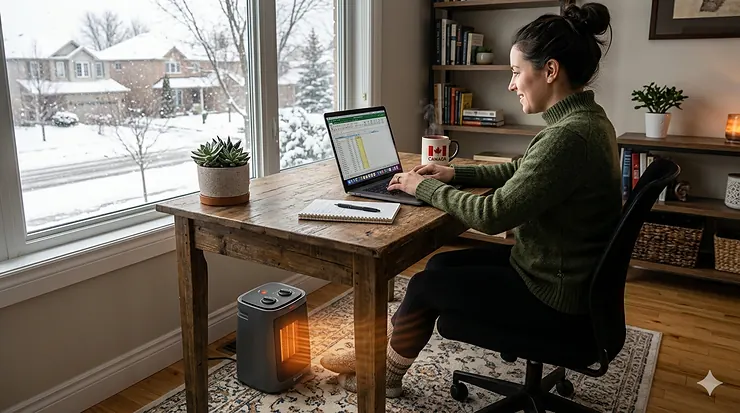
A desk heater under $100 CAD is a small electric ceramic, PTC, or fan-forced heater — usually between 200W and 1500W — built to warm one person at close range rather than an entire room. If your condo runs cold by the window, your home office sits over an unheated garage, or your downtown Toronto cubicle is permanently set to “polite arctic,” a budget desk heater solves the problem for less than the cost of a week of groceries. It won’t replace your furnace, and it won’t heat a whole basement — but for zone heating one body at one desk, it’s one of the cheapest comfort upgrades you can make this winter. 🇨🇦
This guide rounds up seven real, currently available desk heater under $100 options on Amazon.ca, compares them honestly, and walks through what actually matters when shopping for an affordable space heater in a Canadian climate — including the safety standards Health Canada wants you to know about before you plug one in.
As an Amazon Associate, I earn from qualifying purchases.
Quick Comparison Table
| Heater | Wattage | Best For | Price Range (CAD) | Amazon.ca |
|---|---|---|---|---|
| Amazon Basics Ceramic Mini Heater | 500W | Tightest budgets | $25–$35 | ✅ Prime eligible |
| Lasko MyHeat 101 Personal Heater | 200W | Tiny desks, dorms | $20–$30 | ✅ Prime eligible |
| Honeywell HeatBud HCE100 | 170/250W | Office cubicles | $25–$35 | ✅ Prime eligible |
| Dreo PTC Ceramic Heater (1500W line) | 1500W | Whole-desk + nearby floor area | $60–$90 | ✅ Prime eligible |
| PELONIS Oil-Filled Radiator | 1500W | Slow, steady all-day warmth | $55–$80 | ✅ Prime eligible |
| Brightown 450W Wall-Outlet Heater | 450W | Small bedrooms, no floor space | $25–$40 | ✅ Prime eligible |
| Gaiatop Mini PTC Heater | 500W | Backup heater, gifting | $25–$35 | ✅ Prime eligible |
Looking at the table, there’s a clear split between personal warmers (200–500W, under your desk or beside your knees) and room-leaning heaters (1500W, capable of taking the edge off a whole home office). If your space is under 100 sq. ft. and you mostly need warm hands and feet, the lower-wattage options sip electricity and stay safely under $40 CAD. If you’re heating a drafty spare room that doubles as an office, the 1500W picks justify their higher price with real, measurable output — though they’ll also show up more noticeably on your hydro bill.
💬 Just one click — help others make better buying decisions too! 😊
✨ Don’t Miss These Exclusive Deals!
🔍 Take your home office comfort to the next level with these carefully selected picks. Click on any highlighted item to check current pricing and availability on Amazon.ca. These small heaters will help you create a cozy, productive workspace your whole household will appreciate!
Top 7 Desk Heaters Under $100 in Canada: Expert Analysis
1. Amazon Basics Ceramic Mini Space Heater
The Amazon Basics Ceramic Mini Space Heater is the default budget pick for a reason: it’s small enough to disappear under a desk and cheap enough that losing it to a move or a dorm clean-out doesn’t hurt. At 500W with ceramic PTC heating, it warms up almost instantly rather than making you wait — useful on a Calgary morning when your home office hasn’t caught up with the furnace yet.
What the spec sheet won’t tell you is how it behaves in practice: 500W is genuinely a personal-zone wattage, meaning it heats the air around your shins and hands, not the whole room. Don’t expect it to replace a thermostat bump in a Winnipeg basement office. The tip-over protection is a real safety feature, not marketing fluff — it cuts power the instant the unit is knocked over, which matters if you’ve got a cat that treats power cords as toys.
Aggregate Amazon shopper feedback for this category of Amazon Basics mini heater runs strongly positive, with buyers consistently praising the fast warm-up and quiet operation, and a smaller number flagging that the cord is short for desks set away from outlets.
✅ Pros: rock-bottom price, instant heat, lightweight (around 0.6 kg)
❌ Cons: short cord; not for room heating
Best for: Students, renters, and anyone who wants the cheapest functional option on Amazon.ca. Around $25–$35 CAD — hard to beat for the price.
2. Lasko MyHeat 101 Personal Heater
Lasko MyHeat 101 Personal Heater is the smallest unit on this list, measuring roughly 15 cm tall and drawing just 200W — about the same draw as a hair dryer on low. Lasko has built personal heaters since the early 2000s, and the MyHeat line is purpose-designed for “concentrated personal heat,” not room warming.
In real-world terms, 200W means this heater will keep your hands and lower legs comfortable at a desk, but it will not raise the temperature of an open-concept condo living room. That’s the trade-off for a unit this compact and this cheap to run. Where it earns its keep is in shared offices: a 200W draw is quiet on a circuit and unlikely to trip anything, even on an older building’s wiring — a real consideration in some pre-war Montreal walk-ups with limited outlet capacity.
✅ Pros: smallest footprint here, lowest running cost, simple one-switch operation
❌ Cons: no thermostat or auto-shutoff timer; heat radius is short
Best for: A second desk, a craft room corner, or anyone who just wants warm hands without committing real wattage. Typically $20–$30 CAD.
3. Honeywell HeatBud HCE100BCD1
The Honeywell HeatBud HCE100BCD1 stands out for one specific reason: Honeywell has been voted the most trusted space heater brand by Canadian shoppers in the BrandSpark Canadian Trust Study for five consecutive years (2019–2023). That’s a Canada-specific trust signal you don’t get from most off-brand listings.
Specs-wise, it offers two settings — 170W and 250W — which is genuinely low output, intentionally so; Honeywell markets it as a personal heater only, not a room heater, and is upfront that it won’t heat the surrounding space. What that buys you is a cool-touch housing, a tip-over safety switch, and dual overheat protection (a sensor plus a backup cut-off fuse) in a unit that costs about the same as a large pizza. For Canadian buyers who feel safety-conscious about leaving any heater running near paper or fabric at a cluttered desk, the dual-layer overheat protection is the most reassuring feature in this price bracket.
✅ Pros: strong Canadian brand trust, dual overheat protection, no assembly
❌ Cons: very low wattage even on high; no oscillation
Best for: Cubicle workers and anyone prioritizing a known, trusted brand name over raw heat output. Around $25–$35 CAD, and also commonly stocked at Canadian Tire if you’d rather buy in person.
4. Dreo 1500W PTC Ceramic Heater
If the first three heaters are personal warmers, the Dreo 1500W PTC Ceramic Heater line is the jump to room-leaning performance while staying under $100 CAD. Dreo’s PTC ceramic units use a brushless DC motor design that the brand rates as low as roughly 34 decibels — genuinely close to library-quiet, which matters if your desk shares a wall with a baby’s room or you’re on video calls all day.
In practice, 1500W with 70-degree oscillation means this unit can take the chill off an entire small home office (Dreo cites coverage up to roughly 270 sq. ft.), not just your feet — a meaningful upgrade if you’re in a converted garage office in a Canadian winter where the insulation wasn’t designed for year-round use. The trade-off is power draw: at full output, this is pulling as much electricity as a hair dryer running continuously, so it’s not meant to be left on unattended overnight.
✅ Pros: real room-heating power, quiet operation, remote control and timer on most models
❌ Cons: highest running cost on this list; bulkier than the personal heaters
Best for: A genuinely cold home office or a bedroom that needs more than ankle-level warmth. Around $60–$90 CAD depending on the specific model and features.
5. PELONIS Basic Oil-Filled Radiator
The PELONIS Basic Electric Oil-Filled Radiator takes a different approach entirely: instead of blowing hot air, it heats internal oil that radiates steady warmth with zero fan noise. At 1500W with an adjustable thermostat, this is the pick for someone who wants background warmth running for hours without a whirring fan in earshot.
What the spec sheet doesn’t convey is the lag — oil-filled radiators take longer to warm up than ceramic or PTC units, often 10–15 minutes before you feel real output, but they also hold heat after being switched off, which ceramic heaters don’t. For a home office where you settle in for a full workday, that slow-and-steady profile beats a fan heater that cycles on and off all afternoon. It’s a poor choice if you want instant warmth before a 9 a.m. call, though.
✅ Pros: silent operation, even and lingering heat, tip-over and overheat protection
❌ Cons: slow warm-up; heavier and bulkier than ceramic options
Best for: All-day home offices where quiet matters more than speed. Typically $55–$80 CAD.
6. Brightown 450W Wall-Outlet Heater
The Brightown 450W Wall-Outlet Heater plugs directly into the wall with no cord and no floor footprint at all — a genuinely useful design for small bedrooms or apartments where every square centimetre of floor space is already claimed by furniture. It includes a programmable timer and adjustable thermostat, both somewhat unusual at this wattage and price point.
The practical catch: at 450W, plugged into an outlet that may be behind a desk or bed, it heats a small radius directly around the unit rather than projecting warmth across a room. It’s best understood as a “fill-in” heater for a specific corner — say, beside a desk chair in a small Halifax apartment bedroom — rather than a primary heat source.
✅ Pros: zero floor footprint, programmable timer, LED display
❌ Cons: limited heat radius; outlet placement dictates where warmth lands
Best for: Renters with limited floor space or anyone who wants a “set and forget” timer-based heater. Around $25–$40 CAD.
7. Gaiatop Mini PTC Space Heater
The Gaiatop Mini PTC Space Heater rounds out the list as a lightweight, fast-heating backup option — 500W PTC ceramic with tip-over and overheat protection in a unit small enough to toss in a bag. It’s a frequent pick as a second heater: one for the home office, one that travels to a cottage or a parent’s house.
In real terms, this sits in the same personal-heating tier as the Amazon Basics and Gaiatop-style minis above: expect warm hands and a slightly less chilly desk chair, not a heated room. Where it earns a spot on the list is portability and price — it’s consistently one of the cheapest 500W ceramic options that still includes proper overheat protection rather than a bare on/off switch.
✅ Pros: very low price, fast PTC heating, portable
❌ Cons: short cord on most units; basic single-speed control
Best for: A spare desk, a guest room, or as a backup if your main heater needs servicing. Around $25–$35 CAD.
Practical Usage & Winter Safety Guide
A few habits make any of these heaters safer and more effective once they’re plugged in at your desk.
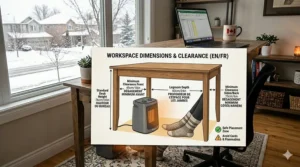
Placement first. Set the heater on a hard, level surface — never on carpet, a rug, or a stack of files — and keep at least one metre of clearance from curtains, paper, and bedding. Don’t tuck a heater under the desk itself if cords or your knees could knock it over; floor-level placement next to (not under) the desk is safer.
Plug it in directly. Avoid extension cords and power bars wherever possible; a heater pulling 1500W through a thin extension cord is a genuine fire risk, and most manufacturers explicitly warn against it. If you must use one, it needs to be rated for the heater’s full wattage.
Match the timer to your schedule. For units with an auto-shutoff timer, set it to match how long you’re actually at your desk — there’s no upside to a heater running into an empty room over lunch. For units without a timer, get in the habit of switching it off, not just stepping away.
Winter storage matters too. When the heating season ends, let the unit cool fully, coil the cord loosely (never wrap it tightly around the body, which stresses the insulation), and store it somewhere dry — damp basements and PTC ceramic elements don’t mix well over a Canadian humid summer.
Real Canadian Buyer Scenarios
The Toronto condo home-office worker: A one-bedroom condo with a desk wedged into a corner away from the main heating vent. A 500W personal heater like the Amazon Basics or Gaiatop mini solves this cleanly — it’s quiet enough for video calls and cheap enough to run all day without guilt.
The Ottawa basement freelancer: A finished basement office that the furnace never quite reaches in January. This is where the Dreo 1500W or PELONIS oil radiator earn their higher price — enough output to actually raise the room temperature a few degrees, not just warm a body.
The Vancouver apartment renter with no floor space: A studio where every inch of floor is already furniture. The Brightown wall-outlet heater is purpose-built for exactly this — no footprint, no tripping hazard, just a timer-controlled warm corner.
How to Choose a Desk Heater Under $100 in Canada
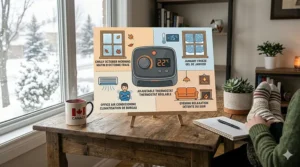
- Decide if you need personal warmth or room warmth. Under 500W heats you; 1500W can meaningfully warm a small room. Don’t overpay for room-heating power you won’t use.
- Check for a CSA or recognized safety mark. Every unit on this list carries tip-over and overheat protection, but always confirm certification on the product listing before buying.
- Measure your outlet situation. Wall-outlet heaters need a clear, accessible outlet at the right height; floor units need actual floor space.
- Think about noise. If you’re on calls all day, a brushless-motor ceramic heater or an oil radiator will be far less distracting than a basic fan-forced unit.
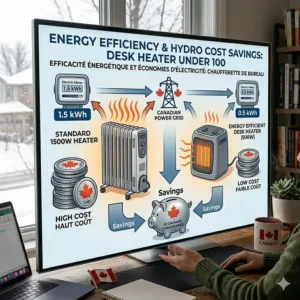
- Factor in your hydro rate, not just the sticker price. A $90 1500W heater run eight hours a day costs meaningfully more over a winter than a $25 250W unit — sometimes enough to erase the price difference within a season.
- Confirm shipping and stock for your province. Some smaller-brand listings ship faster from certain warehouses; check delivery estimates before assuming next-day availability everywhere in Canada.
Ceramic vs PTC vs Oil-Filled: Which Type Wins for Your Desk
Ceramic and PTC heaters (most of this list) heat up in seconds and cool down just as fast once switched off — ideal if you want warmth on demand right before a meeting and don’t mind it fading quickly after. Self-regulating PTC elements, as Wikipedia describes them, are resistance heaters whose resistance rises sharply with temperature, which is the underlying reason these units can run safely without a separate overheat thermostat in many cases.
Oil-filled radiators, like the PELONIS pick, trade that instant response for sustained, silent heat that lingers after you switch it off — better suited to an all-day desk session than a quick warm-up before a call. Neither type is objectively “better”; the right choice depends on whether you value speed (ceramic/PTC) or quiet, lasting warmth (oil-filled) more for your specific routine.
Common Mistakes When Buying a Budget Desk Heater
- Buying based on wattage alone. A 1500W heater isn’t automatically “better” — if you only need warm feet, you’re paying more upfront and on your hydro bill for output you won’t use.
- Ignoring the cord length. Many sub-$35 personal heaters ship with short cords; if your desk isn’t near an outlet, you’ll be reaching for an extension cord the manufacturer warns against.
- Skipping the safety certification check. Always confirm the listing shows a recognized safety mark before buying, especially from lesser-known third-party sellers on Amazon.ca.
- Assuming “space heater” means “room heater.” Several budget listings use generic “space heater” language for units that only realistically warm a one-metre radius — read the wattage, not just the title.
- Forgetting Canadian winter humidity. Storing a heater in a damp basement or garage between seasons can degrade internal components faster than normal indoor storage.
Canadian Regulations & Safety Standards
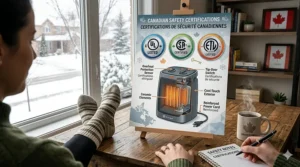
Before buying any portable electric heater in Canada, it’s worth knowing that the applicable national safety standard is CSA C22.2 NO. 46-13 (R2018), the Canadian standard for Electric Air-Heaters, which sets testing requirements specifically around burn and fire hazards. This isn’t a formality — Health Canada has noted that portable electric heaters have caused multiple fires, including some resulting in serious injury or death, which is why every product on this list includes tip-over and overheat protection as a baseline, not a bonus feature.
For workplace or shared-space use, Canadian institutional safety guidance generally goes further: heaters should sit on the floor rather than on desks or filing cabinets where they’re more easily knocked over, and should be unplugged — not just switched off — whenever a room is unoccupied, per University of Waterloo Safety Office guidance. If you’re bringing a desk heater into a shared office, check whether your employer requires pre-approval, as many Canadian workplaces do.
For full detail on the federal hazard assessment behind these standards, see Health Canada’s portable electric heater safety assessment.
✨ Don’t Miss These Exclusive Deals!
🔍 Browse the full range of certified, budget-friendly heaters on Amazon.ca and warm up your workspace today — prices and availability are subject to change, so check the current listing before you buy.
Long-Term Cost & Maintenance in Canada
Electric resistance heaters are, technically, 100% efficient at the point of use — every unit of electricity they draw is converted to one unit of heat, according to Natural Resources Canada. That sounds great until you compare it to the cost per hour. A rough way to estimate your operating cost: multiply the heater’s wattage by your hours of use and your local electricity rate (check your utility bill for your per-kWh rate, since this varies by province).
As an example using a representative rate, a 1500W heater run for 6 hours a day for a 90-day winter season will cost noticeably more than a 250W personal heater run the same hours — often two to three times as much, depending on your local rate. Because electric space heaters aren’t covered by Canada’s Energy Efficiency Regulations and aren’t ENERGY STAR rated, there’s no “high-efficiency” model to chase here — the wattage you choose is the efficiency you get. Maintenance-wise, all the units on this list are sealed, low-maintenance designs: occasional dusting of the vents and an annual cord inspection before the first cold snap is genuinely all they need.
Features That Actually Matter (And Those That Don’t)
Matters: Tip-over protection, overheat protection, a thermostat (rather than just high/low), and an accurate wattage rating that matches your actual space.
Doesn’t matter much at this price point: App connectivity, “smart” branding, or elaborate colour options. At under $100 CAD, you’re buying a heating element and a safety switch — anything beyond that is a nice-to-have, not a deciding factor.
Often overlooked but should matter: Noise level, especially if your desk doubles as a video-call station, and cord length, especially in older homes where outlets weren’t placed with a desk setup in mind.
What to Expect: Real-World Performance in a Canadian Winter
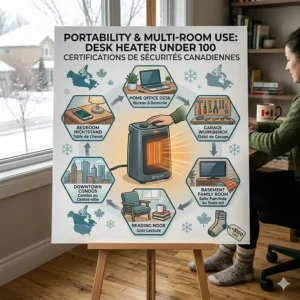
Personal heaters (200–500W) noticeably warm hands, feet, and the immediate desk area within a few minutes, but won’t move the thermostat reading of the room itself — don’t expect your home office to feel “heated” in the way a furnace heats it. The 1500W units genuinely do raise room temperature, particularly in a small, enclosed space like a converted closet office or a basement room with a door that closes, but they’ll also be the most noticeable line item if you’re tracking your hydro use closely through a cold Canadian winter.
FAQ
❓ Is a 500W desk heater enough for a Canadian winter?
❓ Can I leave a desk heater on overnight safely?
❓ Do these desk heaters ship to all Canadian provinces?
❓ What's the difference between a desk heater and a regular space heater?
❓ Are oil-filled radiators safe for small home offices?
Conclusion
For most Canadian home offices, the right desk heater under $100 comes down to one question: do you need to warm yourself, or warm the room? If it’s the former, the Amazon Basics, Lasko MyHeat, Honeywell HeatBud, or Gaiatop mini will all do the job for well under $40 CAD, with low running costs all winter. If it’s the latter, the Dreo 1500W ceramic heater or PELONIS oil radiator earn their higher price with real, measurable room-warming output — just budget for a slightly higher hydro bill to match. Whichever you choose, confirm the CSA safety certification, give it real clearance from anything flammable, and you’ll have a warm, productive desk through the coldest part of the Canadian winter without spending anywhere near $100.
✨ Don’t Miss These Exclusive Deals!
🔍 Ready to elevate your kitchen? Click any highlighted product name in this article to check current pricing and availability on Amazon.ca. Prime members enjoy free shipping to most Canadian provinces!
Recommended for You
- 7 Best Propane Heaters for a Remote Cottage in Canada (2026)
- Best Infrared Heater for Bedroom in Canada 2026: Top 7 Picks
- Cheapest Way to Heat Garage in Canada: 7 Best Options (2026)
Disclaimer: This article contains affiliate links. As an Amazon Associate, I earn from qualifying purchases. If you purchase products through these links, we may earn a small commission at no additional cost to you.
✨ Found this helpful? Share it with your friends! 💬🤗
